

#離岸公司, #Start a Company, #Entrepreneurship Guide
For entrepreneurs, incorporating a company and opening a corporate bank account are the first steps in starting a business. However, when handling these matters, you may encounter complex terms such as KYC and CDD. This article aims to explain these concepts in detail and, through real bank account opening examples, help you understand the difference between KYC and CDD.
What is KYC (Know Your Customer)?
KYC, short for “Know Your Customer”, refers to “Know Your Customer.” As the name suggests, it means getting to know your customer. Because financial institutions (such as banks and trust or company service providers) do not know their customers beforehand, they must understand information such as the customer’s background, business nature, and source of funds before establishing a business relationship, in order to prevent financial crime.
Why is KYC important?
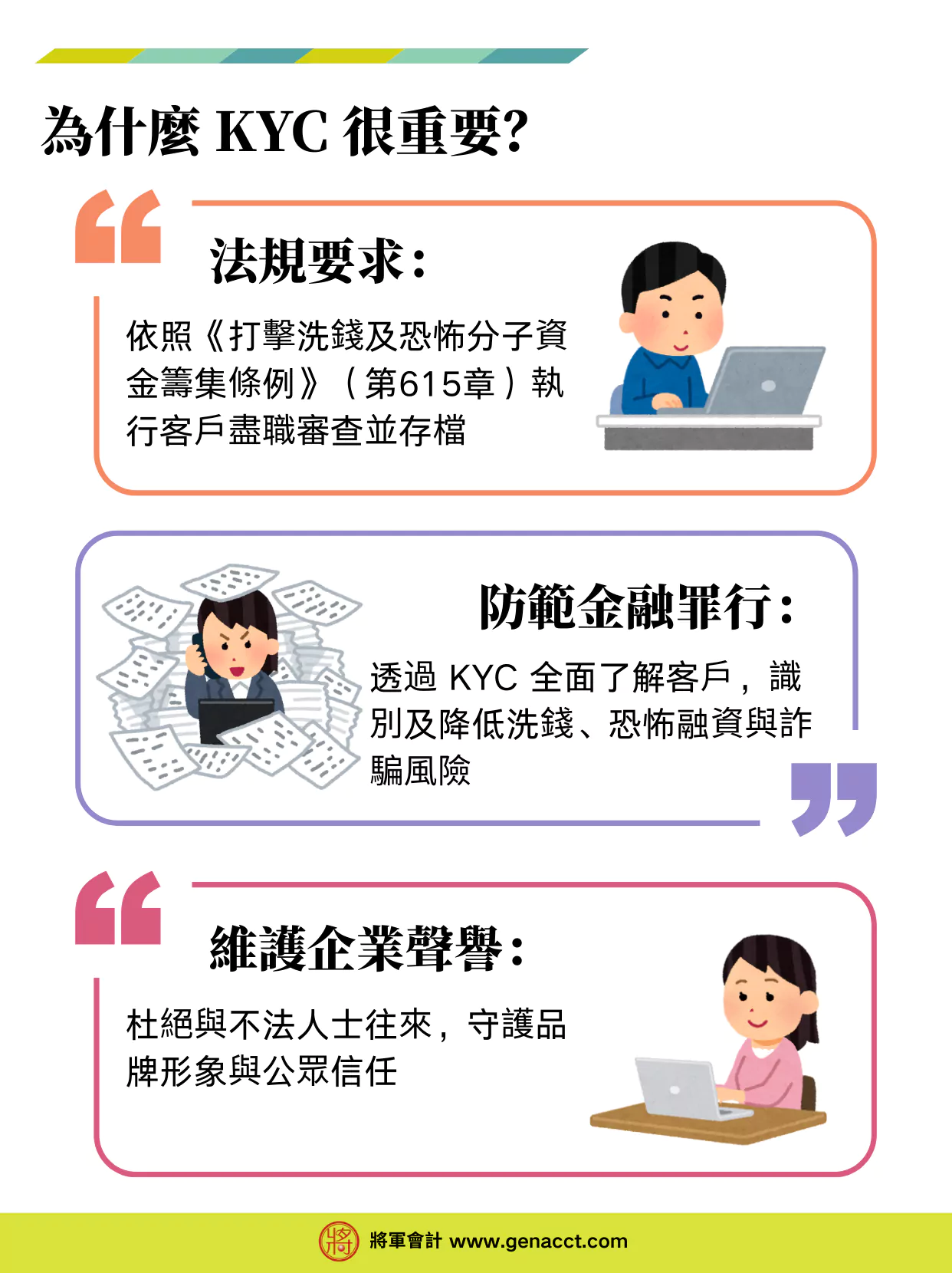
Because KYC is the first line of defence in the global Anti-Money Laundering (AML) and Counter-Terrorist Financing (CFT) framework, including the following key points:
Legal requirements
Under the Anti-Money Laundering and Counter-Terrorist Financing Ordinance (Cap. 615), financial institutions and designated non-financial businesses and professions are required to conduct customer due diligence and keep relevant records.
Further reading: Company Secretary Licence, Qualifications, Legal Liabilities and Duties | TCSP Licence Requirements and Renewal Guide
Preventing financial crime
Through KYC procedures, financial institutions can fully understand a customer’s background and effectively identify and mitigate the risks of money laundering, terrorist financing, fraud, and other illegal activities.
Protecting corporate reputation
Effective KYC measures can reduce money laundering risks and avoid associations with criminals,
helping to safeguard the company’s good reputation.
KYC examples for opening a bank account
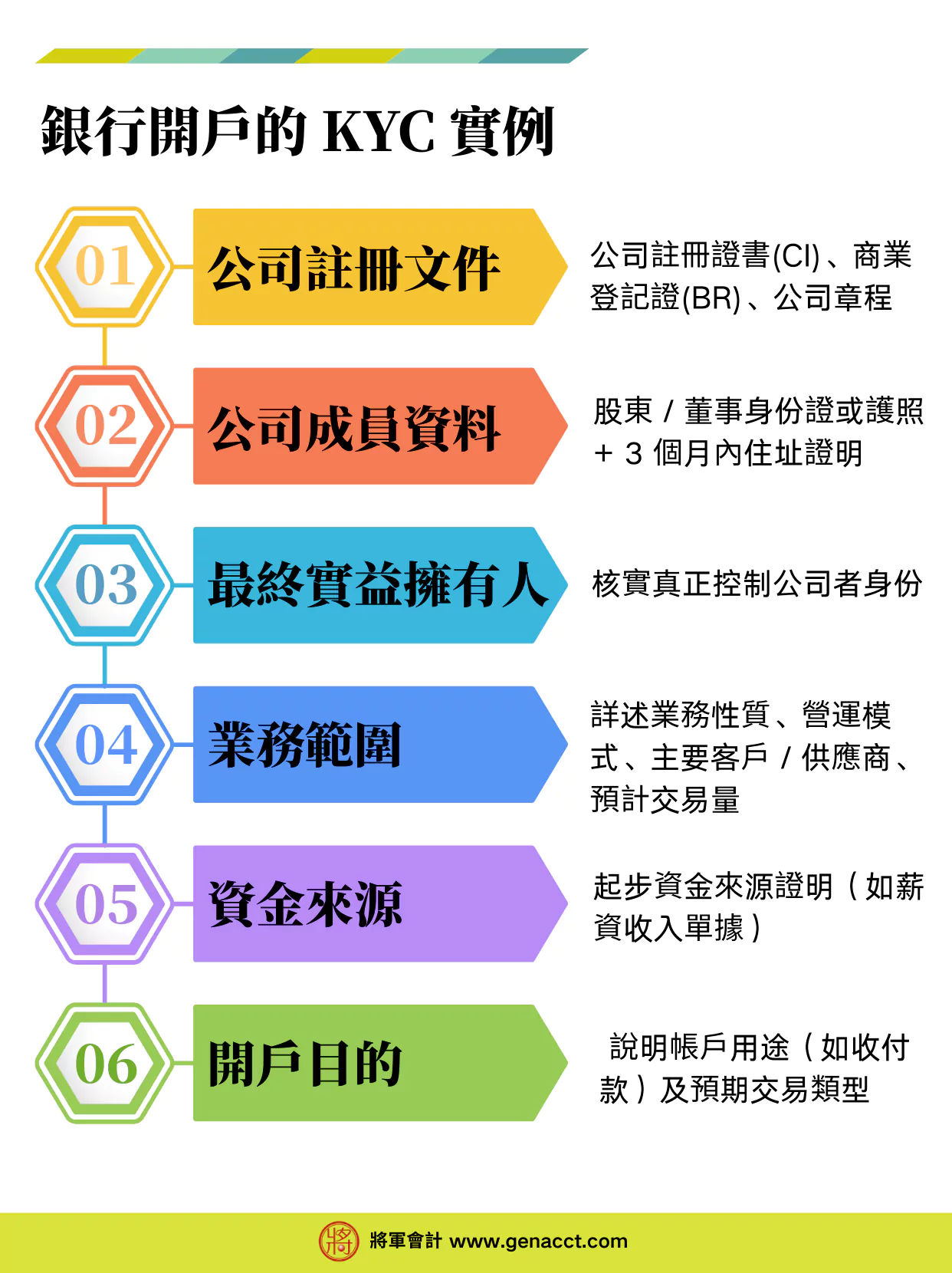
Using the opening of a limited company bank account as an example, banks generally require the following documents for KYC purposes, including:
Company Registration Documents
For example, the Certificate of Incorporation (CI), Business Registration Certificate (BR), and Articles of Association.
Company member information
Identity card/passport and proof of residential address (issued within the last 3 months) for shareholders and directors.
Ultimate beneficial owner information
If there are nominee shareholders, the bank will identify and verify the individual who ultimately controls the company.
Business scope
Provide detailed information and supporting documents on the company’s business nature, operating model, key customers and suppliers, expected transaction volume and amounts, etc.
Source of funds
Proof of the source of start-up capital, such as employment income and supporting documents.
Purpose of account opening and expected nature
Explain the specific purpose of opening the account (e.g., receiving payments) and the expected types of transaction activities.
Further reading: The Ultimate Guide to the Business Registration Certificate | What’s the Difference Between a Director and a Shareholder?
What is CDD (Customer Due Diligence)?
CDD, short for “Customer Due Diligence”, refers to “Customer Due Diligence.”
CDD is the core process of KYC. In addition to conducting due diligence at the start of a business relationship to verify the customer’s identity and understand their background and business, CDD must also be carried out on an ongoing basis to gain deeper insight into the customer’s business behaviour and transaction patterns, and to continuously assess the customer’s risk.
What is the difference between CDD and KYC?
KYC is identity identification and verification when first establishing a relationship with a customer, while CDD is the process of conducting risk assessment, background checks, and ongoing monitoring of the customer.
Financial institutions typically classify customers’ risk assessment results as high, medium, or low risk, and then adopt the following customer due diligence measures in accordance with their AML guidelines:
Standard Customer Due Diligence (Standard CDD)
In general, financial institutions adopt Standard CDD, which includes identifying and verifying the customer’s identity, understanding the company’s business nature and purpose, identifying the beneficial owner(s), and ongoing monitoring of the company’s future business relationship.
Simplified Customer Due Diligence (Simplified CDD)
Only applicable to a small number of low-risk customers, such as companies listed in Hong Kong.
Enhanced Customer Due Diligence (Enhanced CDD, ECDD)
If a customer is assessed as high risk, financial institutions must adopt stricter and more in-depth review measures. In addition to meeting Standard CDD requirements, the customer must also provide additional information based on the reasons for being classified as high risk.
Examples of Enhanced Due Diligence (EDD)
For example, a company is incorporated in Hong Kong but is held through multiple layers of BVI companies. In such cases, financial institutions may find it difficult to identify the company’s beneficial owner(s), and offshore companies cannot be searched via the Hong Kong Companies Registry.
Therefore, financial institutions will require more extensive due diligence and documentation, such as a BVI company’s Certificate of Incumbency (COI), Certificate of Good Standing, reference letters for the beneficial owner(s) (issued by professionals), and lawyer-notarised proof of address, to meet “Anti-Money Laundering” regulatory requirements.
How can entrepreneurs handle KYC and CDD with ease?
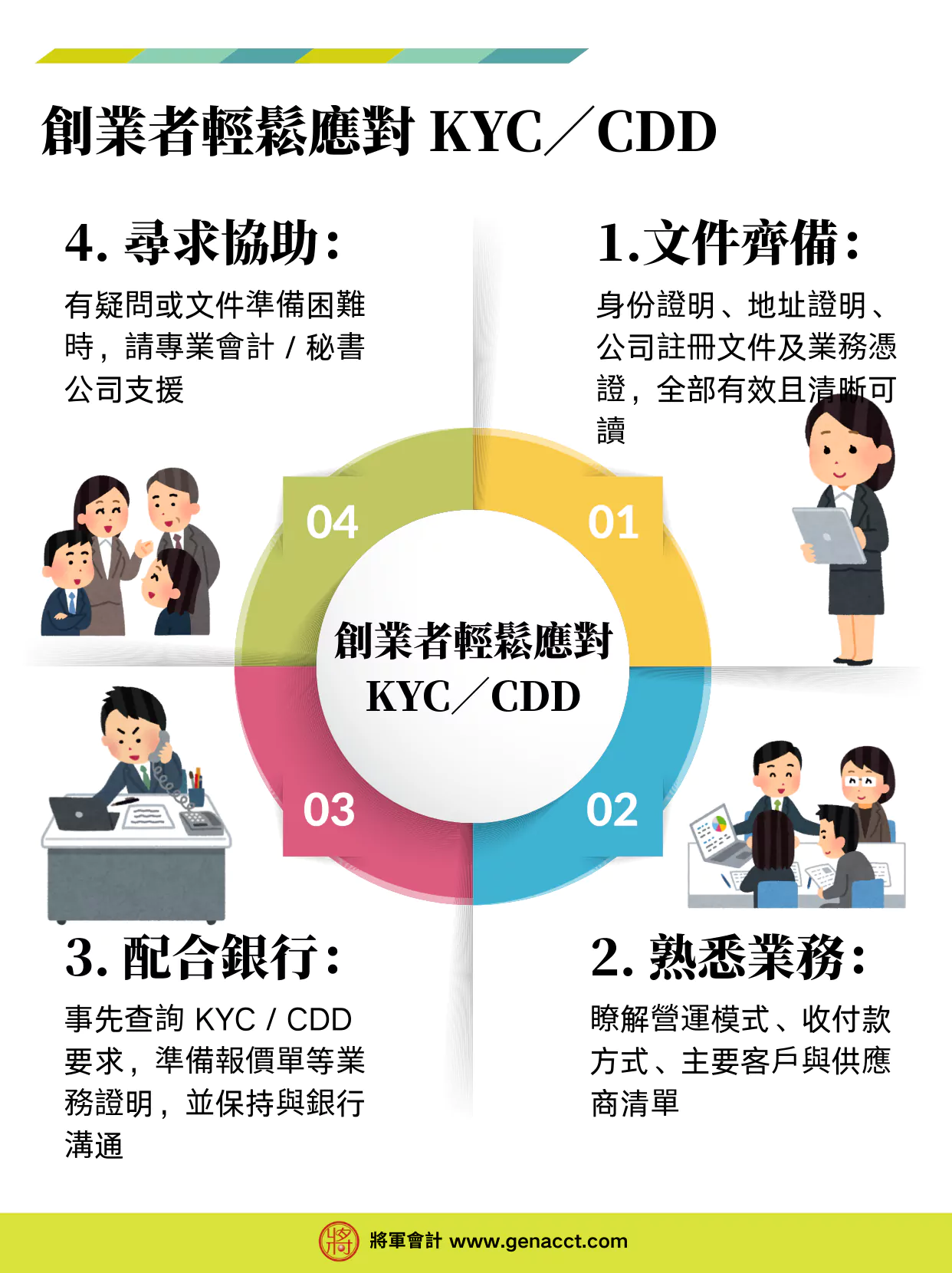
After understanding KYC and CDD, entrepreneurs can make the incorporation and account opening process smoother by taking the following steps:
Prepare all documents thoroughly
Before contacting a bank or financial institution, prepare all identity documents, proof of address, company incorporation documents, and business-related supporting documents. Ensure all documents are valid and clearly legible.
Have a clear understanding of your business:
Before a bank KYC interview, entrepreneurs should “revise” in advance and fully understand the company’s operating model, collection/payment methods, customer and supplier lists, and other relevant information.
Cooperate with bank requirements
You may review the bank’s website or consult bank staff to understand the bank’s KYC and CDD requirements, and prepare business supporting documents in advance.
For example: quotations from customers and suppliers. Entrepreneurs may not yet be formally operating, but some banks accept business quotations in email form. You may communicate with the bank more and cooperate with its requirements.
Seek professional assistance
If you have any questions about KYC or CDD, or encounter difficulties in preparing documents, it is recommended to seek assistance from a professional accounting and company secretarial firm.
Frequently Asked Questions
What is KYC (Know Your Customer)?
KYC stands for “Know Your Customer.” It means that before establishing a business relationship, financial institutions must first understand the customer’s background, business nature, and source of funds. This is to prevent financial crimes such as money laundering and terrorist financing. Under Hong Kong’s Anti-Money Laundering and Counter-Terrorist Financing Ordinance (Cap. 615), banks are required to carry out this procedure.
What is the difference between CDD and KYC?
In simple terms, KYC is identity identification and verification when first establishing a relationship with a customer (e.g., checking an ID card); whereas CDD (Customer Due Diligence) is the process of conducting risk assessment, background checks, and ongoing monitoring of the customer. KYC is the entry threshold; CDD is ongoing risk management.
What documents are required for KYC when opening a bank account?
- Company incorporation documents (e.g., Certificate of Incorporation (CI), Business Registration Certificate (BR), Articles of Association).
- Company member information (identity and address proof for shareholders/directors).
- Ultimate beneficial owner information (if nominee arrangements exist).
- Proof of business scope (e.g., contracts, invoices, quotations).
- Proof of source of funds (to demonstrate the legitimacy of start-up capital).
What is Enhanced Due Diligence (EDD)?
When a customer is assessed as high risk (e.g., involving multi-layer BVI holding structures, cash-intensive businesses, or politically exposed persons), financial institutions will adopt stricter EDD measures. This typically includes requiring proof of the offshore company’s good standing, professional reference letters, and lawyer-notarised documents to ensure the source of funds is legitimate.
Conclusion
General Accounting has been established for over 20 years and provides accounting, tax, and Employer’s Return services. Trust or Company Service Provider (TCSP) licence no.: TC002940. If you have any questions about Know Your Customer or Customer Due Diligence, our professional Client Service Managers can provide free initial KYC and CDD enquiry support.
General Accounting offers free consultation


