General Blog shares the latest Hong Kong business and accounting insights Covering Hong Kong company incorporation, Hong Kong tax regulations, company secretarial services, and entrepreneurship experience
Must-Read Before Starting a Business in Hong Kong: Can Individuals Not Do Business? Clarifying the Difference Between Employment and Self-Employment
Employment vs. Self-Employment: The first step to starting a business in Hong Kong is not deciding what kind of company to open, but clarifying your legal status. Many freelancers believe they can accept work as an “individual,” unaware that this violates the Business Registration Ordinance.
The first step to starting a business in Hong Kong is not deciding what kind of company to open, but clarifying your legal status. Many freelancers believe they can accept work as an “individual,” unaware that this violates the Business Registration Ordinance. This article will explain in detail the definitions of “employment” and “self-employment” under Hong Kong law to help you understand the legal requirements you must follow before starting a business.
Hong Kong Law: Individuals Can Only Be Employed; You Cannot “Do Business” as an Individual
According to the Inland Revenue Department’s clear definition, “a person who only holds an office or is employed is not regarded as carrying on a business and is not required to apply for business registration.” This sentence may seem simple, but it is the critical starting point for understanding Hong Kong’s entrepreneurship laws.
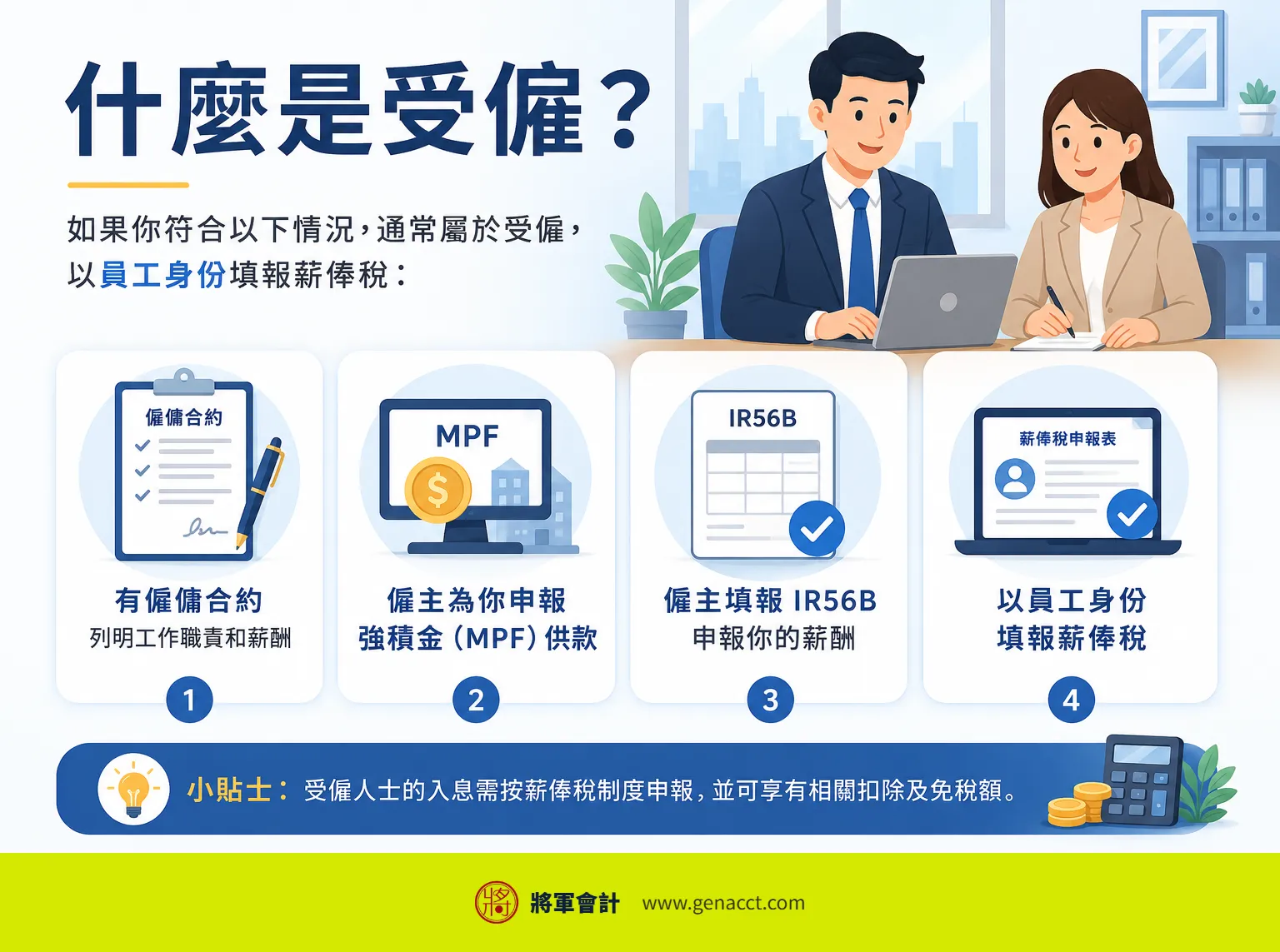
What Situations Count as “Employment”?
An employment relationship has the following characteristics:
A clear employment contract specifying job duties and remuneration
The employer makes Mandatory Provident Fund (MPF) contributions for you
The employer files Form IR56B to report your remuneration
You file Salaries Tax as an employee
In this case, you are simply “working,” and your income is considered “remuneration” reported by your employer. You do not need to apply for business registration yourself because you are not “carrying on a business.”
Only Two Legal Paths
Conversely, if an entrepreneur wishes to make a profit, they must operate under a certain business structure. According to the Inland Revenue Department, “any form of trade, commerce, craftsmanship, profession, calling or other activity carried on for the purpose of gain (whether in physical form or via the Internet)” must apply for business registration.
Therefore, entrepreneurs have only two legal options:
✅ Employment: Officially become an employee and receive remuneration
✅ Self-Employment: Apply for business registration and operate under a business structure (Sole Proprietorship, Partnership, or Limited Company)
There is no third option. Without business registration, you cannot legally engage in any profit-making activities as an individual.
What is Self-Employment? Freelancers Must Also Apply for Business Registration
In the absence of any employment relationship, if you earn income from buying and selling goods or providing professional or personal services, you will be regarded as carrying on a trade, business, or profession—that is, a self-employed person. Freelancing, taking on freelance projects, running an online shop, or providing professional services—all of these fall under “self-employment.” According to the Business Registration Ordinance (Cap. 310), anyone engaging in trade, commerce, profession, calling, or other activities for the purpose of gain, regardless of scale, must apply for business registration.
Common Misconceptions at a Glance
Here are several common misconceptions held by entrepreneurs:
❌ “I’m just doing freelance part-time”
Answer: Even if it is part-time, if no formal employment contract is signed, it is considered self-employment and you must apply for a BR; there is no “part-time exemption.”
❌ “I’m only doing online business on a small scale”
Answer: Operating via the Internet is still “carrying on a business”; the legal definition does not distinguish between online and offline.
❌ “I haven’t hired anyone, so I’m not doing business”
Answer: Not hiring employees does not mean you aren’t carrying on a business; as long as the activity is for the purpose of gain, you must apply for business registration.
✅ Conclusion: Whether full-time or part-time, online or offline, with or without a formal office, as long as you are a freelancer or engaging in activities for profit, you must apply for business registration.
To learn about the latest Hong Kong labor laws, please visit: 418 to 468.
Application Deadline
According to the Business Registration Ordinance, applications for sole proprietorships or partnerships must be submitted to the Business Registration Office of the Inland Revenue Department within one month of commencement. Limited companies must submit a Notification of Commencement of Business (IRBR200) within one month of starting business. Late applications will not only require back-payment of fees but may also face fines.
If you have questions about the IRBR200 form, please refer to the Limited Company Registration Form Guide.
Consequences of Operating Without a License: Fines and Criminal Liability
Failure to handle business registration on time not only requires back-payment of fees but may also lead to heavy fines and criminal liability.
Financial Consequences of Late Registration
According to Inland Revenue Department regulations, if business registration is handled more than 12 months after the business commenced:
The business registration fee and levy for the current year must be paid
The business registration fees and levies for previous years must be paid
Example: Suppose your freelance business started in June 2022, but you did not apply for business registration until March 2025. You would need to pay the fees for the three fiscal years: 2022/23, 2023/24, and 2024/25.
Criminal Liability
More importantly, operating without a license can constitute a criminal offense:
Offenders may be liable to a fine of HK$5,000 and imprisonment for up to 1 year
Providing false information or statements with intent to deceive is also illegal
These penalties are written into the Business Registration Ordinance and are not just theoretical. There have been cases where the Inland Revenue Department proactively conducted spot checks on businesses that failed to register on time and took prosecution action upon verification.
Exemption from Business Registration Fees Does Not Mean Exemption from Business Registration
Small businesses can apply for an exemption from paying business registration fees, but they must first apply for business registration. Many people misunderstand this, thinking that if the business scale is small, they don’t need to apply; this is incorrect.
Conditions for Fee Exemption
According to Section 9 of the Business Registration Ordinance and Inland Revenue Department regulations, fee exemptions can be applied for if the following conditions are met:
Industry Category
Maximum Average Monthly Sales
Service Industry
HK$10,000
Other Industries (e.g., Retail, Wholesale)
HK$30,000
In addition, exemptions have the following restrictions:
Only applicable to sole proprietorship or partnership unlimited companies
A proprietor can only own one sole proprietorship business
The same partners can only operate one partnership company
Important Statement: Fee Exemption Does Not Mean Registration Exemption
“Fee exemption” and “registration exemption” are two completely different things!
Even if eligible for a fee exemption, the business must still:
Apply for business registration according to the law
Submit the application form
Obtain a “Business Registration Certificate with Exemption Noted” issued by the Inland Revenue Department
Exemption only waives the fee; the obligation to register still exists.
Application Method and Validity
Exemptions can be applied for through the following methods:
Fill out “Form 3” (IRBR61)
Paper application: Within one month of commencement
Online application (GovHK): Within 7 weeks of commencement
It is worth noting that the exemption is only valid for 1 year and must be reapplied for annually.
Employment vs. Self-Employment: Major Differences in Tax Filing
Your status determines your tax filing method. The reporting mechanisms for employment and self-employment are completely different; freelancers must not confuse them.
Tax Filing for Employed Persons
If you work as an employee:
Item
Description
Employer Reporting
Files IR56B (Employee Remuneration Details)
Employee Tax Return
Receives BIR60 Individual Tax Return
Tax Type
Salaries Tax
Progressive Tax Rate
2%–17%
Basic Allowance
HK$132,000
Simply put, your employer will help you calculate and report; you only need to truthfully fill out your individual tax return after receiving the BIR60.
More information on Employer’s Returns: Employer’s Return Guide | Form IR56H
Tax Filing for Self-Employed Persons / Freelancers
If you work as a freelancer:
Item
Description
Paying Company Reporting
Files IR56M (Notification of Remuneration Paid to Persons Other Than Employees)
Freelancer Tax Return
BIR60 (Profits Tax section)
Tax Type
Profits Tax
Two-tiered Profits Tax Rates (Unincorporated)
First HK$2M: 7.5%; Remainder: 15%
Payments received by self-employed persons / freelancers are called “remuneration” rather than “salary,” and the tax filing method is also completely different.
If you have questions about filing IR56M, please refer to What is IR56M? How to fill out IR6036B? Step-by-step Guide.
IR56M Reporting Threshold
A company reporting IR56M for a freelancer must meet the following conditions:
Paid to sub-contractors: Exceeding HK$200,000 per year
Paid service fees/commissions: Exceeding HK$25,000 per year
Comparison Table: Employment vs. Self-Employment
Item
Employment
Self-Employment (e.g., Sole Proprietorship/Partnership)
Employer Reporting Form
IR56B
IR56M
Individual Tax Return (BIR60)
Income entered in Salaries Tax section
Income entered in Profits Tax section
MPF
Employer + Employee mandatory contributions
Self-employed persons must make mandatory contributions
Deductible Items
Fixed allowances (e.g., self-education, home loan interest)
Business expenses are tax-deductible
Maximum Marginal Tax Rate
17%
15%
After Understanding Legal Requirements: How to Choose a Business Structure?
After clarifying that you must apply for business registration, the next step is to choose a suitable business structure. There are two main options:
Option 1: Sole Proprietorship or Partnership Business Registration
Incorporate with the Companies Registry under the Companies Ordinance (Cap. 622). Shareholders bear limited liability based on their shareholding.
For a detailed comparison of the two, please refer to General Accounting’s Differences Between Limited Company vs. Unlimited Company.
Who is Suitable for Incorporating a Limited Company?
Based on General Accounting’s years of experience, the following situations are suitable for considering a limited company:
1. Wanting to enjoy more tax deduction benefits
A company has more tax-deductible expenses than an individual (including depreciation, employee benefits, business expenses, etc.)
Losses can be carried forward to offset future profits
Fixed assets (e.g., vehicles, equipment) can be depreciated for tax deductions
2. Business involves risk and requires asset protection
Shareholders bear limited liability up to the amount of their shareholding
Personal assets will not be directly pursued due to company debts
3. Having expansion plans and needing to bring in investors
Shares can be transferred and new investors can be introduced
Easier to apply for bank credit and business collaborations
4. Wanting to open a professional bank account in the company’s name
Clear separation between personal and business affairs, creating a more professional business image
Beneficial for future business credit applications
When starting a business in Hong Kong, first clarify your legal status. After reading this article, you should remember the following three core points:
Individuals cannot do business in an “individual capacity”
Under Hong Kong law, individuals have only two paths: employment (receiving salary) or self-employment (applying for business registration). There is no third option. Engaging in profit-making activities without business registration is considered operating without a license and faces heavy fines and criminal liability.
Freelancer = Self-Employed, must apply for business registration
Whether full-time or part-time, online or offline, freelancers are self-employed persons and must apply for business registration within one month of starting business. Even if eligible for a fee exemption, the obligation to register still exists.
Understand legal requirements first, then choose a business structure
After clarifying that registration is mandatory, choose between “Business Registration (Sole Proprietorship/Partnership)” or “Incorporating a Limited Company” based on income scale, risk level, and development plans. Both have different tax rates, legal liabilities, and administrative requirements; there is no absolute good or bad, only what is suitable.
If you still have questions, feel free to contact General Accounting. We provide a free initial consultation to help you choose the most suitable business structure and take the first step toward compliant entrepreneurship.
No. According to the Inland Revenue Department's definition, individuals can only work in an "employed" capacity. If you wish to make a profit, you must apply for business registration (Sole Proprietorship/Partnership) or incorporate a limited company. Engaging in business without business registration is considered operating without a license and carries the risk of fines and imprisonment.
Does a freelancer need to apply for business registration?
Yes. Freelancers are considered self-employed and must apply for business registration. Even if eligible for a fee exemption, the obligation to register still exists. Do not confuse BR fee exemption with BR exemption.
What are the consequences of not applying for business registration?
If you receive remuneration without being formally employed and have not applied for business registration, you must still declare the income under Salaries Tax; otherwise, it will be treated as tax evasion. Committing such an offense can lead to a fine of $50,000, an additional penalty of up to three times the amount of tax undercharged, and 3 years' imprisonment. Furthermore, failure to handle business registration may face triple consequences: (1) back-payment of previous years' fees; (2) late penalties; (3) criminal prosecution with a maximum fine of HK$5,000 and 1 year's imprisonment.
What is the difference in tax filing between employment and self-employment?
Employment involves the employer reporting IR56B and the employee filing Salaries Tax. Self-employment involves the paying company reporting IR56M and the freelancer filing Profits Tax. The applicable tax types, reporting forms, and deductible items are completely different.
What form does a company use to report taxes for a freelancer?
The paying company fills out IR56M (Notification of Remuneration Paid to Persons Other Than Employees). Reporting is mandatory if annual payments to sub-contractors exceed HK$200,000 or if commissions/service fees exceed HK$25,000. Even if the threshold is not met, it is recommended to keep relevant payment records.
In what situations is it better to incorporate a limited company rather than just business registration?
Incorporating a limited company may be more suitable if any of the following apply: (1) you want to enjoy more tax deduction benefits; (2) the business involves risk and requires limited liability protection; (3) you have expansion plans or need to bring in investors; (4) you wish to open a professional bank account in the company's name.
General Accounting has been established for over 20 years and holds a Trust or Company Service Provider licence (TC002940). We provide comprehensive BR management services, including BR renewal reminders, address changes, business cessation, and all related tax matters.
Senior Consultant at General Accounting, specialising in Hong Kong company incorporation and company secretarial matters, with over 10,000 incorporation and compliance cases handled.
Founded in 2005, General Accounting holds a Trust or Company Service Provider licence issued by the Hong Kong Companies Registry, licence no.
TC002940,
regulated under the Anti-Money Laundering and Counter-Terrorist Financing Ordinance.