

#Corporate tax returns, #Company share transfer, #薪俸稅
What are Hong Kong company dividends?
Hong Kong company dividends, also known as “dividend distribution,” refer to a company distributing part of its profits to shareholders after making money. Regardless of the company’s size, dividends can be distributed as long as there is a surplus.
Hong Kong listed companies generally announce their performance and profits at interim and annual board meetings, while simultaneously declaring the amounts for interim and final dividends, along with the ex-dividend date, record date, and payment date.
Dividend distribution for Hong Kong private companies limited by shares is relatively simple; directors can decide to distribute dividends at any time in accordance with the Articles of Association. Additionally, some Hong Kong limited companies distribute dividends before a share transfer to reduce retained earnings, thereby lowering the stamp duty on the transfer.
Further Reading: Company Sale and Purchase Process | Company Sale and Purchase Agreement
4 Major Conditions for Corporate Dividend Distribution
In addition to complying with the Companies Ordinance, the distribution of dividends must adhere to the following 4 major conditions:
1. The company must have Retained Earnings
The Board of Directors needs to determine that the company has Retained Earnings based on the most recent audit report (generally within 3-6 months) or interim financial statements, and calculate that there is sufficient cash flow to pay the dividends before the distribution date1. Furthermore, dividends can only be paid from distributable profits and must not be paid out of capital2.
2. Audit Report Opinion (Qualified Opinion)
First, review the previous year’s audit report. According to Section 406 of the Companies Ordinance3, if the auditor’s opinion is a QUALIFIED OPINION, the auditor must issue a statement clarifying that the qualified opinion does not conflict with or relate to the company’s dividend distribution.
Articles of association
3. Review the execution details regarding dividend distribution in the Articles of Association to see if the directors can convene a board meeting to decide on Hong Kong company dividends.
4. Board Meeting
Conduct a board resolution and formally pass the details of the dividend distribution in accordance with the board meeting rules in the Articles of Association4.
Do individuals need to pay tax on dividends received?
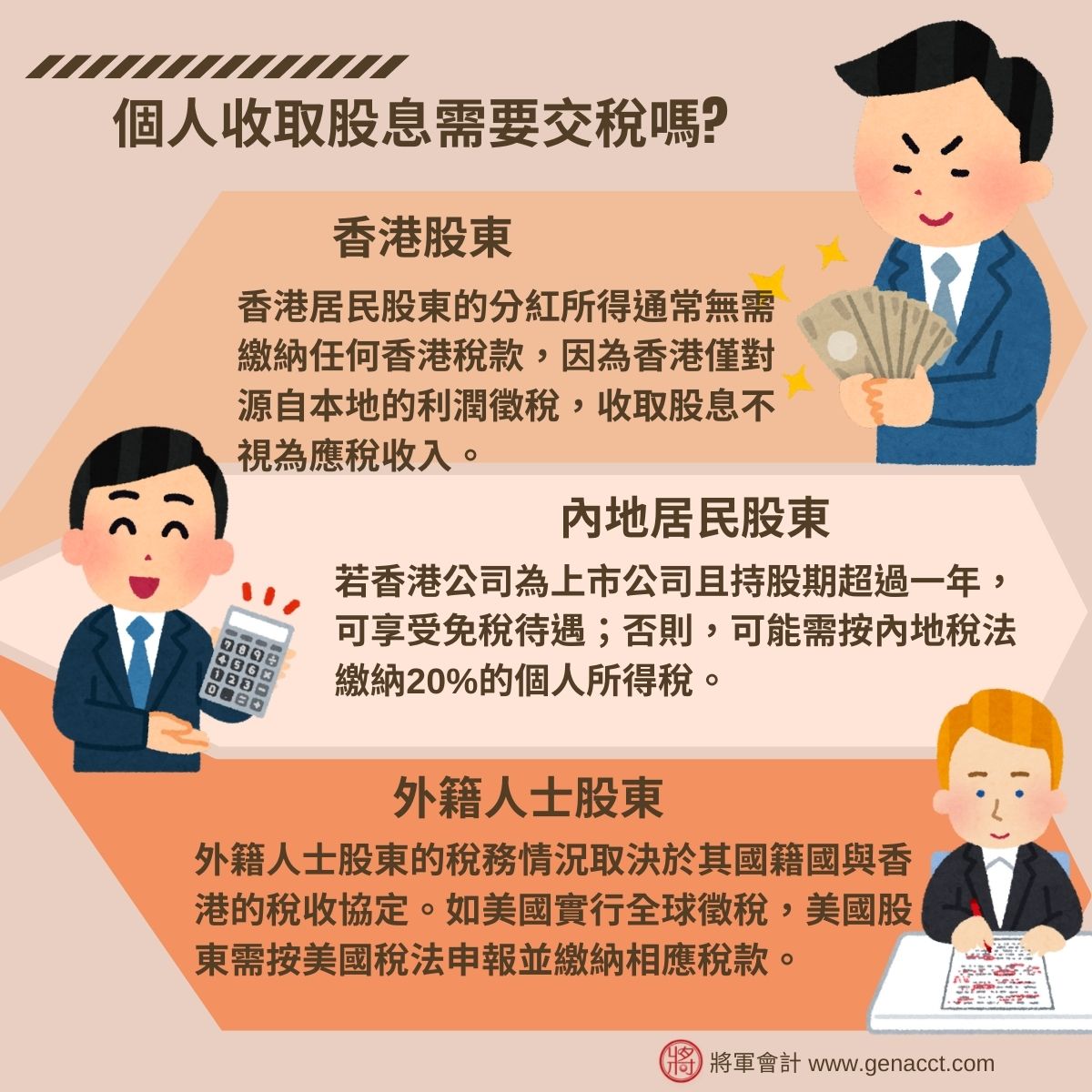
1. 1. Hong Kong residents receiving dividends
Dividend income for Hong Kong resident shareholders is usually not subject to any Hong Kong tax, as Hong Kong only taxes profits sourced locally, and dividends are not considered taxable income.
2. 2. Mainland China residents receiving dividends
The tax treatment for Mainland resident shareholders is more complex. If the Hong Kong company is listed and the holding period exceeds one year, tax-exempt status may apply; otherwise, personal income tax of 20% may be required under Mainland tax laws. According to the Double Taxation Arrangement between Mainland China and Hong Kong5, dividends obtained by Mainland residents in Hong Kong may only be subject to a lower withholding tax.
3. Foreign nationals receiving dividends
The tax situation for foreign shareholders depends on the tax treaty between their country of nationality and Hong Kong. For example, the United States implements a global taxation system6, so US citizen shareholders must report and pay corresponding taxes according to US tax laws; conversely, if a shareholder is a Singaporean national, they do not need to pay Singaporean tax on dividends received.
Do companies need to report taxes on dividends received?
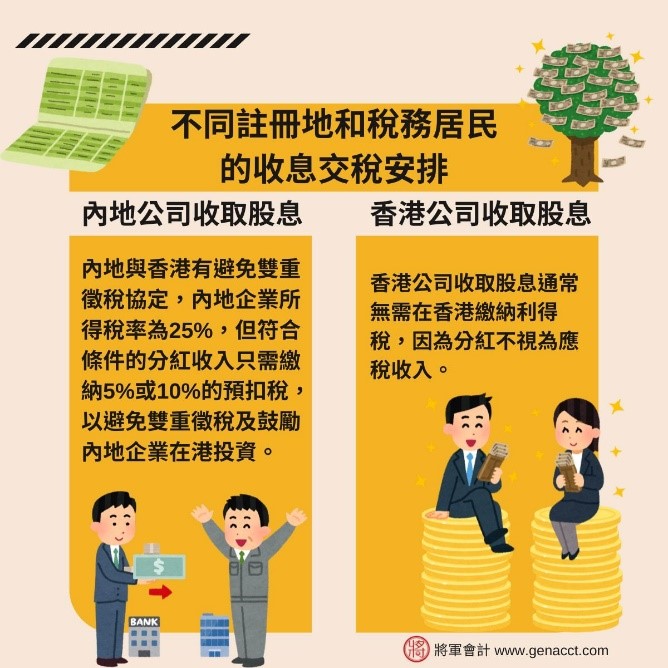
1. 1. Hong Kong companies receiving dividends
Hong Kong companies receiving dividends are usually not required to pay profits tax in Hong Kong, as dividends are not considered taxable income.
2. 2. Mainland China companies receiving dividends
According to the Double Taxation Arrangement between the Mainland and Hong Kong, the Mainland enterprise income tax rate is 25%, but qualifying dividend income is only subject to a 5% or 10% withholding tax, aimed at avoiding double taxation and encouraging Mainland enterprises to invest in Hong Kong.
Considerations for Hong Kong Company Dividends
Cross-border dividends
If a Hong Kong company distributes dividends to overseas shareholders, it must comply with the tax laws of the relevant country or region. For example, some countries impose withholding tax on overseas dividends, and the Hong Kong company must withhold the corresponding tax at the time of distribution.
Dividends from investments in Mainland companies
Frequently Asked Questions
Conclusion
Hong Kong company dividend distribution is a common way for enterprises to distribute profits to shareholders, and the related tax issues depend on the tax residency status of the shareholders or the company. In Hong Kong, distributing dividends must meet four major conditions, including the company having retained earnings, a qualified audit report opinion, compliance with the Articles of Association, and approval by a board resolution.
For individual shareholders, Hong Kong residents usually do not need to pay tax, while Mainland and foreign individuals must handle tax matters according to their respective tax treaties.
Regarding companies receiving dividends, Hong Kong companies usually do not need to pay tax, while Mainland companies must pay corresponding taxes based on the Mainland-Hong Kong Double Taxation Arrangement. Additionally, cross-border dividends and dividends from investments in Mainland enterprises involve different tax regulations, and enterprises should carefully follow relevant laws. Finally, company dividends are not deductible expenses, and the frequency of dividend payments can be flexibly adjusted to meet the enterprise’s needs.
General Accounting has been established for over 20 years, providing one-stop company formation and tax filing services (Trust or Company Service Provider License No.: TC002940). If you have any questions regarding shareholder dividends, our professional customer service managers can provide free preliminary company secretarial service consultations and assistance.
Further reading:
Sources
1. Chapter 622 Companies Ordinance — Section 290 Interpretation
https://www.elegislation.gov.hk/hk/cap622!en
2. Chapter 622 Companies Ordinance — Section 291 Realised profits and losses
https://www.elegislation.gov.hk/hk/cap622!en
3. Chapter 622 Companies Ordinance — Section 406 Auditor’s report on financial statements
https://www.elegislation.gov.hk/hk/cap622!en
4. Companies Ordinance Part 6 Distribution of Profits and Assets
https://www.cr.gov.hk/en/companies_ordinance/docs/part6-e.pdf
5. Arrangement between the Mainland and the Hong Kong Special Administrative Region for the Avoidance of Double Taxation on Income
https://www.clic.org.hk/en/topics/taxation/arrangement_between_mainland_china_and_hongkong
6. United States Income Tax – Wikipedia
https://en.wikipedia.org/wiki/Income_tax_in_the_United_States
7. Arrangement between the Mainland and the Hong Kong Special Administrative Region for the Avoidance of Double Taxation and the Prevention of Fiscal Evasion with respect to Taxes on Income
https://www.ird.gov.hk/eng/pdf/dta_china_new_arrangement.pdf
General Accounting provides free consultation


