
#IR56B, #IR56M, #僱主報稅表, #IR56B, #IR56M, #僱主報稅表
The amendments to the “continuous contract” provisions took effect today, 18 January 2026. The threshold has been relaxed from “418” to “468”. The bill was passed on its third reading on 18 June 2025 by 84 votes in favour and 3 against, and the amendments will be implemented on the first Sunday after six months from the date of gazettal.
This article consolidates the impact of the 468 labour legislation on employers and employees. After the 468 continuous contract threshold is implemented, more part-time and casual workers will be classified as “continuous contract employees” and will be entitled to statutory protections under Hong Kong Cap. 57 Employment Ordinance, including paid annual leave, sickness allowance, severance payment, and long service payment. Employers should review HR budget planning early to prepare for potential changes in manpower and tax costs.
Further reading: [Employer’s Tax Return] What is the difference between BIR56A and IR56B? How companies file taxes for employees
What is the 468 labour legislation?
Current framework
Under the current framework of the Employment Ordinance (Cap. 57), “418” is the dividing line—i.e., if an employee works 18 hours or more per week for 4 consecutive weeks, they are regarded as being employed under a continuous contract.
New 468 labour legislation working-hours model
The standard for continuous contract employees will be 68 hours or more worked in total over every four-week period.
Purpose of the amendment
To expand statutory labour protections for part-time and casual workers, covering entitlements such as annual leave, sick leave, severance payment, and long service payment.
How 468 is calculated
Using a four-week period as the unit: if an employee’s total working hours over 4 weeks reach 68 hours or more, they are deemed to meet the continuous contract threshold.
The four-week period may span across months or years—for example, 24 July to 21 August 2025, or 17 December 2025 to 14 January 2026.
What impact does the 468 labour legislation have on employers?
As employees will find it easier to become continuous contract employees under the new 468 regime than under the old 418 regime, labour costs may increase—especially in industries that hire large numbers of part-time, daily-paid, and casual workers (such as retail, transport, catering, and construction). Details are as follows:
- Higher expenditure on paid annual leave and sick leave pay;
- Higher budgeting required for severance payment/long service payment;
- More paid leave for employees, such as paternity leave and maternity leave;
- In particular, after the abolition of MPF offsetting, employers will need to set aside more reserves for severance payment or long service payment.
In addition, employers should develop HR policies, work-hour arrangements, employment contracts, and payroll calculation methods to address potential cost increases and ensure compliance with the new 468 requirements.
Further reading: What is IR56M? How to complete IR6036B? Step-by-step form-filling guide
Example of the impact on employers when “418” changes to “468”
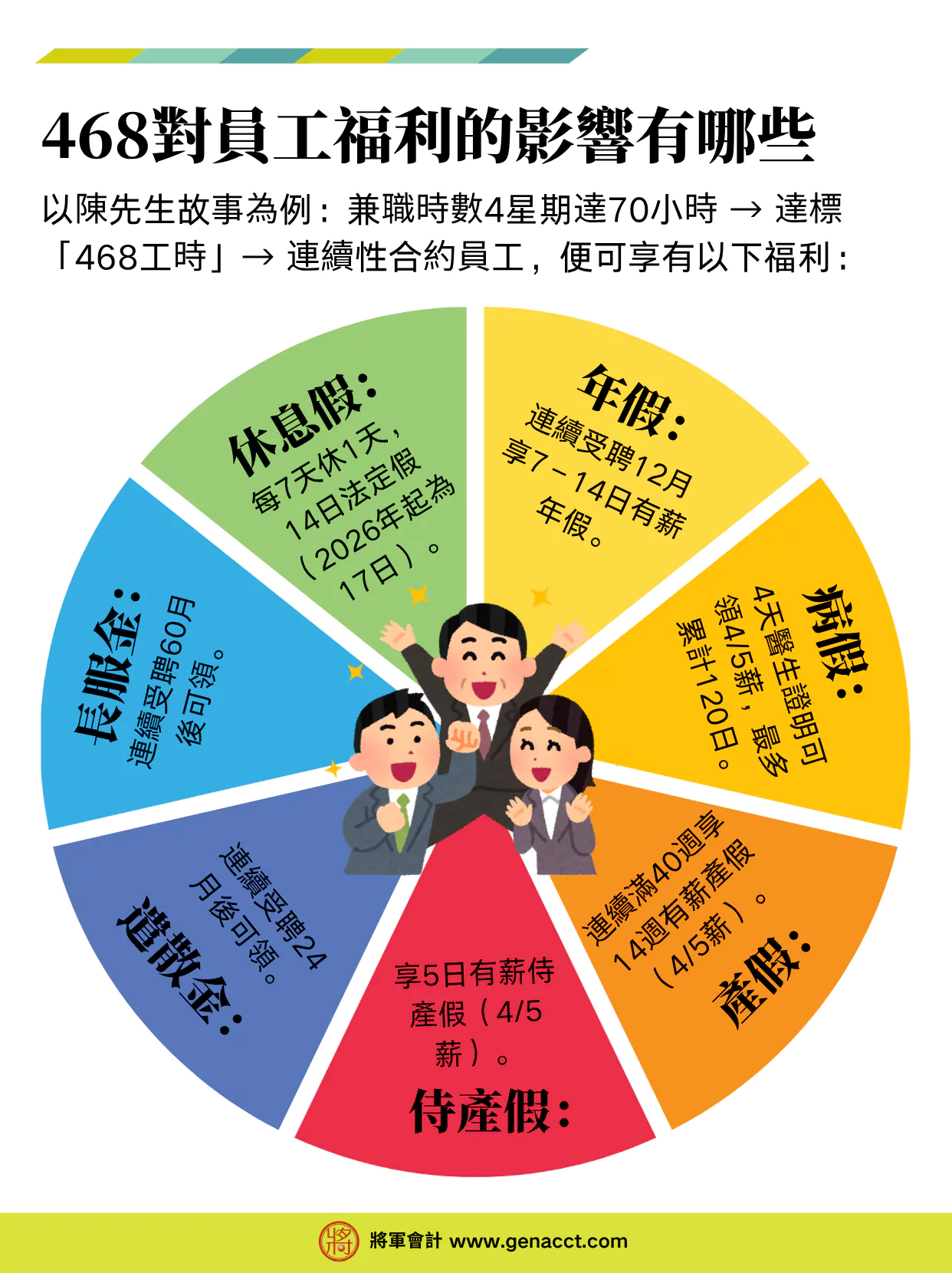
Mr Chan is a part-time employee who works 17.5 hours per week and earns a monthly salary of $9,000. Under the old 418 regime, Mr Chan was not a continuous contract employee. However, after the new 468 regime takes effect, his working hours over four weeks are: 17.5 x 4 = 70 hours, which exceeds 68 hours in four weeks, and therefore meets the definition of a 468 continuous contract employee.
After becoming a continuous contract employee, Mr Chan will be entitled to protections such as sickness allowance, paid annual leave, sick leave, severance payment, and long service payment. Assuming Mr Chan retires at age 65 after 10 years, the company must pay him long service payment, calculated as follows:
Daily-paid / annual-paid employee: wages for any 18 days chosen from the last 30 normal working days (capped at HK$22,500) x years of service
or
Monthly-paid employee: last month’s wages or the average monthly wages over the past 12 months (capped at HK$22,500) x 2/3 x years of service
Using Mr Chan as an example: $9,000 x 2/3 x 10 = $60,000
Therefore, due to the change from “418” to “468”, Mr Chan’s employer would need to pay an additional $60,000 in long service payment for Mr Chan, who previously did not qualify as a continuous contract employee. Employers must clearly understand the effective date and details of the new legislation, and make provisions and plans for HR costs accordingly.
Further reading: [Employers’ reporting obligations] What is IR56H? A complete guide to employers’ tax responsibilities and the purpose of each form
Impact of the 468 labour legislation on employee benefits
Using Mr Chan’s example, employees will find it easier than before to become continuous contract employees and will be entitled to the following labour benefits:
Rest days, statutory holidays, and paid annual leave
Employees employed under a continuous contract are entitled to not less than 1 rest day in every 7 days.
Regardless of length of service, employees are entitled to 14 statutory holidays (17 days in 2026 and thereafter).
Paid annual leave
Employees employed under a continuous contract are entitled to 7–14 days of paid annual leave for each 12 months of employment.
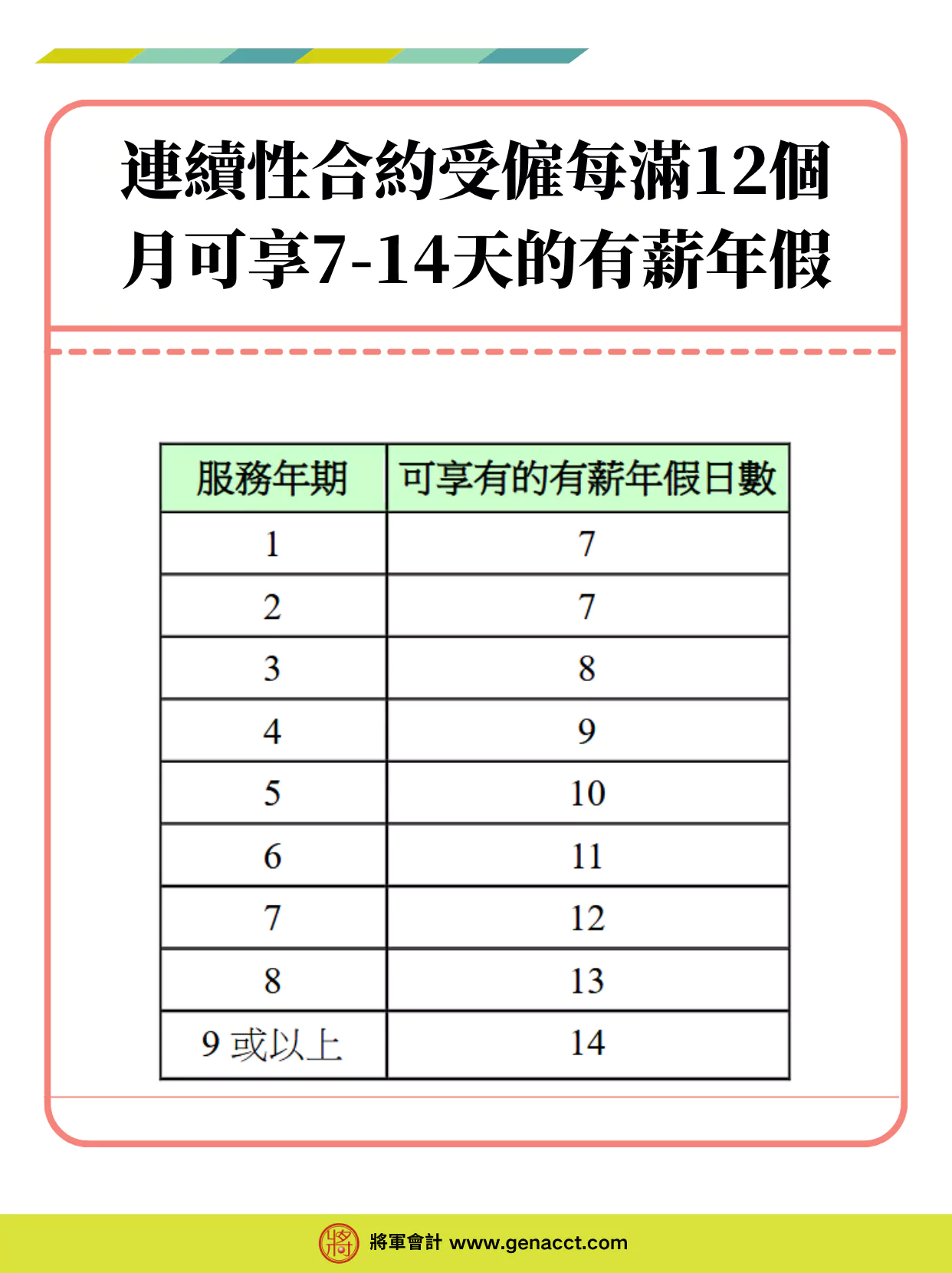
Source: https://www.labour.gov.hk/tc/public/pdf/wcp/ConciseGuide/04.pdf
Sickness allowance (paid sick leave)
If an employee takes sick leave for 4 consecutive days or more and produces a medical certificate, they may receive sickness allowance at 4/5 of their wages (paid sick leave).
Employees employed under a continuous contract may, during the first 12 months of employment, accumulate
2 days of paid sick leave for each completed month of service; thereafter, 4 days for each completed month, up to a maximum accumulation of 120 days of paid sick leave.
Maternity protection
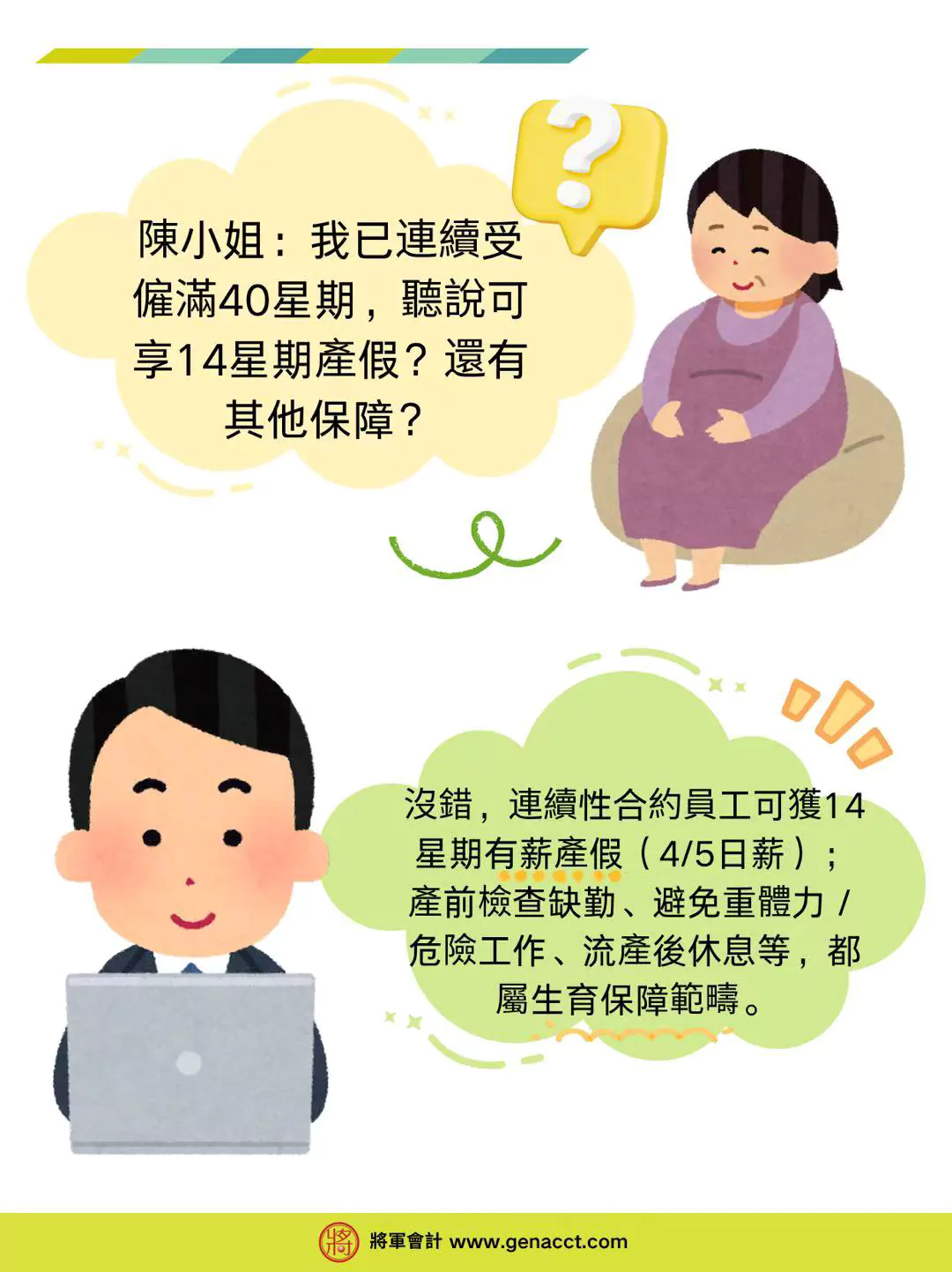
A female employee who has been employed under a continuous contract for at least 40 weeks immediately before the commencement of her maternity leave is entitled to 14 consecutive weeks of maternity leave, with maternity leave pay at 4/5 of her average wages.
In addition, employees are entitled to maternity protection, including protection for absence due to antenatal medical examinations, being unfit for heavy, hazardous, or harmful work, or absence due to miscarriage.
Source: https://www.labour.gov.hk/tc/public/pdf/wcp/ConciseGuide/06.pdf
Paternity leave
A male employee employed under a continuous contract is entitled to 5 days of paternity leave for each confinement of his spouse/partner, with paternity leave pay at 4/5 of his average wages.
Notice period or payment in lieu of notice for termination of an employment contract
If an employer dismisses an employee immediately without the employee having committed serious misconduct, the employer must pay payment in lieu of notice to compensate for the notice period stipulated in the employment contract.
Employment protection
An employee may claim against the employer for unreasonable dismissal, unreasonable variation of the terms of the employment contract, or unreasonable and unlawful dismissal.
Severance payment and long service payment
An employee employed under a continuous contract for 24 months or more may be entitled to severance payment due to redundancy or lay-off. An employee employed for 60 months or more may be entitled to long service payment due to retirement at age 65 or above, death in service, or resignation on medical grounds.
Source: https://www.labour.gov.hk/tc/public/pdf/wcp/ConciseGuide/11.pdf
Protection against anti-union discrimination
Any employee has the right to join a trade union and to become a member or officer of a trade union. Employers must not prevent or deter employees from participating in unions, nor dismiss, penalise, or discriminate against an employee for union participation.
Therefore, employees should also pay attention to their working hours, keep proper records of hours worked, and monitor whether they have reached the 468 threshold so as to enjoy the corresponding rights and benefits.
Frequently Asked Questions
My weekly working hours are not fixed, but my total working hours over 4 weeks exceed 68 hours. Will I be regarded as a continuous contract employee?
Yes. As long as you work for the same employer and your accumulated total hours within four consecutive weeks reach 68 hours or more, you will still be regarded as meeting the continuous contract criteria even if your weekly working hours are not fixed.
This is the key difference between “468” and “418”, and it will cover more part-time and casual workers with unstable working hours.
If I meet the “468” criteria, where can I check the benefits for continuous contract employees?
- You may refer to the Labour Department’s Concise Guide to the Employment Ordinance or
- Labour Department enquiry hotline: 2717 1771 (answered by “1823”)
- Visit in person: Labour Relations Division district offices
What impact does 468 have on part-time employees?
Whether you are daily-paid, part-time, or a casual worker, you will be protected as long as you meet the “468” standard.
Conclusion
The amendment transitioning Hong Kong labour legislation from “418” to “468” for continuous contracts marks a significant enhancement of protection for part-time and casual employees. This change is expected to take effect in 2026, after which more employees with irregular working hours will, by meeting the threshold of “68 hours accumulated within four weeks”, become entitled to statutory employment benefits under the Employment Ordinance.
For employers, this means HR management and cost budgeting will require strategic adjustments. Expenditure on annual leave, sick leave, maternity leave, paternity leave, and severance payment or long service payment may increase—especially after the abolition of MPF offsetting, making prudent reserve planning even more important.
For employees, whether daily-paid, part-time, or casual, meeting the “468” standard provides more comprehensive labour protection, including rest days, statutory holidays, paid annual leave, sickness allowance, maternity protection, paternity leave, and rights related to termination of employment contracts. Employees should proactively understand their rights and keep proper records of working hours to ensure their entitled benefits are realised.
General Accounting has been established for over 20 years and provides professional accounting, tax, and Employer’s Tax Return services. Trust or Company Service Provider licence no.: TC002940. If you have any questions about employee tax filing, our professional Client Service Managers can provide free initial assistance with employer tax filing enquiries.
Further reading:
When will the tax refund cheque arrive? Key notes on IRD tax refunds for Profits Tax/Salaries Tax
Sources:
1. Government welcomes passage of the Employment (Amendment) Bill 2025 by the Legislative Council
https://www.info.gov.hk/gia/general/202506/18/P2025061800288.htm
2. Concise Guide to the Employment Ordinance
https://www.labour.gov.hk/tc/public/pdf/wcp/ConciseGuide/EO_guide_full.pdf
3. Hong Kong Labour Department — Rest days, statutory holidays and paid annual leave
https://www.labour.gov.hk/tc/public/pdf/wcp/ConciseGuide/04.pdf
4. Hong Kong Labour Department — Sickness allowance
https://www.labour.gov.hk/tc/public/pdf/wcp/ConciseGuide/05.pdf
5. Hong Kong Labour Department — Maternity protection
https://www.labour.gov.hk/tc/public/pdf/wcp/ConciseGuide/06.pdf
6. Hong Kong Labour Department — Paternity leave
https://www.labour.gov.hk/tc/public/pdf/wcp/ConciseGuide/07.pdf
7. Hong Kong Labour Department — Employment protection
https://www.labour.gov.hk/tc/public/pdf/wcp/ConciseGuide/10.pdf
8. Hong Kong Labour Department — Severance payment and long service payment
https://www.labour.gov.hk/tc/public/pdf/wcp/ConciseGuide/11.pdf
General Accounting offers free consultation


