

Personal taxation in Hong Kong is divided into three main categories: Salaries Tax, Profits Tax, and Personal Assessment. Self-employed individuals (working independently, without an employment contract, and serving clients in their own name) must pay Profits Tax on business profits. The two-tiered tax rates for unincorporated businesses are 7.5% on the first HKD 2 million and 15% on the remainder. Employed persons (with an employment contract and receiving a fixed salary) must pay Salaries Tax, subject to progressive rates of 2%–17% or a standard rate of 15%.
In simple terms: Having a boss → Salaries Tax; Being your own boss → Profits Tax. If you are both employed and self-employed, both types of tax can be reported separately on the same BIR60 form. It is recommended to apply for Personal Assessment simultaneously; the Inland Revenue Department will automatically compare the calculations and charge the lower amount.
Basic Concepts of Tax Filing for the Self-Employed
Personal taxation in Hong Kong is mainly divided into three categories: Salaries Tax, Profits Tax, and Personal Assessment. Most employed individuals who receive a salary from an employer must pay Salaries Tax. Those who serve clients independently and carry on a business in their own name to earn profits are considered self-employed and must pay Profits Tax on business profits. There are significant differences between the two in terms of reporting methods, tax bases, and deductible items.
The core difference between being self-employed and employed lies in the substance of the working relationship, rather than the title on the contract. The Inland Revenue Ordinance stipulates that individuals who work independently, have no employment contract, serve clients in their own name, and are responsible for their own profits and losses are self-employed and must report Profits Tax. Conversely, those with an employment contract who follow an employer’s instructions and receive a fixed salary are employed persons and must report Salaries Tax.
Employers of employed persons will file Form IR56B (Employer’s Return of Remuneration and Pensions). If remuneration is paid to self-employed/non-employee persons, the employer must file Form IR56M (Notification by an employer of remuneration paid to persons other than employees). Additionally, with the implementation of the new “418” to “468” transition in labor legislation, employers need to re-examine the statutory benefits and tax reporting status of part-time employees.
In simple terms: Having a boss → Salaries Tax; Being your own boss → Profits Tax. However, actual situations are often more complex—many people have both a full-time job and part-time work, or have diverse income as a slashie. In such cases, one needs to handle two or more tax identities on the same tax return. For detailed legal definitions of self-employment and employment, please refer to the Hong Kong Personal Tax Guide.
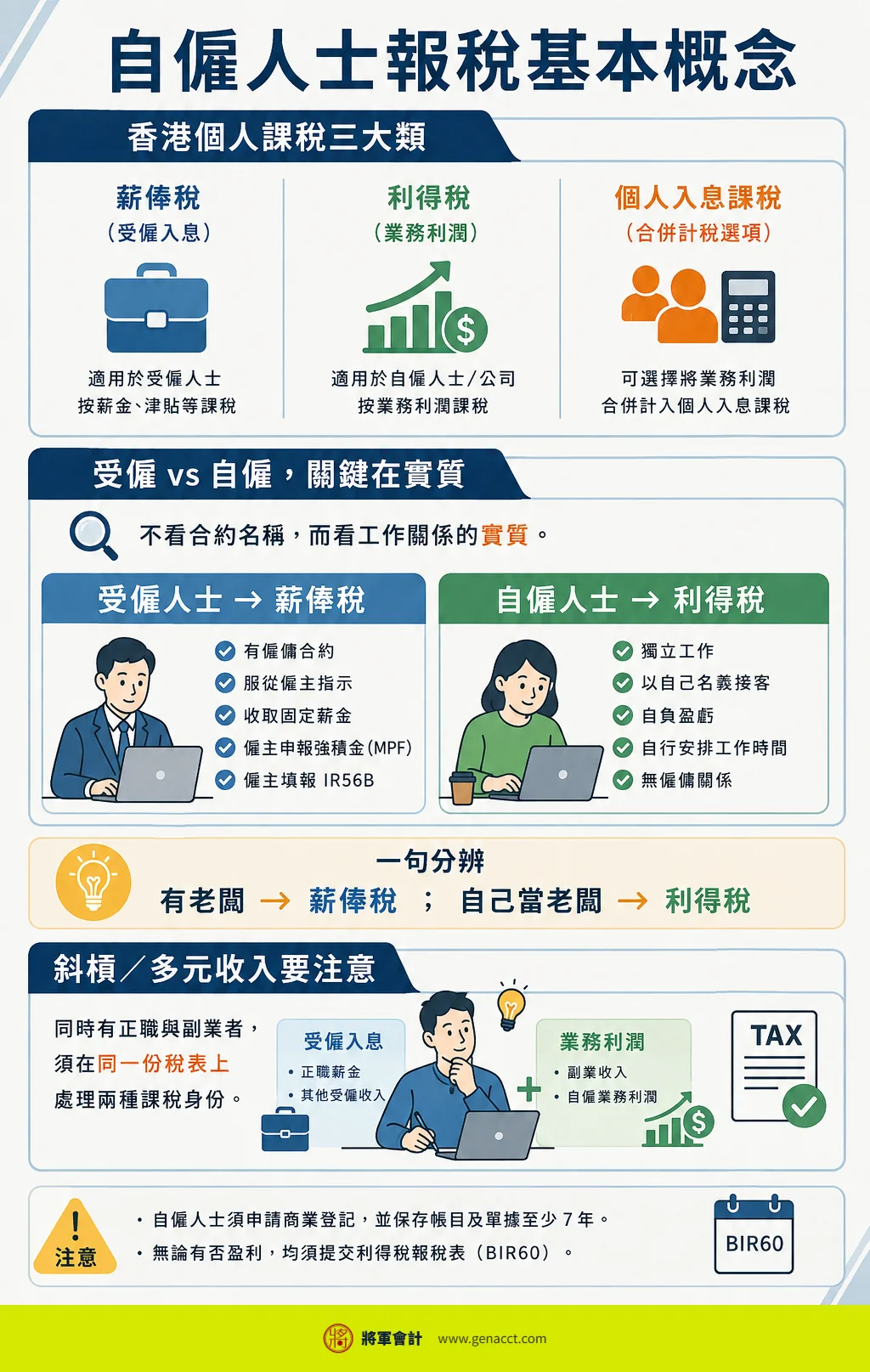
Full Comparison: Profits Tax vs. Salaries Tax
Tax Basis and Target Audience
| Item | Self-employed (Profits Tax) | Employed (Salaries Tax) |
|---|---|---|
| Target Audience | Self-employed persons carrying on a business | Employed persons receiving employment income |
| Tax Basis | Business Profits (Income − Expenses) = Income – Cost – Expenses | Employment Income (Salary, Allowances, Bonuses) |
| Reporting Form | BIR60 Form Part 5 | BIR60 Form Part 4 |
| Basic Allowance | None (but business expenses are deductible) | Yes (Basic Allowance HKD 132,000/year) |
For more on how Salaries Tax is calculated, please refer to the Complete Guide to Hong Kong Salaries Tax.
Tax Rate Comparison
| Item | Profits Tax (Unincorporated Two-tiered) | Salaries Tax |
|---|---|---|
| First HKD 2 Million | 7.5% | N/A |
| Over HKD 2 Million | 15% | N/A |
| Progressive Rates | N/A | 2%–17% (depending on Net Chargeable Income) |
| Standard Rate | 15% | 15% (Net Income); Two-tiered from 2024/25: 15% for first HKD 5,000,000, 16% for the remainder |
| 2025/26 Reduction | 100%, capped at HKD 3,000 | 100%, capped at HKD 3,000 |
Deductible Items
- Profits Tax: All reasonable expenses related to the business are deductible, including equipment depreciation, office rent, software subscriptions, marketing costs, etc. Mandatory MPF contributions for self-employed persons (capped at HKD 18,000/year) are also deductible.
- Salaries Tax: Mandatory MPF contributions for employees (capped at HKD 18,000/year), approved charitable donations, self-education expenses, etc., are deductible, but personal living expenses are not.
Mandatory MPF Contributions
| Item | Self-employed | Employed |
|---|---|---|
| Mandatory Contribution | 5% of annual income (capped at HKD 18,000/year) | Employee 5% + Employer 5% |
| Tax Deductible | Yes (deducted under Profits Tax) | Yes (deducted under Salaries Tax) |
| Form | Reported in BIR60 Part 5 | BIR60 Part 4 |
Note: IR56B is the form for employers to report employee remuneration; employees themselves do not need to fill out IR56B.
Provisional Tax
Both have a provisional tax mechanism—the IRD will estimate the next year’s tax based on the current year’s income, and taxpayers must pay in advance. If the actual income for the next year is lower than the estimate, you can apply to the IRD for a hold-over of provisional tax. For details on how provisional tax is calculated, please refer to the Hong Kong Provisional Tax Guide.
Full-time Self-employment: Scenarios and Procedures for Reporting Profits Tax
Case Scenario: Siu Ming is a full-time freelance designer
Siu Ming takes on graphic design projects full-time in his own name, has no fixed employer, and signs contracts with clients under the name “Siu Ming Studio.” His annual income is approximately HKD 600,000, and he has applied for business registration. Siu Ming’s tax status: Self-employed, must report Profits Tax.
For details on how freelancers can apply for business registration, please refer to the Complete Guide to Hong Kong Business Registration.
Taxation method applicable to Siu Ming:
- Fill out BIR60 Form Part 5 (Profits Tax section)
- Calculated according to the two-tiered Profits Tax rates: 7.5% on the first HKD 2,000,000, and 15% on the remainder
- Business expenses and mandatory MPF contributions for self-employed persons (capped at HKD 18,000/year) are deductible
- General Accounting suggests: You can apply for Personal Assessment at the same time; the IRD will automatically compare the two calculation methods and charge the lower amount
Reporting Process
- Receive BIR60 Form annually (Tax Return – Individuals, usually issued by the IRD in May)
- Prepare accounting accounts: Calculate total annual business income and expenses to determine net profit or loss. Accounting records must be kept for at least 7 years.
- Fill out BIR60 Part 5: Report business name, business registration number, total income, deductible expenses, mandatory MPF contributions, etc.
- Calculate assessable profits: Income – Cost − Expenses − Depreciation = Profit
- Choose taxation method: Two-tiered Profits Tax or Personal Assessment (the IRD will automatically compare and take the lower tax amount)
- Submit to IRD with accounts: Small businesses (total income not exceeding HKD 2,000,000) do not need to attach accounts when submitting BIR60, but General Accounting recommends attaching them anyway, as the IRD almost always requests them later
General Accounting Note: Although accounts do not need to be attached to the BIR60 if total annual income does not exceed HKD 2,000,000, in the vast majority of cases, the Inland Revenue Department will request them. Therefore, General Accounting recommends attaching the accounts when submitting the tax return.

Business Registration Reminder
Self-employed persons must apply for business registration with the Inland Revenue Department within 1 month of starting business operations; otherwise, they may be fined. For detailed fees and application procedures for business registration, please refer to the Complete Guide to Hong Kong Business Registration.
Employed and Self-employed: Reporting Methods for Dual Status
Case Scenario: Siu Mei is a full-time employee who does personal shopping services part-time after work
Siu Mei works at a trading company with a monthly salary of HKD 30,000, and has an annual income of about HKD 100,000 from her amateur personal shopping business.Siu Mei has two sources of income simultaneously:
| Income Type | Source | Applicable Tax | Reporting Section |
|---|---|---|---|
| Full-time Salary HKD 30,000/month | Employment Income | Salaries Tax | BIR60 Part 4 |
| Personal Shopping Annual Income HKD 100,000 | Business Profits | Profits Tax | BIR60 Part 5 |
Key Considerations
1. If you have both salary income and business income, you only need to fill out one BIR60. Report them separately in different sections of the same form—salary income in Part 4 and business income in Part 5.
2. Personal shopping income can deduct business-related expenses. For example: shipping costs, packaging materials, and online store platform fees can all be deducted as business expenses.
3. Allocation of MPF contributions. Siu Mei’s employer already deducts MPF contributions from her full-time job. For her self-employed personal shopping business, she can deduct the remaining mandatory MPF contributions (capped at HKD 18,000/year, the balance after deducting the amount already paid through her full-time job) under Profits Tax.
4. It is recommended to apply for Personal Assessment simultaneously. When you have both salary income and business profits, Personal Assessment can combine the two and tax them at progressive rates (2%–17%). The IRD will automatically compare the “tax calculated under two-tiered Profits Tax” with the “tax calculated under Personal Assessment” and ultimately charge the lower amount.
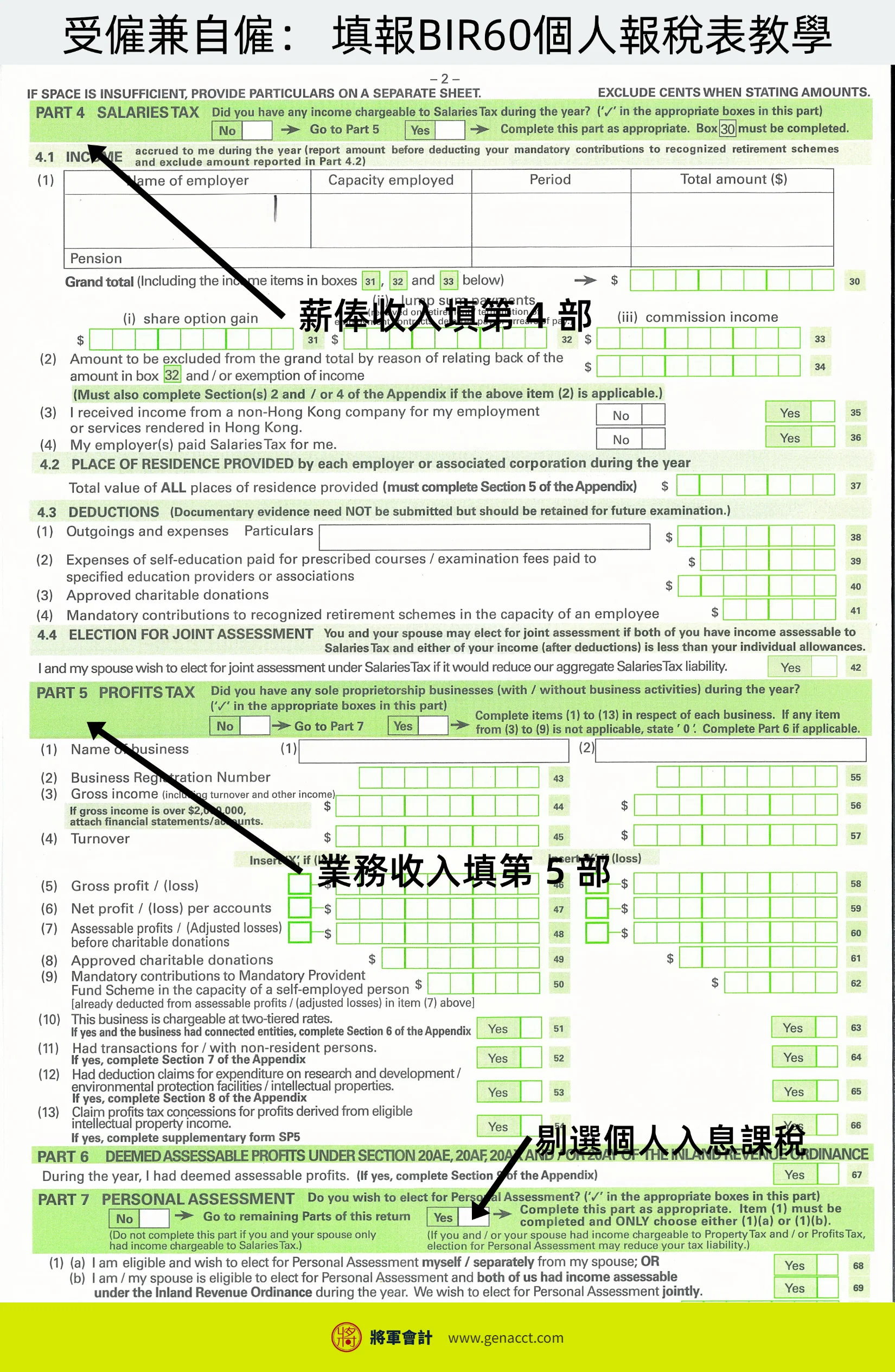
If you have both salary income and business profits, please refer to the Unlimited Company Tax Guide and Complete Guide to Company Tax Filing and Deductions to learn how to combine the calculations.
General Accounting Note: In all cases, it is recommended to apply for Personal Assessment at the same time. The IRD will automatically compare the “tax calculated under two-tiered Profits Tax” with the “tax calculated under Personal Assessment,” and will only levy the lower tax amount.
Handling Slashies and Multiple Part-time Jobs
Case Scenario: Tai Wah has three sources of income simultaneously
Tai Wah is a full-time engineer who manages multiple income sources in his spare time:
| # | Income Source | Annual Income | Applicable Tax | Handling Method |
|---|---|---|---|---|
| 1 | Full-time Engineer (Salary 50k/month) | HKD 600,000 | Salaries Tax | BIR60 Part 4 |
| 2 | Weekend Private Tutor | HKD 80,000 | Depends on situation | Can choose Profits Tax or Personal Assessment |
| 3 | Amateur Freelance Programming | HKD 150,000 | Profits Tax | BIR60 Part 5 |
Practical Advice
1. Keep complete records of income and expenditure. Establish separate accounts for each income source, including invoices, receipts, and quotations, for IRD audit purposes. Accounting records must be kept for at least 7 years.
2. Distinguish between company expenses and private expenses. Only expenses incurred for the purpose of producing profits for the company are tax-deductible. Private expenses, such as those of a domestic or private nature, cannot be used for tax deduction.
3. Evaluate whether Personal Assessment is suitable. When there are multiple income sources, Personal Assessment can combine all income and calculate tax at progressive rates. If the full-time Salaries Tax rate is higher than the Profits Tax rate, combined calculation may be more favorable.
4. Note if total business income exceeds HKD 2,000,000. If total business income exceeds HKD 2,000,000, a balance sheet and Profits Tax computation must be submitted.
BIR60 Filing Steps and Personal Assessment
Steps to Fill Out BIR60
Step 1: Fill in Basic Information
- Name, ID number
- Business name and business registration number (if any)
- Nature of business and address
Step 2: Fill in Income and Expenses (Part 5)
- Total business income
- Deductible expenses (business-related costs, mandatory MPF contributions, etc.)
- Depreciation allowance (if applicable)
Step 3: Calculate Taxable Profit
Formula: Income – Cost − Expenses − Depreciation = Profit
Step 4: Choose Taxation Method
- Two-tiered Profits Tax: 7.5% for the first HKD 2 million, 15% thereafter
- Personal Assessment: Combine all income and calculate at progressive rates of 2%–17%

Explanation of Personal Assessment
Applicable Scenarios:
- Having both salary income and business profits
- Business profits are high, but other allowances are not fully utilized
- Wishing to unify all income under one tax bracket calculation
Why it is sometimes more favorable:
Personal Assessment can combine salary income, rental income, and business profits, deduct various allowances (such as Basic Allowance HKD 132,000, Child Allowance, Parent Allowance, etc.), and then calculate tax at progressive rates. If the progressive tax brackets for various types of income are not fully utilized, the tax after combined calculation may be lower than the sum of separate calculations.
General Accounting suggests: In all cases, it is recommended to apply for Personal Assessment at the same time. The IRD will automatically compare the “tax calculated under two-tiered Profits Tax” with the “tax calculated under Personal Assessment” and charge the lower amount; you don’t need to guess which one is more cost-effective.
Note: If business profits do not exceed HKD 2 million, Personal Assessment is not necessarily more favorable because all income must be combined and recalculated. For details, please refer to IRD Two-tiered Rates FAQ Q14.
For a complete understanding of Personal Assessment calculations and application procedures, please refer to the Unlimited Company Tax Guide and Complete Guide to Company Tax Filing and Deductions.
Penalties for Under-reporting and Remedies
Common Penalties
| Violation Type | Penalty | Legal Basis |
|---|---|---|
| Failure to report on time | Fine of HKD 10,000, plus 3 times the undercharged tax (repeat offenders may be prosecuted) | Inland Revenue Ordinance Cap. 112 §80(2) |
| Wilful tax evasion | Risk of prosecution, maximum fine of HKD 50,000 + 3 times the undercharged tax + 3 years imprisonment (up to 7 years) | Inland Revenue Ordinance Cap. 112 §82 |
| Providing false information | Maximum fine of HKD 10,000 + 3 times the undercharged tax | Inland Revenue Ordinance Cap. 112 §80(2) |
| Failure to keep accounting records | Maximum fine of HKD 100,000 + imprisonment | Inland Revenue Ordinance Cap. 112 §80(1A) |
Remedies
Proactive Remedy: If you discover an under-reporting, you should proactively contact the IRD to explain the situation. Voluntary disclosure may lead to more lenient treatment.
Payment by Installments: You can apply to pay the arrears in installments to reduce the pressure of a lump-sum payment.
Seek Professional Assistance: Hire a professional tax consultant to help handle complex reporting issues and avoid penalties due to unfamiliarity with regulations. General Accounting provides one-stop personal and company tax filing services. For tax filing deadlines, please refer to the Summary of Hong Kong Tax Filing Deadlines.
Conclusion
Self-employed persons in Hong Kong must report Profits Tax on business profits, while employed persons must report Salaries Tax on their salary. If you have both types of income, you only need to report them separately in different sections of the same BIR60 form. It is recommended that all self-employed persons check the Personal Assessment option; the IRD will automatically compare and charge the lower tax amount.
Accounting records must be kept for at least 7 years, and business registration must be applied for within 1 month of commencement. Under-reporting can lead to fines and imprisonment; it is recommended to report proactively and seek professional assistance.


