
#Personal Allowances, #Personal Assessment, #薪俸稅
Does joint assessment necessarily save tax? Whether I should choose joint assessment is a popular question for married individuals. This article shares the benefits and calculation examples of joint assessment for couples, providing a complete guide on how married individuals should fill out their tax returns, helping couples better understand the differences, pros, and cons between joint and separate assessment.
What is Joint Assessment?
Joint Assessment is a tax filing method allowed by the Hong Kong Inland Revenue Department that enables married couples to combine their income, allowances, and deductions within the same year of assessment to calculate their total tax liability.
Joint assessment allows a spouse who has not fully utilized their personal allowance to share the remaining balance with their partner, thereby reducing the overall tax payable by the taxpayer and their spouse.
Extended Reading: How much do you need to earn to pay tax? A guide to Salaries Tax calculation, Personal Assessment, and tax allowances
Conditions for Joint Assessment
- Must be married;
- Both spouses must agree, and the choice cannot be automatically carried forward to the next year;
- Both spouses must sign the tax return to confirm;
- Select the application for joint assessment on the individual tax return;
- Must have been married during that financial year. For example, for the 2025/26 tax return, the couple must be married by March 31, 2026. If the marriage date is April 5, 2026, joint assessment can only be selected starting from the 2026/27 tax year.
What are the benefits of Joint Assessment for couples?
Full utilization of tax allowances
Since the Basic Allowance for a single person is HK$132,000 and the Married Person’s Allowance is HK$264,000 (HK$132,000 x 2), if one spouse has a low income and does not fully utilize their personal allowance, the remaining allowance can be applied to the other spouse to save tax for the higher-earning partner.
Enhancing the efficiency of tax deductions
Deductions such as self-education expenses, elderly care, home loan interest, qualifying annuity premiums, tax-deductible MPF voluntary contributions, and approved charitable donations can be combined to achieve maximum efficiency and minimize tax payments.
Extended Reading: Abolition of the MPF Offsetting Mechanism
Assessment using the most favorable method
As long as joint assessment is selected, the taxpayer only needs to pay tax calculated using the most favorable method. This is because the Inland Revenue Department will simultaneously calculate the tax payable for the couple using both separate and joint assessment methods, and issue the Notice of Salaries Tax Assessment based on the lower amount, ensuring the taxpayer’s rights are protected.
Therefore, we recommend that married individuals opt for joint assessment. There is no need to do the math yourself; the Inland Revenue Department will automatically calculate and select the most cost-effective tax amount.
Guide for Married Individuals Filling Out Tax Returns (Joint Assessment)
If married individuals wish to apply for joint assessment, they must follow these three steps:
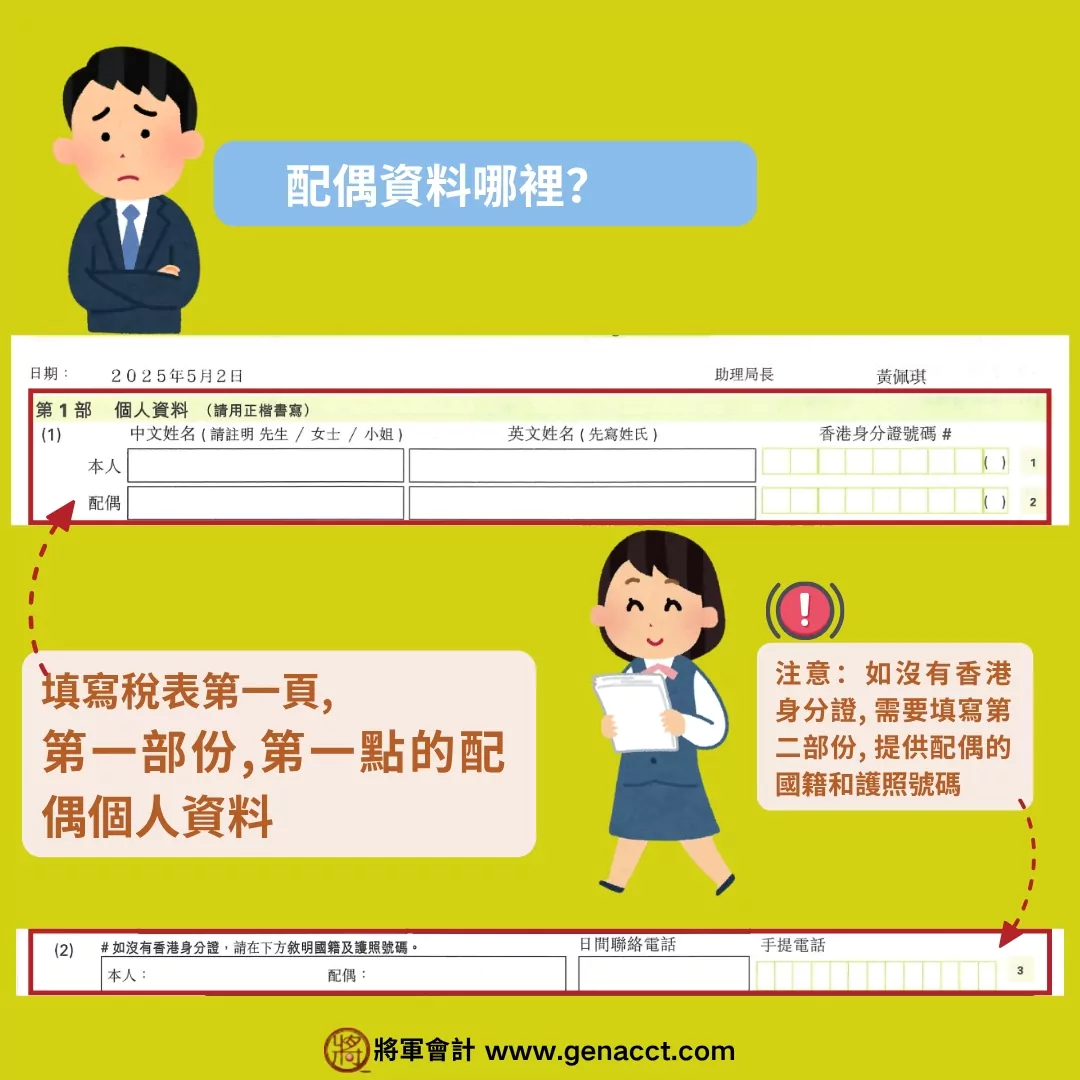
Step 1: Fill in spouse's information
Fill in the spouse’s personal details in Part 1, Point 1 on the first page of the tax return. If they do not have a Hong Kong Identity Card, you need to fill in Part 2 to provide the spouse’s nationality and passport number.
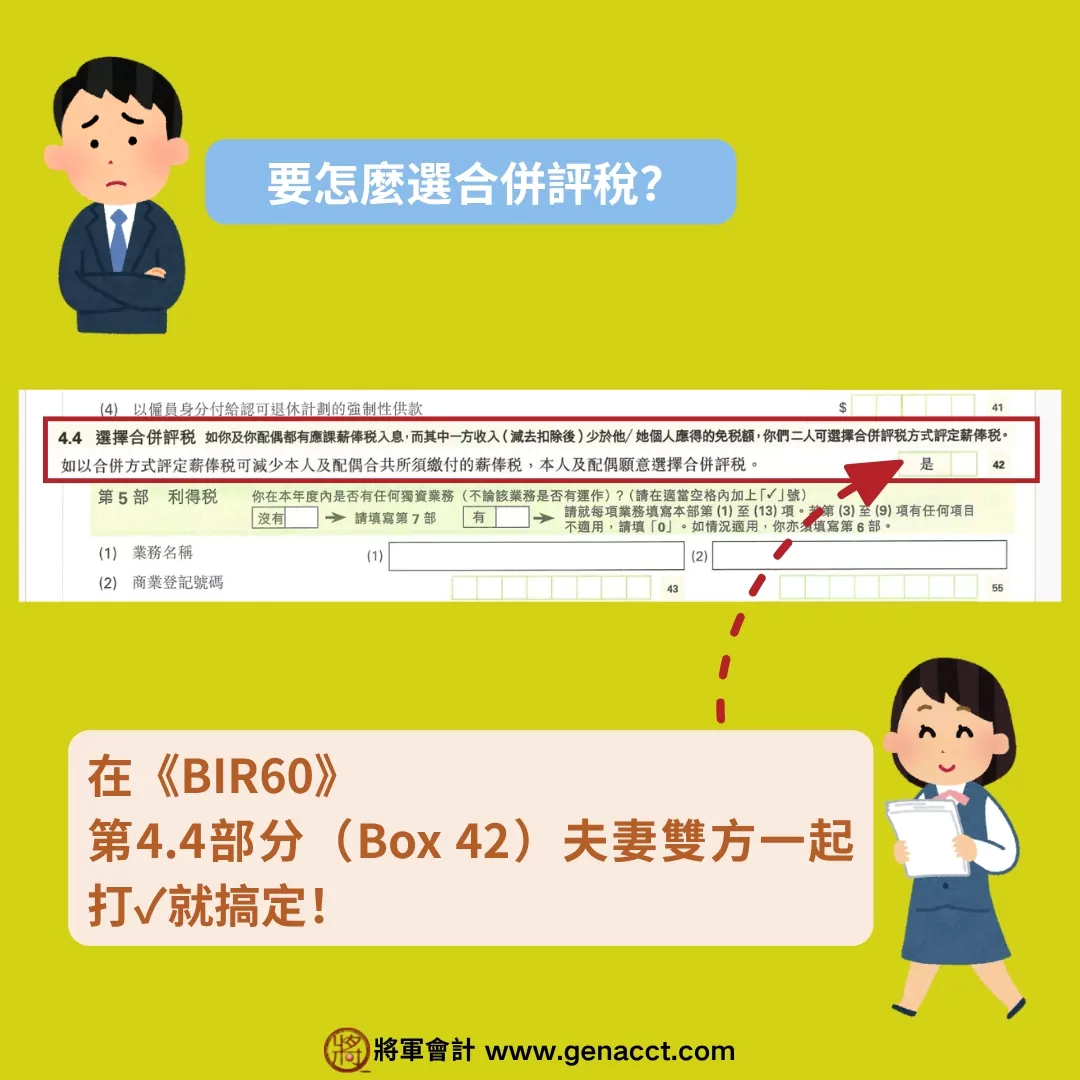
Step 2: Tick the application for joint assessment
Both the taxpayer and the spouse must place a “✓” in Part 4.4 (Box 42) of their individual tax return (BIR60) to indicate their consent;
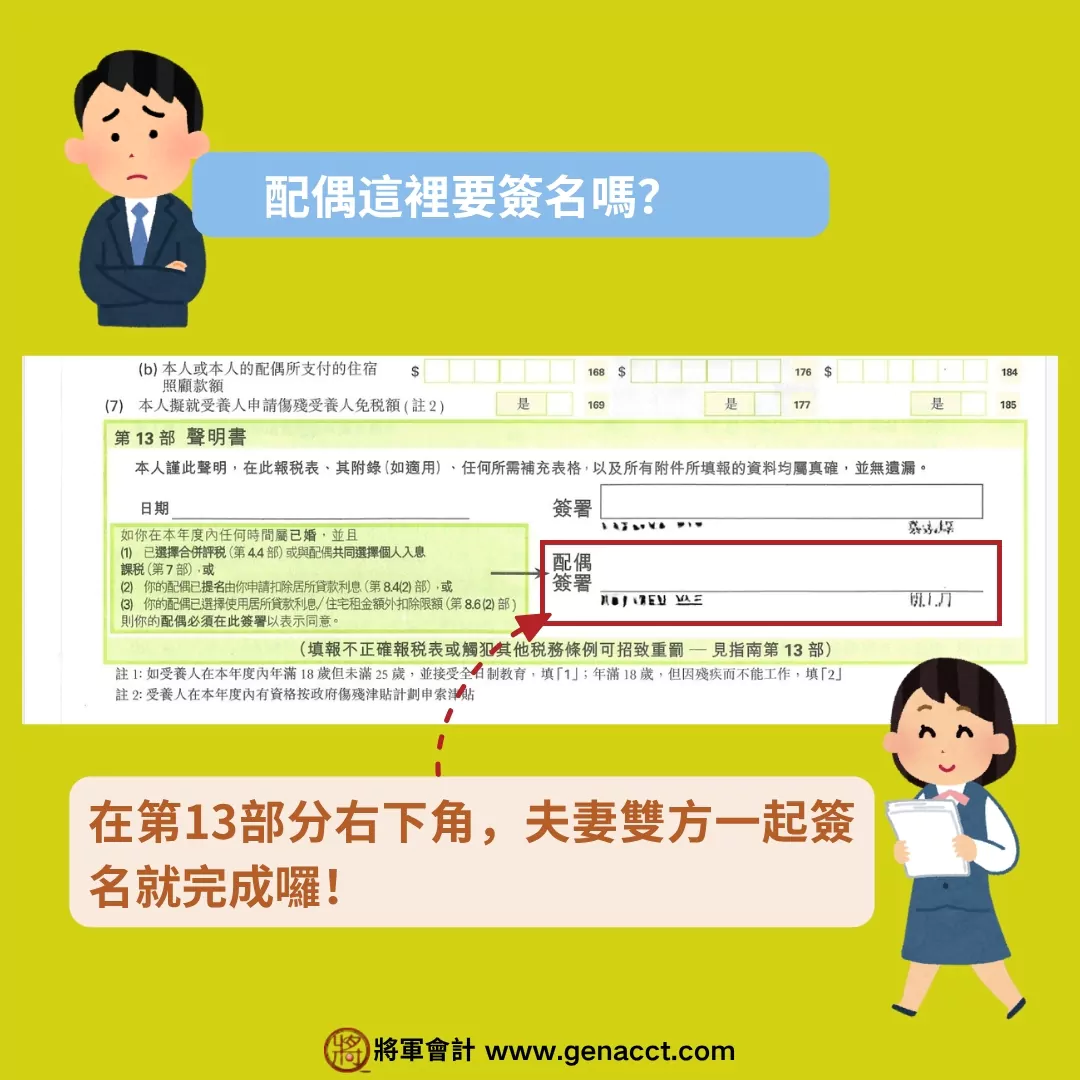
Step 3: Signatures of taxpayer and spouse
The taxpayer and the spouse must sign for confirmation in Part 13 at the bottom right corner of the last page of the tax return.
How to apply for joint assessment in the first year of marriage?
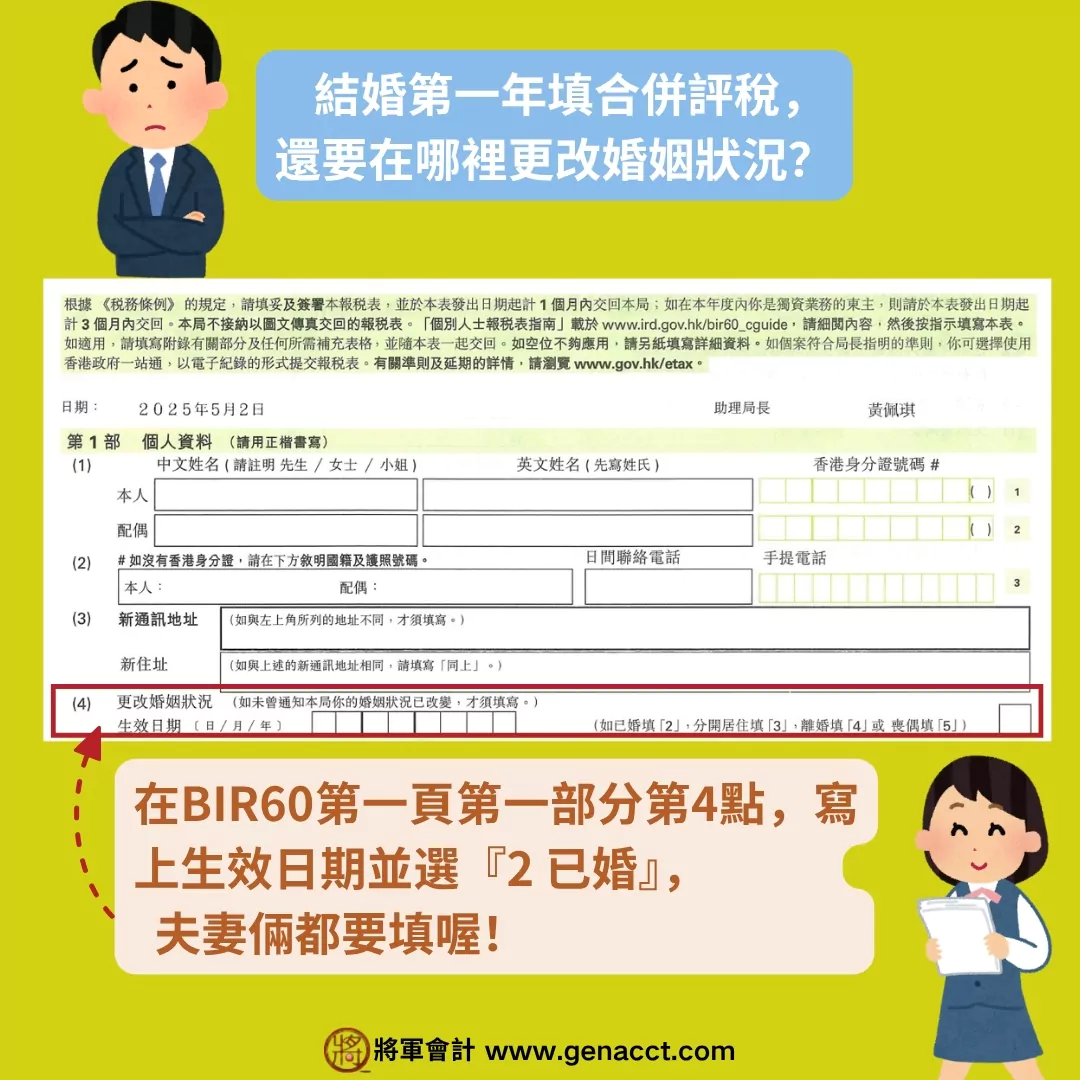
Taxpayers who have just married during the financial year must, in addition to the three steps above, fill in the effective date and report “2 Married” in Part 1, Point 4 “Change in Marital Status” on the first page of the BIR60.
Note: Both spouses need to fill this in!!
Does choosing joint assessment necessarily save tax for married individuals?
No. As mentioned above, the Inland Revenue Department will calculate tax both jointly and separately. If both the taxpayer and the spouse are high-income earners, or after calculating additional tax concessions, it is possible that separate assessment may save more tax.
Taking the 2025/26 tax reduction as an example, each taxpayer can enjoy a tax reduction of HK$3,000. For a couple filing separately, each can reduce their tax by HK$3,000, totaling HK$6,000. If joint assessment is chosen for that year, the couple shares a single HK$3,000 tax reduction. In this case, separate assessment might be more advantageous.
The following two examples compare the tax differences between separate and joint assessment.
Joint Assessment Examples
Joint Assessment Example 1: One spouse's income is lower than the Basic Allowance and they have two children
Mr. Wong and Mrs. Wong have annual salaries of HK$96,000 and HK$680,000 respectively. They have two children. Since Mrs. Wong’s income is higher than the Basic Allowance, she claims the child allowance for both children.
Under joint assessment, the couple only needs to pay a total tax of HK$17,964, which is significantly lower than the HK$24,900 Mrs. Wong would pay under separate assessment.
The main reason is that Mr. Wong’s income is below the Basic Allowance. By choosing joint assessment, Mrs. Wong can fully utilize the Married Person’s Allowance. Consequently, joint assessment saves HK$6,936 in tax.
| Tax calculation using separate assessment | Tax calculation using joint assessment | |||||
|---|---|---|---|---|---|---|
| Mr. Wong | Mrs. Wong | Mr. Wong | Mrs. Wong | Joint Assessment | ||
| HKD | HKD | HKD | HKD | HKD | ||
| Income | 96,000 | 680,000 | Income | 96,000 | 680,000 | |
| Less: MPF | (4,800) | (18,000) | Less: MPF | (4,800) | (18,000) | |
| Net Income | 91,200 | 662,000 | Net Income | 91,200 | 662,000 | 753,200 |
| Less: Basic Allowance | (132,000) | (132,000) | Less: Married Person’s Allowance | (264,000) | ||
| Less: Child Allowance X2 | N/A | (260,000) | Less: Child Allowance X2 | (260,000) | ||
| Net Chargeable Income | N/A | 270,000 | Net Chargeable Income | 229,200 | ||
| Progressive Tax Calculation | Progressive Tax Calculation | |||||
| First $50,000 x 2% | 1,000 | First $50,000 x 2% | 1,000 | |||
| Next $50,000 x 6% | 3,000 | Next $50,000 x 6% | 3,000 | |||
| Next $50,000 x 10% | 5,000 | Next $50,000 x 10% | 5,000 | |||
| Next $50,000 x 14% | 7,000 | Next $50,000 x 14% | 7,000 | |||
| Remainder $70,000 x 17% | 11,900 | Remainder $29,200 x 17% | 4,964 | |||
| 2025/26 Tax Reduction | (3,000) | (3,000) | ||||
| Tax Payable | 24,900 | Tax Payable | 17,964 | |||
Joint Assessment Example 2: Both spouses' incomes are higher than the Basic Allowance and they have two children
However, when both spouses have similar incomes that are higher than the Basic Allowance, joint assessment may not save tax. Take Mr. Lau and Mrs. Lau as an example: both have an annual salary of HK$500,000 and have two child allowances (which must be claimed in full by one of them).
Using separate assessment, the couple only needs to pay a total of HK$38,900 in tax (38,500 + 400), which is HK$14,900 less than the HK$53,800 required under joint assessment.
Therefore, do not blindly assume that joint assessment is always more beneficial than separate assessment. Since every tax case has its own unique factors and variables, taxpayers should consult a professional tax advisor to plan for the maximum tax benefits.
| Tax calculation using separate assessment | Tax calculation using joint assessment | |||||
|---|---|---|---|---|---|---|
| Mr. Lau | Mrs. Lau | Mr. Lau | Mrs. Lau | Joint Assessment | ||
| HKD | HKD | HKD | HKD | HKD | ||
| Income | 500,000 | 500,000 | Income | 500,000 | 500,000 | |
| Less: MPF Contributions | (18,000) | (18,000) | Less: MPF Contributions | (18,000) | (18,000) | |
| Total Net Income | 482,000 | 482,000 | Total Net Income | 482,000 | 482,000 | 964,000 |
| Less: Basic Allowance | (132,000) | (132,000) | Less: Married Person’s Allowance | (264,000) | ||
| Less: Child Allowance X2 | N/A | (260,000) | Less: Child Allowance X2 | (260,000) | ||
| Net Chargeable Income | 350,000 | 90,000 | Net Chargeable Income | 440,000 | ||
| Progressive Tax Calculation | Progressive Tax Calculation | |||||
| First $50,000 x 2% | 1,000 | 1,000 | First $50,000 x 2% | 1,000 | ||
| Next $50,000 x 6% | 3,000 | 40,000 x 6% =2,400 | Next $50,000 x 6% | 3,000 | ||
| Next $50,000 x 10% | 5,000 | 0 | Next $50,000 x 10% | 5,000 | ||
| Next $50,000 x 14% | 7,000 | 0 | Next $50,000 x 14% | 7,000 | ||
| Remainder x 17% | 25,500 | 0 | Remainder x 17% | 40,800 | ||
| 2025/26 Tax Reduction | (3,000) | (3,000) | (3,000) | |||
| Tax Payable | 38,900 | Tax Payable | 53,800 | |||
Important Notes
1. No automatic extension
Even if joint assessment is selected this year, it does not mean it will be automatically applied next year.
2. Tick every year
Joint assessment must be ticked on the individual tax return for every year of assessment.
3. Mutual consent required
If only one party agrees or ticks the box, the Inland Revenue Department will not process the joint assessment.
Are there any disadvantages to Joint Assessment?
Yes, the biggest disadvantage is the issue of privacy. Because joint assessment is used, the Notice of Salaries Tax Assessment will clearly list the total income of both spouses. If you do not want your partner to know your income, you should not choose joint assessment.
Frequently Asked Questions
How much is the Married Person's Allowance?
The Married Person's Allowance is HK$264,000.
Can same-sex marriages use joint assessment?
Yes. According to Section 2 of the Inland Revenue Ordinance, "marriage" is defined to include any marriage contracted outside Hong Kong by two persons capable of marrying according to the local law where it was celebrated, regardless of whether such marriage is recognized by the laws of Hong Kong. Therefore, same-sex marriages can also opt for joint assessment.
What is the BIR50E form?
If a taxpayer does not proactively select joint assessment, but the Inland Revenue Department finds after assessment that joint assessment would be more favorable, they will issue form BIR50E to invite the taxpayer and their spouse to make that choice.
What should I do if I make a mistake in a joint assessment tax return?
Depending on the reason for the error or omission, you can fill out a form to apply for a correction from the Inland Revenue Department. For details, please refer to another article: [Tax Error] How to correct omissions in a tax return? Guide to revised assessments.
Conclusion
Joint assessment for couples allows for the centralized calculation of allowances and various deductions for both parties. The Inland Revenue Department will simultaneously compare the tax amounts for both joint and separate assessment methods and issue the assessment notice based on the most favorable result. However, it must be proactively applied for and legally signed by both parties for each year of assessment. When both parties have high and similar incomes or value privacy, separate assessment may actually be more advantageous. Taxpayers and their spouses should flexibly choose between joint or separate assessment based on income, allowances, deductions, and privacy considerations to achieve the best Salaries Tax arrangement.
Further reading:
Sources:
1. Joint Assessment and Election for Personal Assessment
https://www.ird.gov.hk/eng/pdf/ind_jae.pdf
2. Separate or Joint Assessment for Married Persons and Their Spouses
https://www.gov.hk/en/residents/taxes/salaries/salariestax/jointassessment.htm
3. Completing Tax Returns for Individuals
https://www.ird.gov.hk/eng/faq/ctr.htm
General Accounting provides free consultation


