

#Corporate tax returns, #Company Deregistration, #公司秘書
How to avoid failure in company deregistration? Most failures or issues during company closure occur because directors and shareholders lack understanding of the termination process: specifically, failing to handle company tax filing, managing company bank accounts, neglecting to file annual returns, or improperly handling company assets (and liabilities).
Physical Fitness & Beauty closed all its branches on September 6, 2024 (1). Although Physical’s financial status has not been made public, the company certainly has outstanding “prepaid” liabilities. If a company cannot repay its debts, it cannot be closed via the deregistration method.
General Accounting has been established for over 20 years, with extensive professional experience in company deregistration services. This article shares essential knowledge regarding asset arrangements, closing company bank accounts, and tax matters before deregistering a company. We hope this helps you plan effectively before closing your business to complete the process as quickly as possible.
Form IR1263: Request for Notice of No Objection to a Company / Limited Partnership Fund being Deregistered
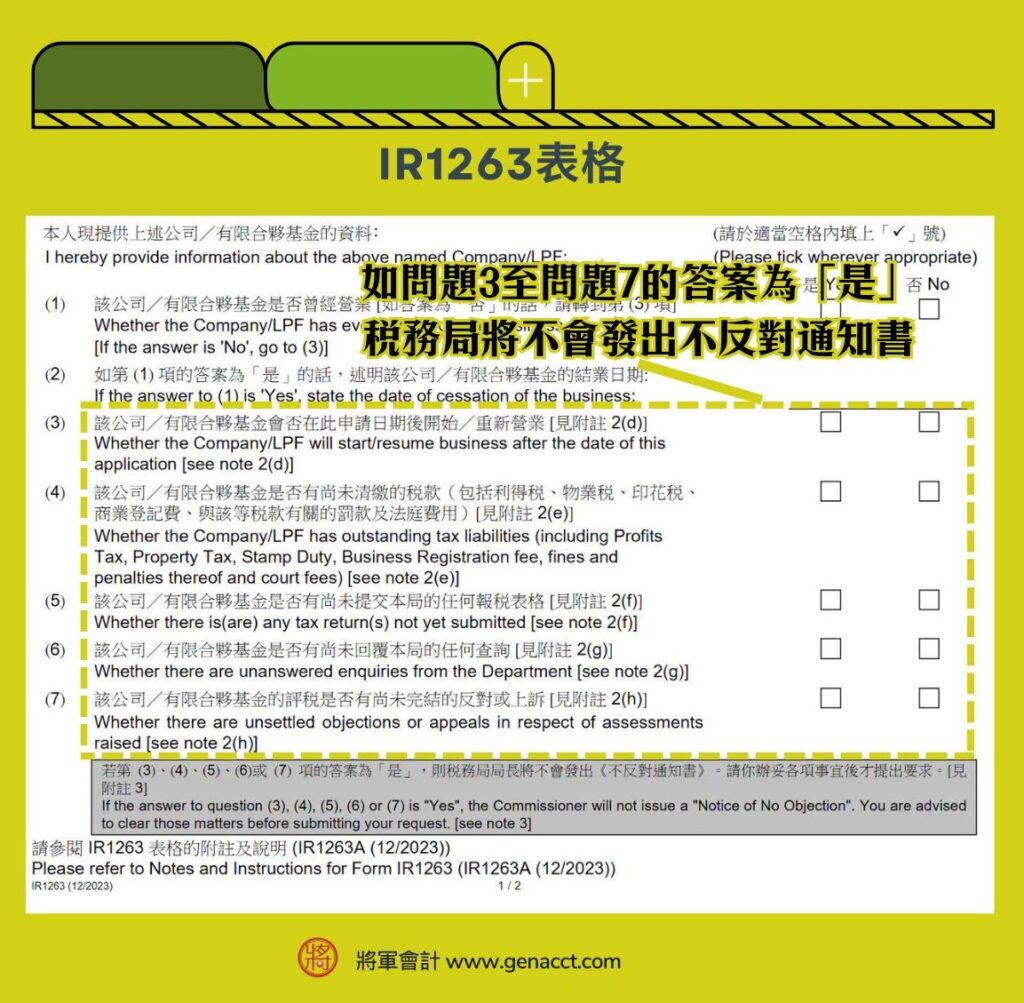
The first step in applying for company closure is submitting Form IR1263 (2). Applicants must answer 11 questions within the form. The Inland Revenue Department (IRD) has clearly stated that if the answer to any of questions 3 through 7 is “Yes,” the IRD will not issue a Notice of No Objection. Applicants must resolve the matters in questions 3 to 7 before applying for deregistration.
How to handle company assets upon closure?
After a limited company is successfully closed, the Companies Registry will immediately strike it off the register. Since a limited company is a separate legal entity with independent legal status, the company basically cannot operate once it has been successfully deregistered.
Therefore, the assets of a limited company must be transferred to a third party, distributed to shareholders, or disposed of before applying for closure. Otherwise, company assets will be confiscated as bona vacantia after the company is struck off.

Methods for Handling Assets During Company Closure
- Properties
Shareholders should sell properties held in the name of the limited company before applying for deregistration. If a company holds property, it cannot apply for deregistration. - Subsidiaries / Associated Companies
If the company holds shares in other limited companies, shareholders should first transfer the subsidiary shares to a third party. - Stock Investments
Before closing the company, shareholders should sell or transfer any stock investments held in the name of the limited company. - Other Fixed Assets
For items such as machinery, vehicles, computers, photocopiers, and fax machines, shareholders should sell or dispose of them before applying to terminate the business. - Accounts Receivable
The person in charge should calculate outstanding receivables and urge debtors to make payments as soon as possible. - Prepayments
If deposits or service fees have been prepaid, the company should use the services or negotiate a refund immediately. - Deposits
For rental deposits, water, electricity, and telephone deposits, services must be terminated and arrangements made for the return of deposits.
How to handle company liabilities during deregistration?
A company must clear all debts before submitting a closure application. When filing Form IR1263 to request a Notice of No Objection, the company must declare that it has no outstanding debts. If false statements are discovered, prosecution may follow.
Furthermore, the Companies Registry will publish a notice in the Gazette (3) regarding the company being in the process of deregistration (4). Creditors have the right to request the Companies Registry to stay the deregistration application.
The only exception is money owed by the company to shareholders or directors. If the company cannot repay these debts, shareholders and directors can pass a resolution to waive their claims against the company.
Common Company Liabilities:
- Accounts Payable: Such as unpaid supplier invoices.
- Prepaid Receipts: Such as prepaid service fees from customers of beauty salons or gyms.
- Accrued Expenses: Such as water, electricity, telephone, and broadband bills.
- Bank Loans: Letters of credit.
- Installment Payments: Such as for photocopiers, vehicles, or machinery.
- Employee Expenses Payable: Salaries, severance pay, long service payments, and MPF contributions.
- Government Fees Payable: Such as taxes and other government charges.
When and how to close the bank account during company closure?
Before closing the company, assets must be sold, and the proceeds deposited into the company bank account. Recovered receivables or prepayments will also be deposited via FPS, check, or bank transfer. Therefore, you must maintain the company bank account to receive funds before considering deregistration.
However, once a limited company is officially struck off, the company account will be frozen. Therefore, the person in charge must carefully plan the timing for closing the bank account. It is recommended to appoint a professional secretarial company to handle the deregistration procedures.
We once had a client who sought help after applying for deregistration themselves. Due to a lack of familiarity with company law and asset handling, they only discovered that the company bank account still had a balance after receiving approval and the official notice of deregistration. By then, the bank had already transferred the account assets to the government.
To recover the funds, shareholders must hire a lawyer to apply to the High Court to vacate the deregistration, which costs approximately HK$30,000 to HK$50,000. Only after the limited company is restored can shareholders apply to the bank to recover the funds, after which they must restart the deregistration process—a waste of both time and money.
Is tax filing required for company deregistration?
Yes. When the IRD receives a deregistration application, it reviews the company’s tax records and issues a letter notifying the company to settle outstanding tax obligations, including unfiled tax returns, unpaid taxes, Business Registration (BR) fees, or other pending tax matters.
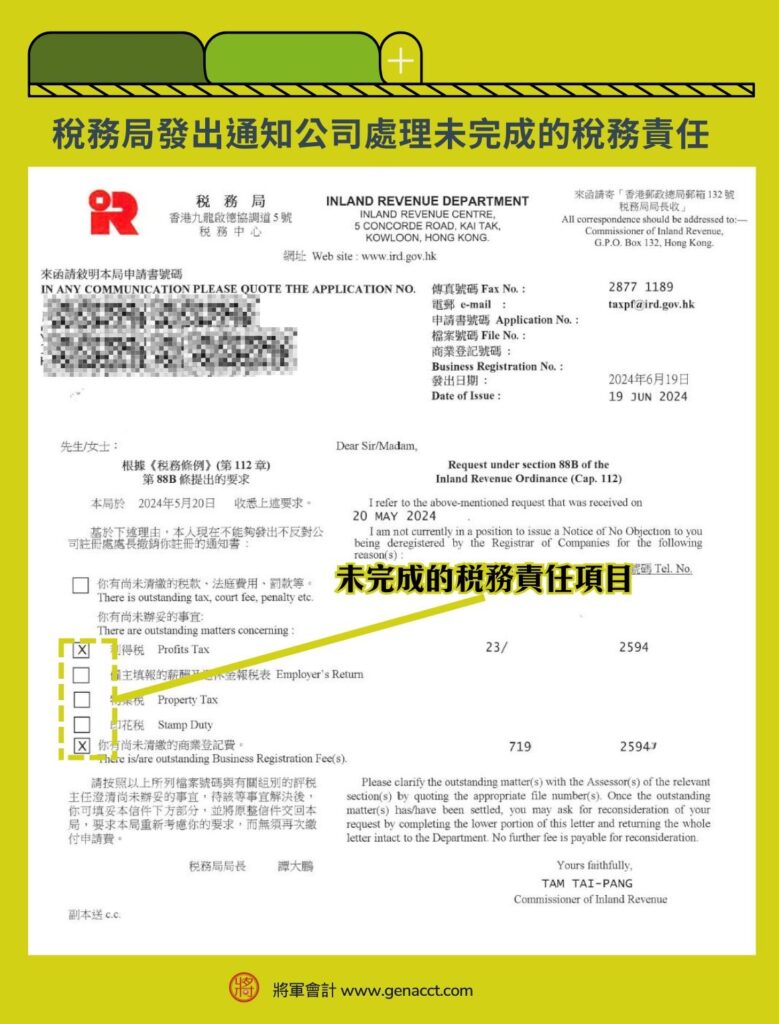
For example, if the company closure date is August 31, 2024, and the last submitted audit report ended on March 31, 2024, the IRD will first issue a 2024/25 Profits Tax Return upon receiving the deregistration application. It will also require the company to submit an audit report and tax computation for the period from the day following the last accounting year-end to the date of cessation—in this case, from April 1, 2024, to August 31, 2024.
Therefore, the company must fulfill its tax filing obligations before the IRD issues the “Notice of No Objection to Deregistration of a Company,” allowing the deregistration process to proceed to the next step.
Further Reading: When to receive tax returns? A complete guide to tax months, individual/company tax filing, and tax extensions
Will shareholders go bankrupt due to the deregistration of a limited company?
No. To deregister a limited company via the deregistration method, the company’s financial status must not be insolvent; therefore, shareholders will not go bankrupt due to deregistration.
Even if a company is insolvent, it can apply for winding-up. Since a limited company has limited liability, the shareholders’ financial responsibility is limited to the company’s share capital; they are not liable for amounts exceeding that capital. Whether through deregistration or winding-up, shareholders need not worry about personal bankruptcy resulting from the closure of a limited company.
Conclusion
The above are the key points on how to avoid failure in company deregistration. In addition to paying attention to the procedures and fees, applicants must have a detailed plan for handling company assets, closing bank accounts, and managing tax matters. It is recommended that shareholders consult a professional secretarial company before applying for deregistration.
General Accounting has been established for over 20 years and provides company deregistration services (Trust or Company Service Provider License No.: TC002940). If you have any questions regarding company closure, our professional customer service managers can provide a free initial consultation for business termination.
Sources
1. Wikipedia: Physical Fitness
https://zh.wikipedia.org/wiki/%E8%88%92%E9%81%A9%E5%A0%A1
2. How to apply for a Notice of No Objection to Deregistration of a Company / Limited Partnership Fund
https://www.ird.gov.hk/eng/tax/bus_han.htm
3. Government of the Hong Kong Special Administrative Region Gazette
https://www.gld.gov.hk/egazette/english/index.html
4. Companies Registry: Deregistration, Striking off and Winding up
https://www.cr.gov.hk/en/faq/local-company/dereg-striking-off-winding-up.htm
General Accounting provides free consultation


