

Introduction: $5.5M Account Lump-sum Entry + Disappearance = Court Order Fine
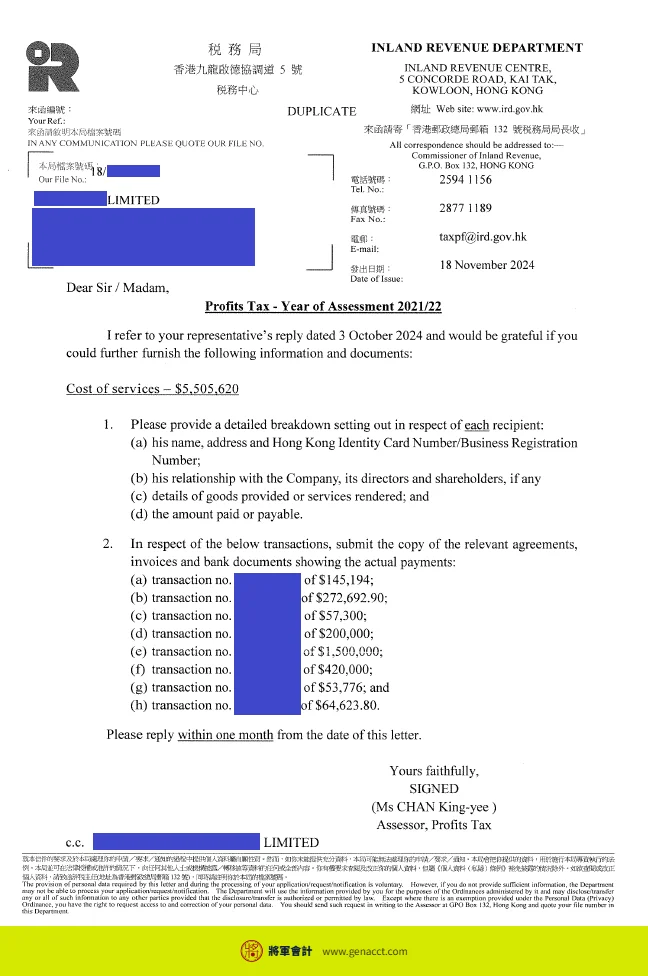
This is a real case—an SME in Hong Kong had its 2021/22 accounts handled by a cheap accounting firm that entered $5,505,620 as “Cost of Services” in a single lump sum without any breakdown. Result: The IRD proactively issued an enquiry letter. The previous firm gave a perfunctory reply and then disappeared. Ultimately, the IRD initiated legal proceedings, the court issued a Court Order, and the client had to pay fines and spend double the time redoing the accounts.
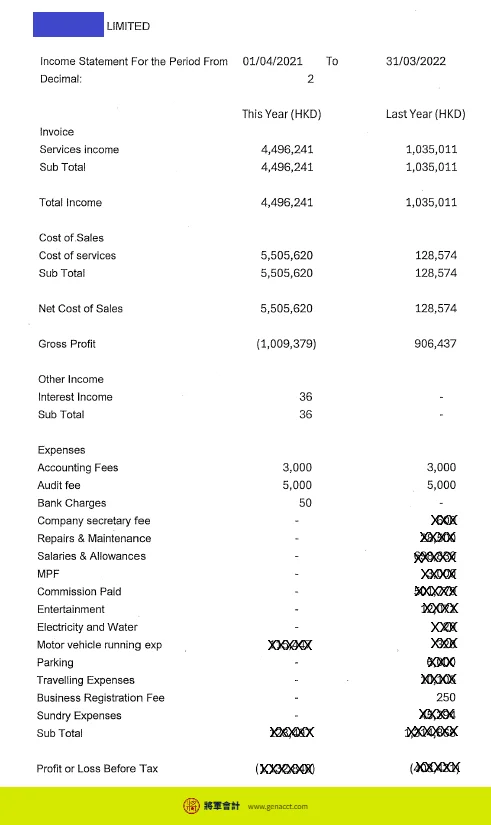
$5,505,620 vs $1,030,000 — Last year, costs were only 12.4% of revenue (high margin); this year, costs were 122.4% of revenue (extreme Gross Loss). This inversion of nearly 100 percentage points is a typical trigger for the IRD’s automated risk alerts.
This article uses a timeline narrative to reconstruct the case and analyzes the 3 major traps of cheap accounting firms from a professional perspective, providing an immediate red flag guide for SME owners.
Case Background Timeline: How a $4.49M Business Was Pushed into the Abyss by a “Disappearing Accounting Firm”
The Original Plan — Why Choose a Cheap Accounting Firm
The client operates an SME in Hong Kong with a 2021/22 turnover of approximately $4,490,000. The reasons for choosing a cheap accounting firm are familiar to many business owners:
- “Recommended by a friend,” “Cheap price,” “It’s good enough”
- “It’s just tax filing anyway, any firm should be able to do it”
- “I don’t understand professional matters, I’ll leave it to the firm”
This “price-first” decision isn’t wrong in itself—but if after-sales support, the ability to handle the IRD, and compliance levels are ignored, it buries risks for the future.
The First Warning — IRD Enquiry Letter Arrives
Before October 2024, the IRD issued an Enquiry Letter requesting detailed receipts and bank statements for the $5,505,620 Cost of Services. The IRD’s response period is 30 days (extensions can be applied for).
The Previous Firm’s “Perfunctory Reply” and “Disappearance”
The accounting firm initially replied with a letter (2024-10-03) but could not provide the corresponding supporting documents. When the IRD followed up, the firm chose to disappear and stop replying.
“The client contacted our team to take over in desperation, only to find that the previous firm no longer responded.” — This is a real record from the takeover team.
The Final Outcome — Court Order and Fines
Due to the previous firm’s excessive delays and failure to handle the matter properly, the IRD referred the case to legal channels. Ultimately, the court issued a Court Order. The client had to pay court fines and spend double the time and cost to reorganize the accounts.
This is the ultimate price of a cheap accounting firm’s “after-sales disappearance.”
Trap 1: $5.5M Lump-sum Entry (No Breakdown)
A large amount is not the problem; “No Breakdown” is the problem.
Basic accounting principle: Every expenditure must be traceable. Specifically, Contract + Invoice + Bank Statement must match—this is what the accounting world calls “Three-way Matching.”
The previous firm entered $5,505,620 as a lump sum under Cost of Services with absolutely no breakdown—neither by supplier nor by service category. When the IRD requested supporting documents, the firm simply couldn’t provide them.
Legal Basis for the Violation
Section 51C of the Inland Revenue Ordinance (Cap. 112) clearly stipulates that every person carrying on a trade or business in Hong Kong must keep sufficient accounting records, and such records must be retained for at least 7 years from the date of the transaction.
Consequences of non-compliance? Section 80(2) of the Inland Revenue Ordinance provides for a maximum fine of HKD 100,000 and 6 months’ imprisonment.
Reader Self-Checklist
- [ ] Does your PL Cost of Services have a breakdown?
- [ ] Can every expenditure be matched to an invoice?
- [ ] Can every invoice be matched to a bank statement?
- [ ] Three-way Matching (Contract + Invoice + Bank Statement)
If you cannot answer even one of these questions, your accounts are already sounding an alarm.
Fatal Professional Logic: “Inverted Ratio” Triggers IRD Risk Alert
Comparison of Last Year vs. Current Year Figures
Let’s look directly at the numbers. The PL for this case shows a highly unusual “inverted ratio” (abnormal gross margin):
| Item | Last Year (2020/21) | Current Year (2021/22) | Change |
|---|---|---|---|
| Revenue | $1,030,000 | $4,490,000 | ↑ 3.3x |
| Cost of Services | $120,000 | $5,505,620 | ↑ 41.8x |
| Cost-to-Revenue Ratio | 12.4% | 122.4% | Inversion of nearly 100 percentage points |
| Gross Margin | 87.6% (High Margin) | -22.4% (Gross Loss) | Complete Reversal |
Why is a large amount not the problem, but the “inverted ratio” is?
If turnover rises from $1M to $4.5M, it is reasonable for costs to rise 3-5 times—this is normal business growth.
But in this case, costs rose 41.8 times—this is commercially impossible.
The IRD’s Perspective — Paying $122 in Costs for Every $100 in Revenue
Imagine: For every $100 of business done, $122 in costs are incurred. Losing money on every single transaction.
Anyone with basic business judgment knows this business is “unsustainable.” Yet, these accounts were presented to the IRD.
How Automated Risk Alerts Work
The IRD automatically flags high-risk cases through indicators like “abnormal changes in gross margin.” This process doesn’t require manual review of every case—the system automatically calculates the gross margin change for every tax return and compares it with peers, the previous year, and industry averages. Once an anomaly like “high margin suddenly becoming extreme Gross Loss” appears, an Enquiry Letter is automatically issued.
And “Zero Breakdown” further increases the IRD’s suspicion—it’s both abnormal and unexplained, which is exactly what the IRD’s automatic risk alert is designed to catch.
Debunking Trap Concepts: “No Taxes if You Make a Loss”? Wrong!
Why a Loss is Actually More Dangerous
Many business owners think “making a loss means no tax” or “reporting a Gross Loss is safer”—the truth is exactly the opposite.
A commercially unreasonable Gross Loss is what attracts the IRD’s attention most.
The IRD’s Perspective on Commercially Unreasonable Gross Loss
The IRD looks at “Why is there a loss? Is it real?”
A normally functioning SME that has had high margins of over 80% for years suddenly reports an extreme loss of -22% in one year—this isn’t a business miracle; it’s an accounting anomaly.
Furthermore, this case included “Zero Breakdown”—the IRD couldn’t even get a reasonable explanation for “why there was a loss” from the accounts, so naturally, they pursued it to the end.
The Truly Safe Approach
- Reasonable Gross Margin + Reasonable Expense Breakdown
- Three-way Matching (Contract + Invoice + Bank Statement)
- Retain Records for 7 Years
In business, reasonable gross margins and transparent expenses are the truly safe way to operate (Limited Company Tax Filing Guide).
Psychological Trap: Deadline Emotional Blackmail
The Client’s Personal Experience
What chilled the business owner most in this case was not just the lump-sum entries and the disappearance, but the accounting firm’s manipulation script.
The client initially had doubts about the figures in the accounts. However, the previous accounting firm deliberately delayed providing the draft accounts until the very last moment before the deadline. When the client tried to clarify the numbers, the firm responded with emotional blackmail:
“So many questions! If we miss the deadline for the IRD, there will be fines!”
The client felt anxious upon hearing “there will be fines.” Under time pressure and fear, the client signed the report—which buried millions in risk—without time for review and without fully understanding it.
Deconstructing the Three-Step Manipulation: “Delay + Fear + Refusal to Answer”
This manipulation script has three steps:
- Delay — Deliberately stalling until the last minute to deliver the draft, creating time pressure.
- Fear — Exaggerating the consequences of “being fined by the IRD.”
- Refusal to Answer — Preventing you from understanding the numbers and depriving you of the opportunity to review.
Together, these three steps form an emotional blackmail script. The client wasn’t just deceived; they were pushed by “fear + time pressure.”
Why does “fear of fines” lead to blind signing?
Psychologically, fear and time pressure significantly reduce judgment. Combined with a lack of familiarity with accounting details, business owners often choose to “just sign and get it over with”—accounting firms exploit this human weakness.
If you have ever encountered a situation where “asking a few more questions leads the firm to say they’ll miss the deadline,” please be on high alert (see Differences Between Limited and Unlimited Companies to learn more about directors’ responsibilities for accounts).
The Most Painful Price: Disappearance → Court Order Fine
What is a Court Order?
A Court Order is a judicial command with more serious legal weight than a standard summons. It usually occurs after “prolonged failure to respond or non-cooperation.” Violating an order can lead to further prosecution (contempt of court).
This means: A Court Order is already the legal endgame of a tax dispute—all previous procedural windows (Enquiry Letter response period, tax objection period) have been missed (see Tax Objection to understand appeal possibilities).
Why “Disappearance” Escalates a Tax Dispute into Legal Proceedings
The IRD’s procedure is: Enquiry Letter → 30-day response period → Extension / Restatement (re-doing accounting) → Assessment / Revised Assessment → Objection period.
Accounting firm disappearance = Client misses all procedural windows. The IRD has no choice but to initiate legal channels: Lawyer’s letter → Court Summons → Court Order.
The Ultimate Responsibility Always Lies with the Company Director
Poorly prepared financial statements are just the first step; the previous firm’s “after-sales disappearance and irresponsibility” are the main reasons the company was pushed into the abyss.
But the ultimate legal responsibility always lies with the company director personally.
Section 475(1) of the Companies Ordinance (Cap. 622) stipulates that a company without a secretary in continuous default can be fined HKD 50,000 plus HKD 1,000 per day. Section 662 further stipulates that continuous default can lead to prosecution, with a maximum fine of HKD 50,000 and HKD 1,000 per day.
Even if the accounting firm handles matters improperly, the director assumes responsibility upon signing. This is why understanding Company Directors’ Responsibilities and Duties is vital for every business owner.
The Cost in Time and Fees for Redoing Accounts
The client ultimately had to bear:
- Spending double the time to reorganize accounts (accountants checking old receipts from years ago from scratch)
- Additional costs (accounting fees + legal fees + court fines)
- Years of hard work going down the drain
This is the true cost of a cheap accounting firm.
A Warning Quote
“Many business owners think ‘doing accounts a bit cheaper’ is the best deal, but when trouble strikes and the previous firm walks away, it is always the company director who bears the tax risk, Court Order, court fines, and the extra cost of redoing the accounts!”
Extended Reading: Frozen Bank Accounts — Extended impact of tax disputes: When the IRD enters legal proceedings, bank accounts may also be affected.
4 Red Flag Rules for SME Owners

Rule 1: Refuse Blind Trust — Signing Means Assuming Responsibility
You must understand the report before signing. If you don’t understand the numbers, ask the firm to explain—this is your right.
- Ensure there is a breakdown
- Ensure three-way matching
- Do not sign without understanding
For every number on the accounting report, you are the one who ultimately bears the responsibility (see 5 Major Traps of Registering a Hong Kong Company to learn more about compliance landmines).
Rule 2: Beware of Deadline Emotional Blackmail
A truly professional accounting firm will give you time to review in advance.
“Missing the deadline will lead to fines” is a threat, not a fact. The IRD has mechanisms for reasonable extensions (see Amending Tax Assessments to learn about the application process).
Ask clearly:
- How much time is left?
- Can it be submitted in stages?
- Where is the breakdown for each number?
Never sign without understanding.
Rule 3: Choose a Professional Team — See “If They Can Stand by You When Trouble Strikes”
Choosing an accounting firm isn’t just about price; look at the after-sales support:
- [ ] Understand the team size
- [ ] Customer reviews
- [ ] After-sales support commitment (in writing)
- [ ] Response process when trouble strikes
The last one is the most important—can the firm step up and serve as your tax defense line when the IRD asks questions?
Rule 4: Ensure “Contract + Invoice + Bank Statement” Three-way Matching
Reports must conform to business logic. Three-way matching is the most basic accounting principle—any expenditure that doesn’t match must have a reasonable explanation.
Summary
Completing tax filing is not as simple as “handing over the report.” It involves accounting records, audit verification, and tax reporting, each with substantial workload. Low-cost packages in the market often compress manpower and professional thresholds to win price wars, sometimes even hiring unlicensed or unprofessional staff to make up the numbers. When trouble strikes, these teams are more likely to disappear or relocate to avoid IRD enquiries. Accounts can be outsourced, but legal responsibility cannot be outsourced—once the director signs, the consequences are borne by the director alone.
When choosing an accounting firm, don’t just look at the price. The real question is: When the IRD writes to you, does the other party have the ability and willingness to organize a breakdown, prepare supporting documents, and respond professionally within the deadline? This article provides general educational information only and is not professional advice; for specific cases, please consult a licensed TCSP or a qualified accountant.


