General Blog shares the latest Hong Kong business and accounting insights Covering Hong Kong company incorporation, Hong Kong tax regulations, company secretarial services, and entrepreneurship experience
Received a Tax Demand for 4 Years of Back Taxes? Tax Traps and Remedies for Unreported Intermediary Income and Missing Business Registration
Did you fail to report intermediary income or lack a Business Registration (BR), thinking that only earning a price difference meant no tax was due? In July 2026, an individual received a notice from the Inland Revenue Department (IRD) demanding four years of back taxes at once. Why did the IRD tax the gross income when only a margin was earned? Because the paying company files Form IR56M annually to report expenses, and the system’s auto-matching discovered the individual never reported that income. More seriously, because there was no Business Registration, the IRD treated the entire amount as Salaries Tax, allowing no deduction for outsourcing costs, resulting in a multi-fold tax increase. This article uses a real case to break down the power of IR56M reporting, the consequences of tax classification disputes, tax evasion penalties, and remedy methods.
In 2019, the individual left full-time employment and began taking jobs personally, providing intermediary services to Company A. The business model was simple: receive service fees from Company A, outsource the work to other suppliers or freelancers, and earn the difference. The individual assumed that as a “middleman” earning only a small margin, there was no need to report to the IRD—a misunderstanding that ultimately came at a very high price.
Case Figures Snapshot
Unreported Years: 2019/20 to 2022/23 (4 consecutive years)
Total Cumulative Income: HKD 2,719,199
Cumulative Outsourcing Costs: HKD 2,059,199
Cumulative Actual Profit: HKD 660,000
Cumulative Salaries Tax (Current): HKD 249,061
Cumulative Profits Tax (Target): HKD 20,500
Difference: HKD 228,561
Real Case: 4 Years Unreported, IRD Demands All at Once
Image: Real case of a Hong Kong intermediary pursued by the IRD for 4 years of unreported income
The Individual’s Timeline
2019: Started taking jobs after leaving employment
After leaving their job in 2019, the individual began taking jobs personally, providing intermediary services to Company A. The model was simple: receive service fees from Company A, outsource to other suppliers or freelancers, and earn the margin. The individual felt they were “just a middleman” earning a small amount that didn’t need to be reported to the IRD.
2019-2022 (4 consecutive years): Company A filed IR56M annually
As the payer, Company A filed Form IR56M (Notification of Amounts Paid to Persons Not at Employment) every year to report all remuneration paid to the individual for tax deduction purposes. During these 4 years, the individual never reported this income to the IRD and did not apply for a Business Registration Certificate (BR).
July 2026: Received IRD Demand Notice
Through auto-matching, the IRD found that Company A reported payments every year, but the individual never reported this income on their BIR60 (Tax Return – Individuals). The IRD then issued a demand notice for 4 years of taxes from the 2019-2022 years of assessment.
More seriously, because there was no Business Registration (BR), the IRD had no record of the individual “carrying on a business.” Therefore, the entire amount on the IR56M was treated as “remuneration for personal services/salary” and calculated under Salaries Tax, with no consideration for the claimed outsourcing costs.
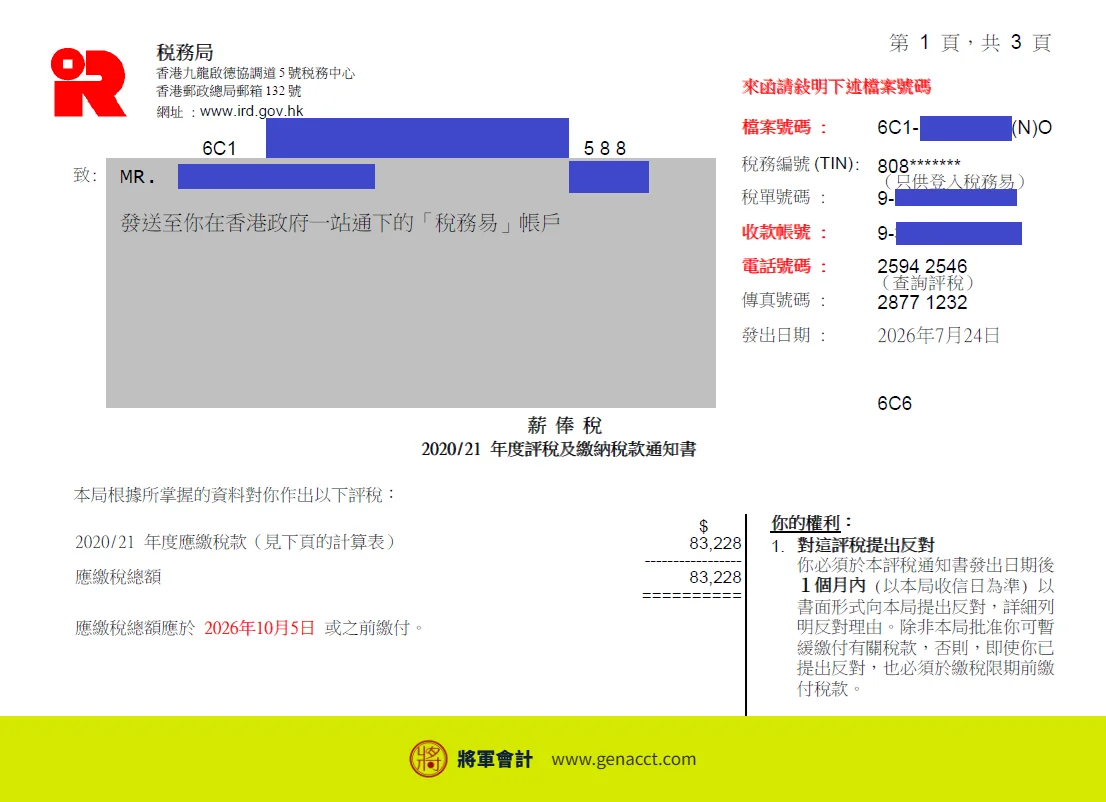
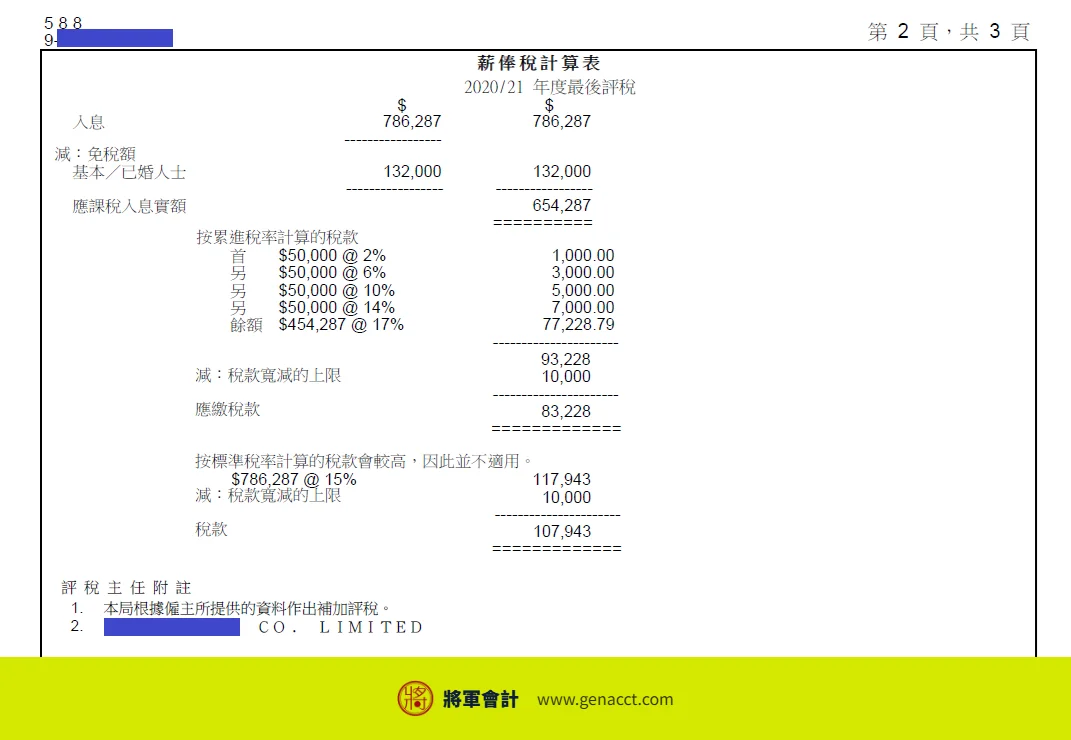
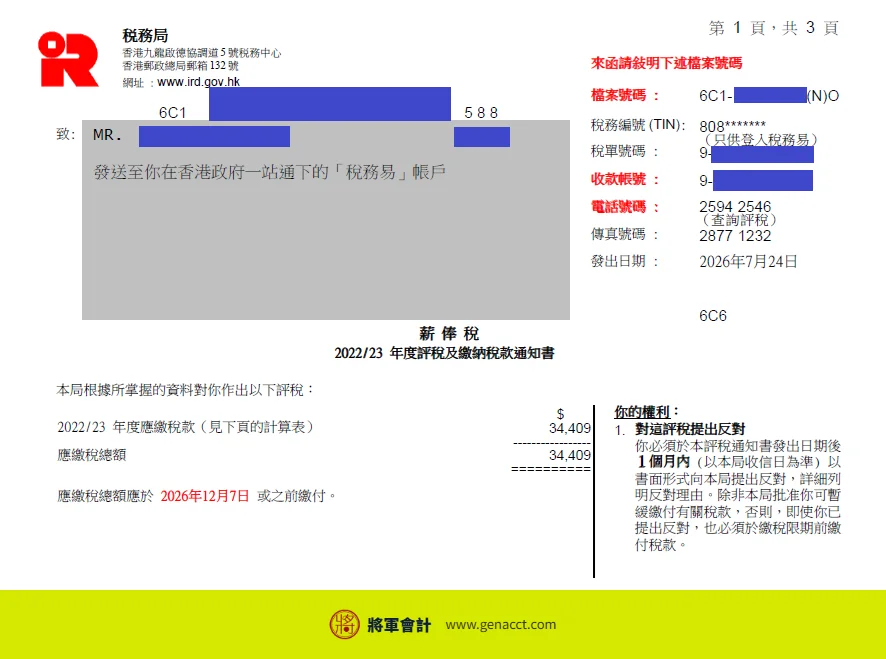
2020/21 Notice of Assessment
2020/21 Demand Note
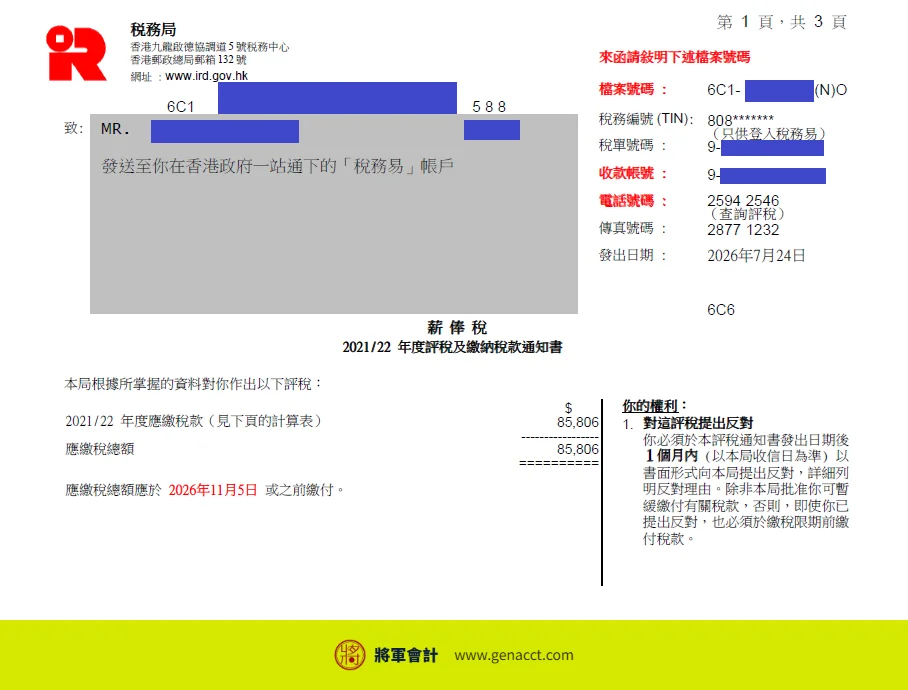
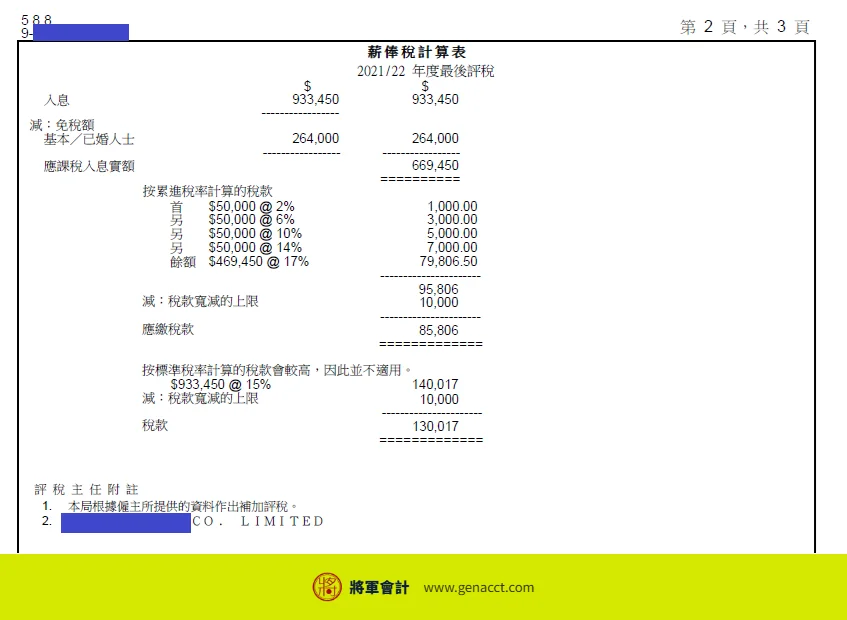
2021/22 Notice of Assessment
2021/22 Demand Note
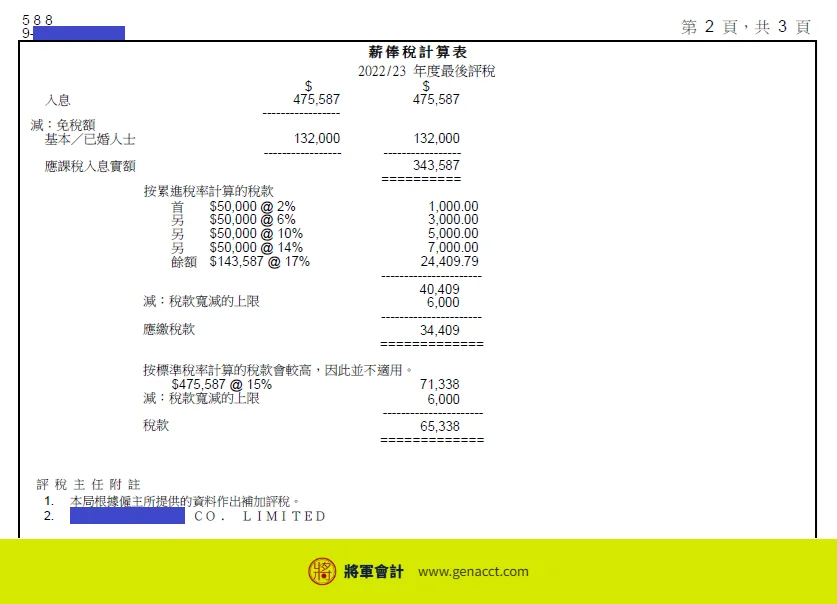
2022/23 Notice of Assessment
2022/23 Demand Note
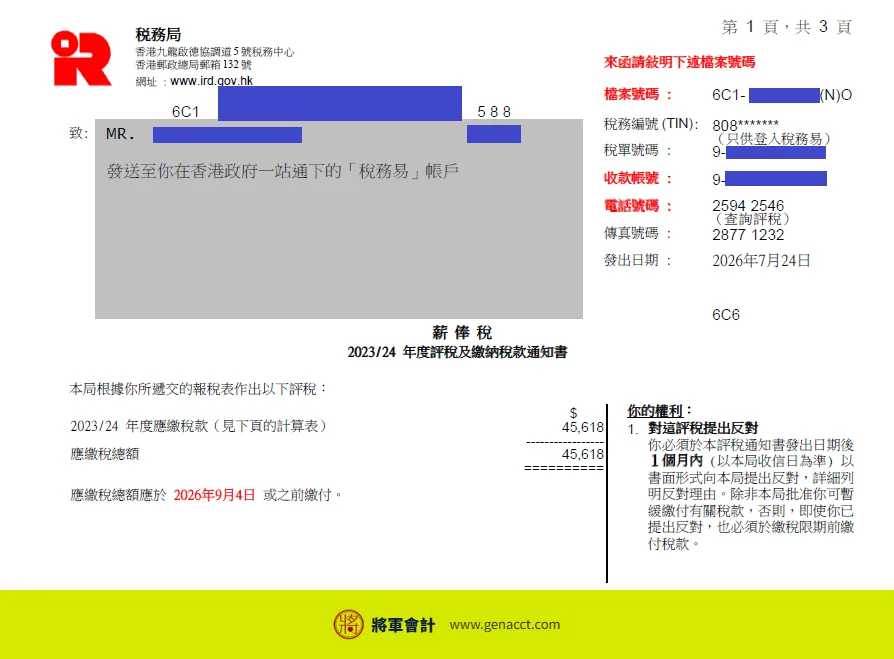
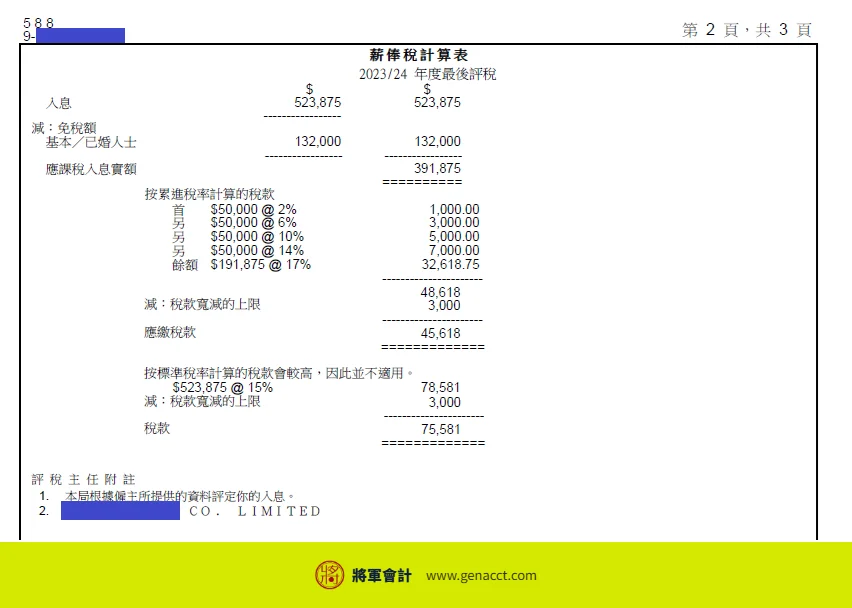
2023/24 Notice of Assessment
2023/24 Demand Note
Three Major Problems Faced by the Individual
Gross Income Calculated as Personal Income: Due to the lack of a BR, related expenses (outsourcing costs) could not be deducted, and the entire income was taxed directly.
Risk of Tax Evasion Penalties: Failing to report income for several consecutive years could be viewed as tax evasion, leading to fines or even criminal liability.
No BR Penalties: Carrying on a business without applying for a BR can lead to additional fines (up to HKD 5,000 + 1 year imprisonment).
The calculation of gross income as personal income is the most direct financial impact. If expenses are not deducted, the tax difference can be substantial:
Year
Service Fees Received
Outsourcing Costs
Actual Profit
Salaries Tax Amount
Profits Tax Amount
Difference
2020/21
HKD 786,287
HKD 586,287
HKD 200,000
HKD 83,228
HKD 5,000
HKD 78,228
2021/22
HKD 933,450
HKD 653,450
HKD 280,000
HKD 85,806
HKD 11,000
HKD 74,806
2022/23
HKD 475,587
HKD 395,587
HKD 80,000
HKD 34,409
HKD 0
HKD 34,409
2023/24
HKD 523,875
HKD 423,875
HKD 100,000
HKD 45,618
HKD 4,500
HKD 41,118
Total
HKD 2,719,199
HKD 2,059,199
HKD 660,000
HKD 249,061
HKD 20,500
HKD 228,561
Note: Tax amounts are after tax reductions – 2020/21 reduction of HKD 10,000; 2021/22 reduction of HKD 10,000; 2022/23 reduction of HKD 6,000; 2023/24 reduction of HKD 3,000.
If the individual pays Salaries Tax, the 4-year cumulative tax is HKD 249,061. If they successfully reclassify to Profits Tax and deduct outsourcing costs, the tax is only HKD 20,500. The difference is as high as HKD 228,561!
How Did the IRD Know? The Power of Form IR56M
What is IR56M?
Many people mistakenly believe that “if I don’t report my taxes, the IRD won’t know.” This is a huge misconception.
The formal name of Form IR56M is “Notification by a Person Other Than a Corporation of Remuneration Paid to Persons Other Than Employees.” Simply put, when a company pays service fees, consultancy fees, intermediary fees, or commissions to an individual, the company must file an IR56M to report it to the IRD.
Common Situations Triggering IR56M:
A company hires an individual consultant (non-employee)
A company pays service fees to a freelancer
A company pays commissions to an intermediary
A company pays lecture fees, royalties, etc., to an individual
Reporting Deadline: Must be submitted to the IRD before April 1st each year.
The IRD’s Auto-Matching System
The IRD requires taxpayers to fill out different tax returns and collects data from various sources for auto-matching. The process is as follows:
Company A files IR56M
      ↓
IRD receives gross amount data
      ↓
System cross-checks if the individual reported it on BIR60
      ↓
System finds no reporting record
      ↓
System automatically triggers tax recovery process
      ↓
Demand notice is issued
Why is “thinking no one will know if I don’t report” wrong?
Key Reason: The paying company will definitely report
To claim tax deductions (listing payments to non-employees as business expenses), the company will certainly report to the IRD. Once the company reports, the IRD knows about your income. The IRD system auto-matches:
IR56B (Employer’s Return of Remuneration)
IR56M (Return of Remuneration to Non-Employees)
BIR60 (Tax Return – Individuals)
Any discrepancy will trigger an investigation. Do not take chances.
Tax Classification Dispute: Why Did the IRD Use Salaries Tax?
The IRD’s Judgment Logic
After receiving the IR56M, the IRD checks the individual’s tax status. In this case:
The IRD found:
The individual received the full amount reported on IR56M
The individual had no Business Registration (BR)
No record of “carrying on a business” in the IRD system
Result: The IRD treated the entire amount reported on IR56M as “remuneration for personal services/salary” and calculated it under Salaries Tax. For details on how to distinguish which tax to report, see Profits Tax vs Salaries Tax for Self-Employed Persons.
Key Differences: Salaries Tax vs Profits Tax
Item
Salaries Tax (Current Situation) ❌
Profits Tax (Target) ✅
Tax Basis
Gross Income
Business Profit (Income − Costs − Expenses)
Outsourcing Costs
❌ Not Deductible
✅ Deductible
Operating Expenses
❌ Not Deductible (Phone, transport, etc.)
✅ Deductible (If compliant)
Tax Rate
Progressive 2%-17% or Standard 15%
Two-tiered: First HKD 2M at 7.5%, remainder at 15%
BR Required
Not Required
✅ Mandatory
Reporting Form
BIR60 Part 4
BIR60 Part 5
Suppose the individual received HKD 523,875 in service fees from Company A in 2023/24, with costs of about HKD 423,875, leaving an actual profit of only about HKD 100,000:
Why are outsourcing costs not deductible under Salaries Tax?
Cost of Goods Sold and Direct Expenses are not within the scope of Salaries Tax deductions. Outsourcing expenses can only be deducted as Deductible Expenses under the Profits Tax framework.
Remedy Methods: Four Key Steps
Received a tax demand letter? Don’t delay; failing to reply within a month could cost hundreds of thousands.
Image: Receiving a tax demand letter; late replies or poor wording could cost hundreds of thousands in tax differences.
Tax demand letters have a reply deadline. If you fail to reply, the IRD will assume you accept the assessment, making it extremely difficult to overturn later. If you reply hastily with improper wording, it may be viewed as “intent to evade tax,” and penalties will double.
The key to this case is reclassifying “personal salary income” as “business profit.” Once successful, outsourcing costs can be deducted, and the tax amount can be significantly reduced. Here are the four key steps:
❌ Error 1: Failing to reply on time, missing the golden month
After receiving a demand notice, the priority is to respond within the deadline. If you do nothing, the IRD has the right to issue the assessment directly, making remedies more costly later. More dangerously, any wording in the reply letter will serve as the basis for future assessments—insufficient reasons or incorrect statements could lead to a “willful tax evasion” classification, increasing the penalty multiplier.
❌ Error 2: Late rectification, missing the key prerequisite
To overturn the “personal salary” classification, the key prerequisite is proving you are “carrying on a business.” Without a BR, the IRD has a reasonable basis to treat the funds as personal service income rather than business earnings. Rectifying years of missing BR involves government levies, late fees, and explaining the business start date to the Business Registration Office. Any mistake here could weaken your entire defense.
❌ Error 3: No invoices for outsourcing costs, no tax deduction
Whether outsourcing costs can be deducted is the fundamental cause of the tax difference in this case. If you cannot provide proof meeting IRD standards, expenses will be excluded, and you will still have to pay tax on the gross income. Many subcontractors may have closed down, be unreachable, or lack formal invoices; submitting non-standard documents (like screenshots or handwritten receipts) is easily rejected by the IRD.
❌ Error 4: Non-compliant accounts, leading to direct rejection
To apply for Profits Tax reclassification, you must submit financial statements for past years and refile BIR60. Accounts that do not comply with Hong Kong accounting standards will be rejected by the IRD and may even lead to warning fines or criminal prosecution.
🛠️ What General Accounting Can Do for You
✅ Draft a formal reply letter for you, using the “intermediary service and outsourcing model” as the entry point to apply for reclassification as business profit.
✅ Handle all procedures for back-applying for BR, including estimating the best cost plan, determining a reasonable business start date, and submitting it to the IRD immediately.
✅ Assist in organizing scattered data such as bank statements, WhatsApp or email correspondence, and transfer records into a “complete chain of evidence” that meets IRD audit requirements.
✅ Prepare compliant business accounts and negotiate with the IRD on your behalf to position the case as an “honest mistake,” striving to minimize the penalty multiplier.
⚠️ Received a tax demand letter? Don’t delay; failing to reply within a month could cost hundreds of thousands.
Tax demand letters have a reply deadline. If you fail to reply, the IRD will assume you accept the assessment, making it extremely difficult to overturn later. If you reply hastily with improper wording, it may be viewed as “intent to evade tax,” and penalties will double. The key to this case is reclassifying “personal salary income” as “business profit.” Once successful, outsourcing costs can be deducted, and the tax amount can be significantly reduced.
📲 Received a tax demand letter?WhatsApp General Accounting now
Expected Results
If remedies are handled correctly:
✅ Successfully reclassified to Profits Tax calculation
✅ Outsourcing costs legally deducted
✅ Tax amount significantly reduced (from hundreds of thousands to tens of thousands)
✅ Penalty multiplier reduced (potentially from 3x to 1x)
⚠️ Tax evasion penalties still apply (though reduced)
⚠️ Late BR application fines still apply
Key Lessons: 3 Essential Tips for Freelancers / Intermediaries
From this case, friends who take personal jobs, act as intermediaries, or freelance must remember these 3 points:
1. Personal jobs do not mean no tax reporting
Myth: No need to report if it’s part-time, low income, just earning a margin, or if no company is opened?
Truth: As long as you carry on a business and earn profit, you must apply for a BR within 1 month of starting. See the Personal Income Tax Guide.
2. Never ignore IR56M (The IRD will definitely know)
Paying companies will inevitably submit IR56M to the IRD for tax deduction. The IRD will auto-match your personal tax return (BIR60); hiding it is 100% likely to be discovered.
3. Keep records for at least 7 years
Income and expense vouchers must be kept for at least 7 years. If you cannot produce proof of expenses, the IRD has the right to refuse deductions for outsourcing costs, and the tax difference can reach hundreds of thousands!
General Accounting’s Advice: The simplest way is to separate personal and business bank accounts, process all income and expenses through the business account, and match records monthly. If bookkeeping feels tedious, let a professional team handle it to save time and avoid potential tax risks!
Prevention is Better Than Cure: The Right Way to Start
If you are preparing to start taking jobs, freelancing, or providing intermediary services, please do it right from the beginning to avoid future trouble.
This real case tells us that the cost of failing to report taxes is extremely high. The individual assumed that “only earning a margin meant no need to report,” resulting in a 4-year tax demand, a multi-fold tax increase, and penalties.
Core Lessons
IRD discovers omissions through IR56M auto-matching: Paying companies will definitely report; do not take chances.
The cost of no BR is extremely high: Gross income is taxed as Salaries Tax, costs are not deducted, and tax can increase 10-fold.
Record-keeping is crucial: Without proof, costs cannot be deducted, and the difference can reach hundreds of thousands.
Early remedies are still possible: Rectifying BR, providing proof, and hiring professional help can lead to Profits Tax reclassification.
Call to Action
If you are currently taking jobs, acting as an intermediary, or freelancing personally, please check immediately:
Have you applied for Business Registration (BR)?
Do you report taxes on time every year?
Do you keep all income and expense records?
If you have received a tax demand notice or have questions about your tax obligations, please contact the General Accounting professional team for assistance.
Yes. IR56M indicates that the payer has reported your income to the IRD, and the system will auto-match to see if you have reported it. Failure to report will trigger a tax recovery process. Even if the amount is small, it must be reported.
I only earn a margin; do I have to report the gross income?
The entire gross income must be reported, but business-related costs (such as outsourcing expenses) can be deducted. The prerequisite is that you must have a Business Registration (BR) and keep supporting records. Without a BR, the IRD will tax the gross income without deducting costs.
What happens if I don't have a Business Registration?
You will face a double blow: (1) The IRD will calculate the gross income under Salaries Tax (no cost deduction), potentially increasing the tax multi-fold; (2) You will be pursued for no-BR penalties, up to HKD 5,000 + 1 year imprisonment, plus back payment of past BR fees.
How much is the penalty for failing to report for several years?
Civil penalties are up to 3 times the undercharged tax; criminal prosecution can lead to a maximum fine of HKD 50,000 + 3 years imprisonment. The actual penalty depends on the circumstances, level of cooperation, and whether disclosure was voluntary.
Can I still rectify the situation after receiving a tax demand notice?
Yes, but you must act immediately. Remedy steps: (1) Reply to the IRD within 1 month; (2) Rectify the BR; (3) Provide proof of outsourcing costs (bank records, invoices, contracts); (4) Hire a professional tax representative to assist in negotiations. Success can lead to Profits Tax reclassification and significantly reduced tax.
How many years back can the IRD go?
Generally 6 years; in cases of willful tax evasion, it can go back 10 years. The 4-year recovery in this case is well within the statutory limit.
What if I don't have invoices for outsourcing costs?
The IRD has the right to disallow the expense, resulting in tax on the gross income. You must keep all records for at least 7 years. If they are truly lost, you can try: (1) Contacting subcontractors for replacement proof; (2) Providing bank transfer records along with WhatsApp/Email correspondence; (3) Any documents proving the outsourcing relationship. However, the success rate is lower.
Do I have to open a company to take personal jobs?
Yes. Taking personal jobs constitutes carrying on a business, and you must apply for a Business Registration (BR); however, "opening a company" specifically refers to forming a Limited Company. The key difference: a Sole Proprietor operates under their own name with a BR, income is taxed under personal Profits Tax, and they have unlimited legal liability—suitable for freelancers just starting with simple business and low income. A Limited Company is a separate legal entity where shareholders' liability is limited to their capital contribution—suitable for those with higher income, brand positioning, financing needs, or a desire to lower personal tax risk. Summary: "BR is mandatory (otherwise illegal), a Limited Company is strongly recommended (asset protection + tax planning space)." For details, refer to Differences Between Limited and Unlimited Companies.
General Accounting has been established for over 20 years and holds a Trust or Company Service Provider licence (TC002940). We provide comprehensive BR management services, including BR renewal reminders, address changes, business cessation, and all related tax matters.
Senior Consultant at General Accounting, specialising in Hong Kong company incorporation and company secretarial matters, with over 10,000 incorporation and compliance cases handled.
Founded in 2005, General Accounting holds a Trust or Company Service Provider licence issued by the Hong Kong Companies Registry, licence no.
TC002940,
regulated under the Anti-Money Laundering and Counter-Terrorist Financing Ordinance.