

#Start a Company, #Company Account Opening, #離岸公司
A Director’s Certificate of Incumbency (Certificate of Incumbency, or COI)is a key document for planning to open an offshore company bank account, conducting cross-border transactions, or meeting financial institutions’ compliance requirements. This article explores the multiple uses of COI, why it is essential for opening an offshore company account, and the full application process and required documents for obtaining a Director’s Certificate of Incumbency.
For more details: Offshore Company Registration Services
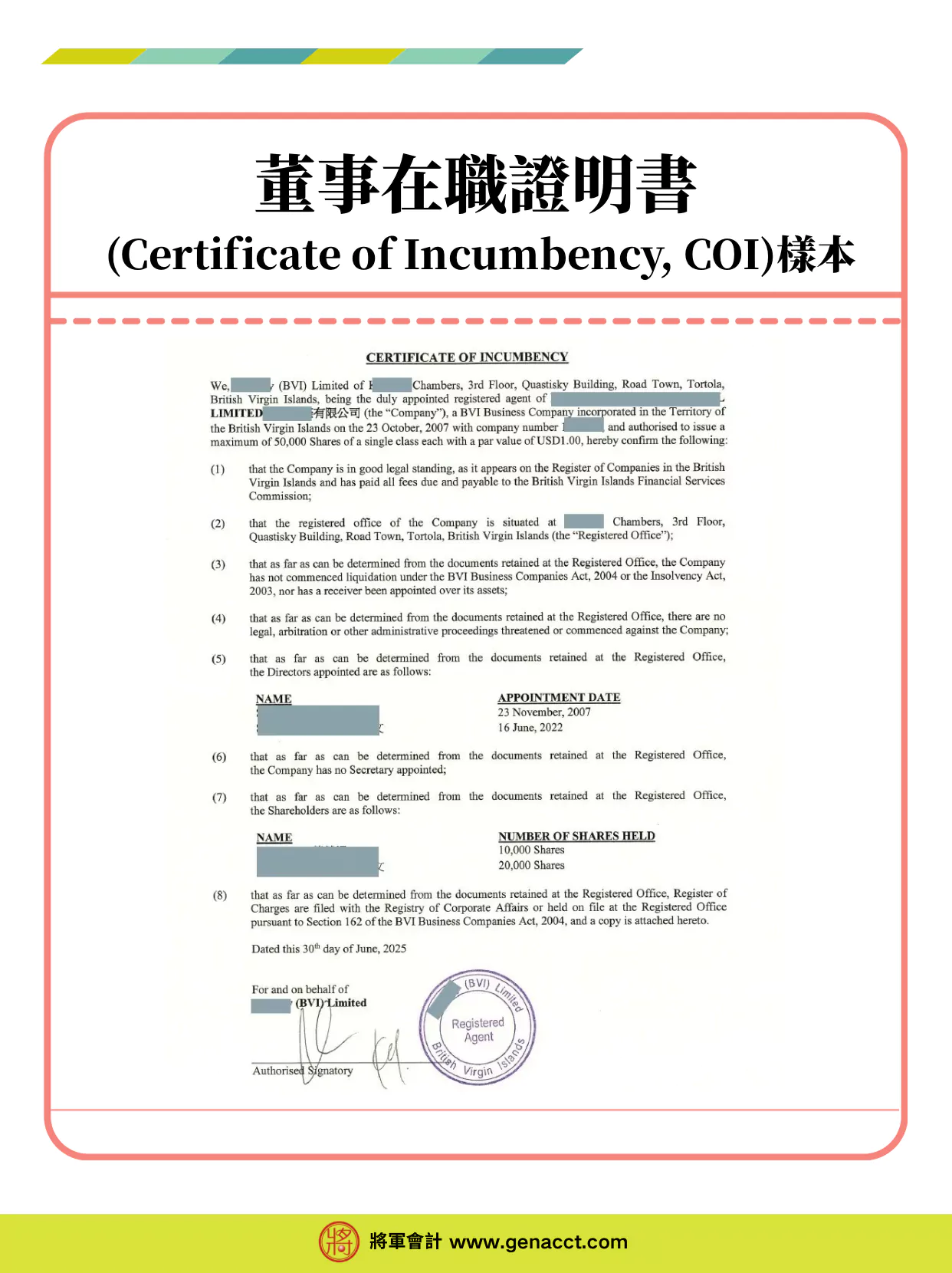
What information does a Certificate of Incumbency include?
A Director’s Certificate of Incumbency (COI) has no fixed format. Within a reasonable scope, clients may draft the Certificate of Incumbency content themselves or use the registered agent’s standard template.
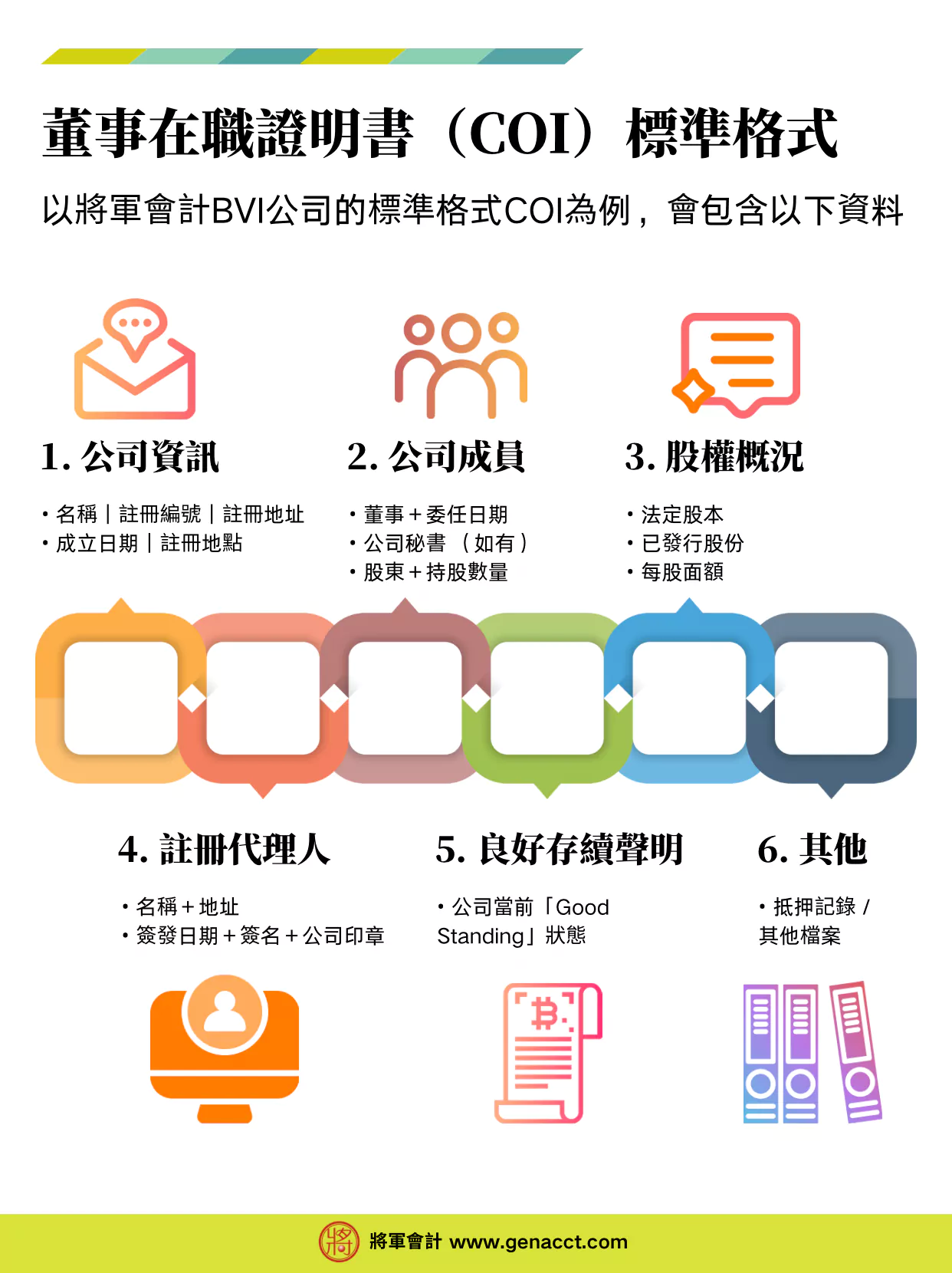
Using General Accounting’s standard COI format for a BVI company as an example, it includes the following information:
Company information
Company name, company registration number, registered address, incorporation date, and place of registration.
Company member information
Current directors and their appointment dates, company secretary information (if any), shareholders’ names, and number of shares held.
Shareholding information
The company’s authorised share capital, number of shares issued, and par value per share.
Registered agent information
Registered agent name, registered address, and issue date, signed by the agent and affixed with the company seal.
Good Standing statement
A statement confirming whether the company is in “Good Standing.”
Other
Whether the company has any charges registered or other documents on file.
What is a Director’s Certificate of Incumbency (COI) used for?
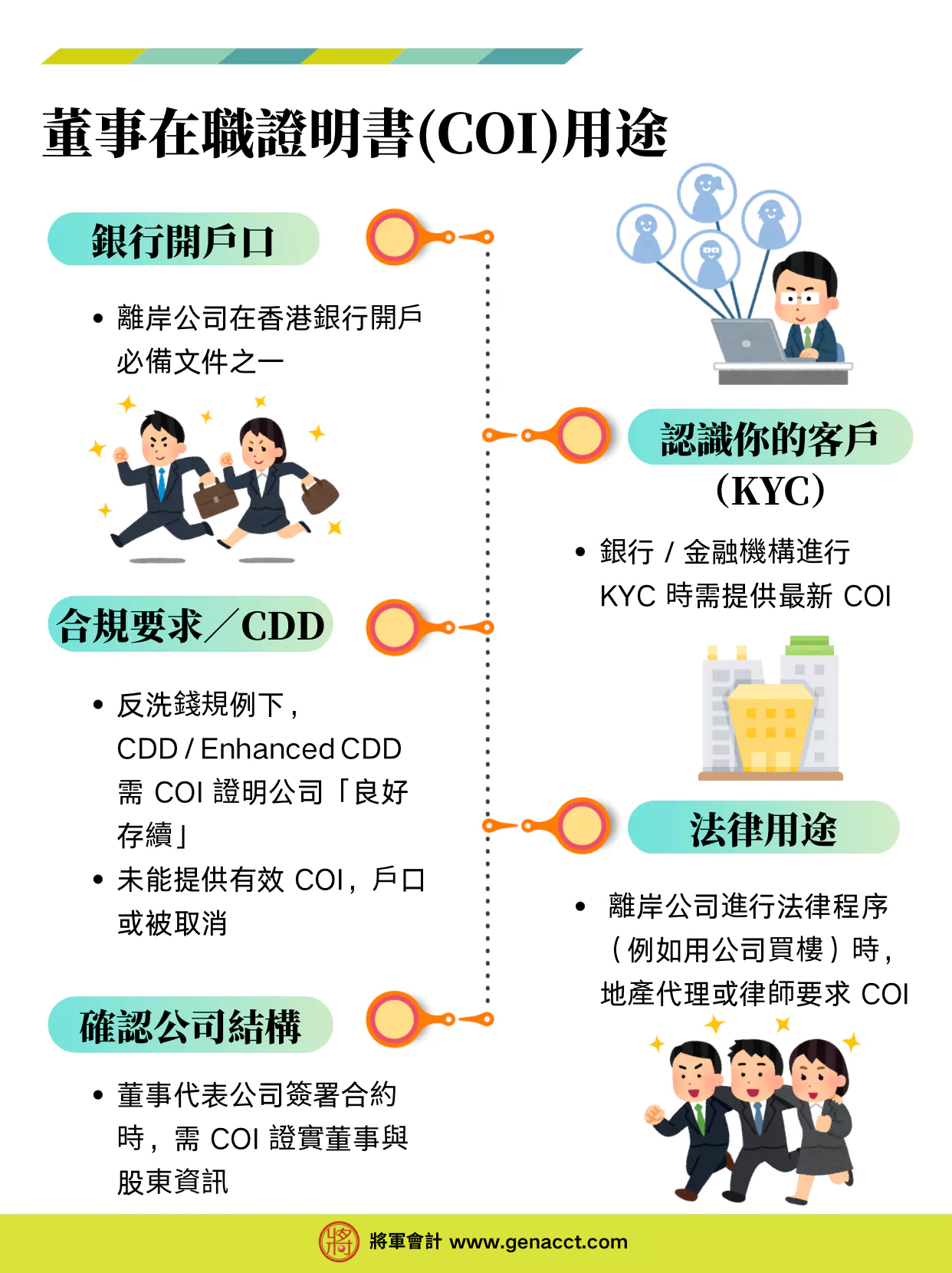
Opening a bank account
When an offshore company needs to open a bank account in Hong Kong, a Director’s Certificate of Incumbency (COI) is one of the required documents and is the most common use of a COI.
Know Your Customer (KYC)
Banks or financial institutions require clients to provide the latest Director’s Certificate of Incumbency when conducting Know Your Customer (KYC) procedures.
For example, under General Accounting’s limited company incorporation services, if a Cayman company holds the shares, or in a share transfer of a limited company where the transferee is a Seychelles company, we will require the client to provide the offshore company’s Certificate of Incumbency.
Compliance requirements / proving the company’s legal existence
Banks, financial institutions, or any regulated entity must conduct ongoing standard Customer Due Diligence (CDD) or Enhanced CDD under anti-money laundering regulations. If the corporate structure involves an offshore company, the client must provide a COI to prove the company’s latest structure and that it is in “Good Standing.”
If a valid COI cannot be provided, the company account may be closed by the bank.
Legal purposes
If an offshore company needs to undertake legal procedures, such as purchasing property in the company’s name, both estate agents and solicitors will require the company to provide a Director’s Certificate of Incumbency.
Further reading: Benefits and process of buying and selling property in a company name
Confirming the company structure
When directors need to act on behalf of the company—for example, signing contracts as a director—they must provide a valid Certificate of Incumbency to prove the company’s director and shareholder information.
Why is a Certificate of Incumbency important for opening an offshore company account?
Because an offshore company is not incorporated in Hong Kong, banks cannot verify its structure and status through Hong Kong company searches. They must rely on documents such as a Certificate of Good Standing issued by the local government and a Certificate of Incumbency issued by the registered agent to confirm the company’s information and authenticity.
Therefore, a Certificate of Incumbency is an indispensable document for opening an offshore company bank account.
Further reading: The complete guide to KYC and CDD: Understand the differences between Know Your Customer and Customer Due Diligence
Documents required to open an offshore company account
To open an offshore company bank account, banks generally require the following documents:
- Company registration certificate
- “Director’s Certificate of Incumbency” issued by the company’s registered agent
Certificate of Incumbency issued by the company’s registered agent - Certificate of Good Standing
- Memorandum and Articles of Association
- Business supporting documents: including invoices, business contracts, trade documents, transaction records, and office/shop lease agreements or land registry search records for owned properties to prove the company’s operating status
- Identity and address proof documents of directors and shareholders
- Board resolutions
- Register of shareholders and register of directors /
- Corporate structure chart: if the company involves multiple holding layers, it must clearly show the shareholding relationships at each level up to the ultimate beneficial owner.
How to apply for a Certificate of Incumbency?
You may apply directly to the company’s registered agent. The procedure is as follows:
Step 1: Application requirements
Submit the application and confirm the COI content or request the standard version.
Step 2: Payment
Pay the service fee.
Step 3: Review the draft
You will receive a draft of the Director’s Certificate of Incumbency in about 2–3 business days and must review the information carefully.
Step 4: Completion
After confirming the content is correct, you will receive the original Certificate of Incumbency in about 2–3 business days.
Director’s Certificate of Incumbency (COI) fees
Fees vary by jurisdiction. For example, a BVI company COI typically costs around USD 200–300, while a Cayman company Certificate of Incumbency typically costs around USD 400–600. Please refer to the registered agent’s quotation for details.
Frequently Asked Questions
Conclusion
General Accounting offers free consultation


