

#Profits Tax, #Corporate tax returns, #Corporate Tax Filing Tutorial, #利得稅
For a limited company operating in Hong Kong, tax filing is not only a statutory obligation but also a key part of corporate governance. Under the Hong Kong Companies Ordinance and Inland Revenue Ordinance, the financial statements of all limited companies must be audited by a practising accountant (CPA) , and submitted together with the audit report with the Profits Tax Return. This article breaks down the latest 2026 tax filing procedures, tax rate calculations, and common pitfalls to help you stay compliant with ease.
2026 Hong Kong Limited Company Profits Tax Rates
Hong Kong adopts a “two-tier profits tax” regime, which is particularly beneficial for SMEs. The structured tax rates are as follows:
| Profit band | Profits tax rate |
|---|---|
| First HK$2 million of profits | 8.25% |
| Profits exceeding HK$2 million thereafter | 16.5% |
Example calculation: If a company’s assessable profits are HK$3 million, the first HK$2 million is taxed at 8.25% (HK$165,000), and the remaining HK$1 million is taxed at 16.5% (HK$165,000). Total tax payable is HK$330,000, with an effective tax rate of only 11%.
⚠️ Professional reminder: If the same shareholder owns multiple companies, only one of them can enjoy the half-rate concession. Be sure to confirm the filing approach with your accountant in advance.
Limited Company Tax Filing Process
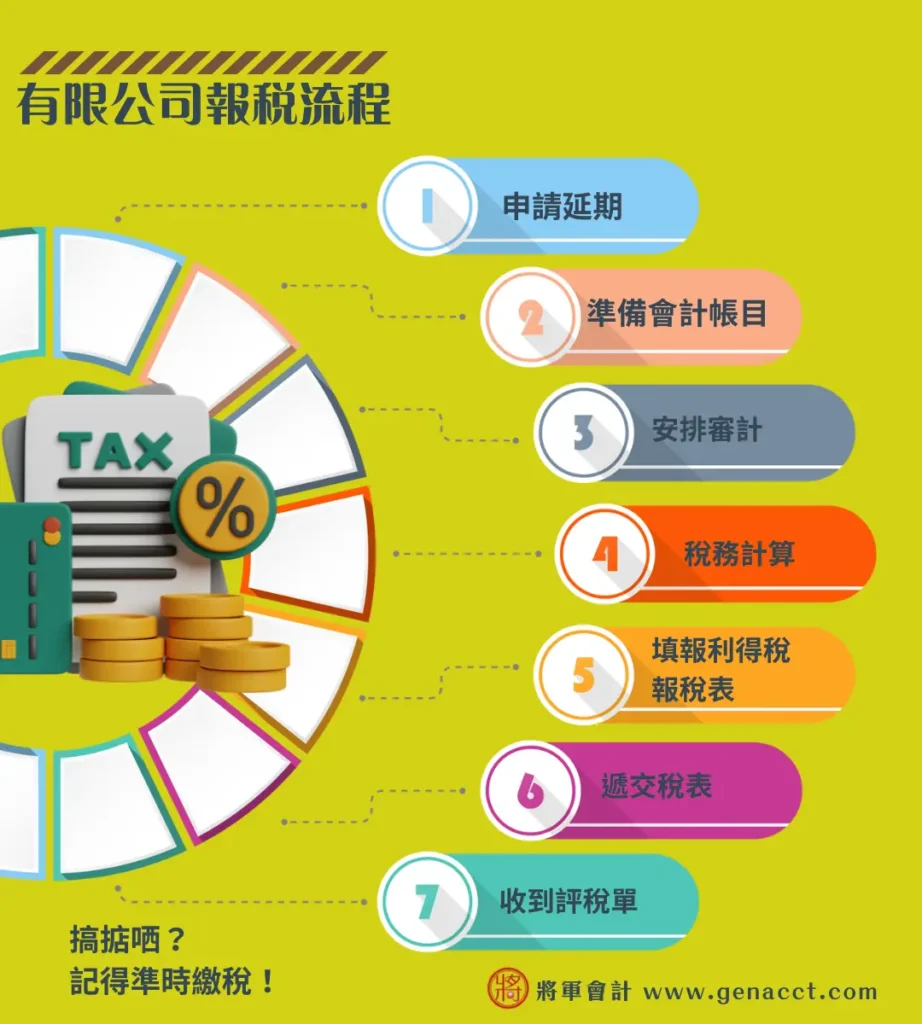
To ensure you do not miss the deadline, it is recommended to follow the standardized workflow below:
- Apply for an extension: After receiving the BIR51 tax return, contact your tax representative immediately to apply for an extension.
- Organize accounting records: Compile annual invoices, bank statements, and expense receipts.
- Arrange an audit (Audit): Submit the accounts to a practising accountant for the statutory audit and signing of the report.
- Tax computation: A tax adviser calculates assessable profits based on the audit results (tax profits are not the same as accounting profits).
- Complete the BIR51 form: Fill in the tax return based on the tax computation.
- Official submission: Submit the signed tax return, audit report, and profit and loss statement to the Inland Revenue Department.
- Receive the assessment: The Inland Revenue Department will issue a notice of assessment in about 3 months.
- Pay tax (if applicable): Verify the amount and pay within the deadline to complete the annual tax obligations.
Essential Document Checklist for Limited Company Tax Filing
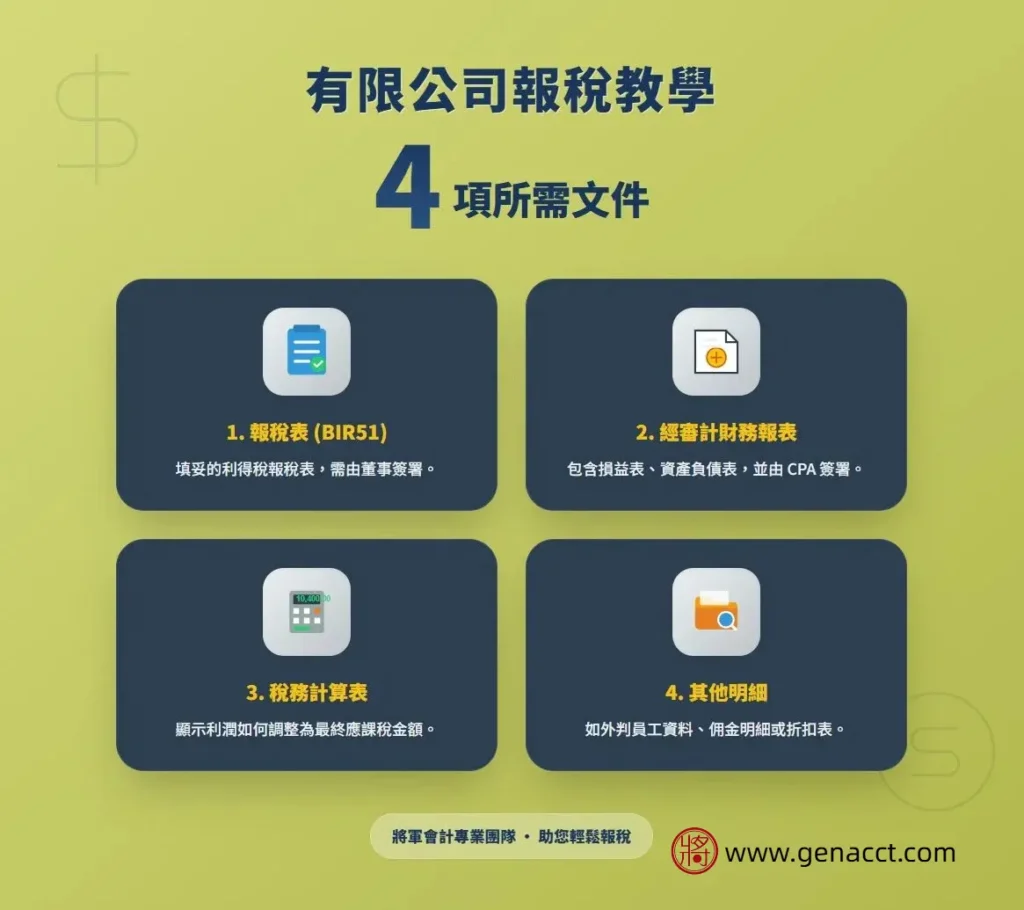
When submitting the Profits Tax Return, the following supporting documents must be attached; otherwise, the submission will be regarded as invalid:
- Completed Profits Tax Return (BIR51)
- Audited financial statements: Including the profit and loss statement and balance sheet, signed by a CPA
- Tax computation (Tax Computation): Showing how profits are adjusted to the taxable amount
- Other schedules: Such as outsourced staff information, commission breakdowns, or discount schedules
Further reading:
2026 Tax Return Issuance Timeline
- Newly incorporated companies: The first tax return is usually issued about 18 months after incorporation and must be filed within 3 months.
- Existing companies: The Inland Revenue Department typically issues returns in bulk on April 1 each year.
Common Mistakes Made by New Business Owners
Many entrepreneurs face penalties due to misunderstandings of legal requirements. Please refer to the table below:
| Common mistake | Correct approach | Expert recommendation |
|---|---|---|
| No business means no need to file taxes | Unless you have applied to be a "dormant company", you must still file | Submit a no-operations audit report and the tax return |
| No need to file if the company is making a loss | If you receive a tax return, you must file; filing does not mean paying tax | Declared losses can offset future profits and help avoid penalties |
| If you don’t receive a tax return, you can ignore it | Proactively contact the Inland Revenue Department or your tax representative to identify the cause | An incorrect address or postal error is not a valid reason for late filing |
| Mistaking NAR1 for tax filing | NAR1 is the Annual Return filed with the Companies Registry | They are entirely different in nature—do not confuse them |
Further reading:
Frequently Asked Questions on Limited Company Tax Filing
Conclusion
This latest 2026 guide provides a comprehensive breakdown of the core requirements and procedures for limited company tax filing. Key highlights include:
- Regulatory requirements: Under the Companies Ordinance, a limited company must prepare financial statements and an audit report audited by a practising accountant (CPA) before submitting the Profits Tax Return.
- Two-tier tax rates: The first HK$2 million of profits is taxed at 8.25%, and any excess is taxed at 16.5%.
- Standardized process: Tax filing covers 8 key steps, from applying for an extension and organizing accounting records to arranging an audit and submitting the BIR51 form.
- Pitfall avoidance: For new business owners, it clarifies common misconceptions such as “you must file even with no business activity” and “the Annual Return (NAR1) is not the same as tax filing.”
- Professional services: General Accounting provides one-stop professional support, from transparent pricing to representing clients in handling tax enquiries.
General Accounting has been established for over 20 years and provides limited company tax filing services. Trust or Company Service Provider licence no.: TC002940. If you have any questions about company tax filing, our professional Client Service Managers can provide free initial tax filing consultation support.
General Accounting provides free consultation


