
Many startups mistakenly believe that “no income” allows them to submit a “Nil Return” directly to the Inland Revenue Department (IRD). However, according to the new arrangements implemented by the IRD starting April 1, 2023, all companies that are not “dormant companies” are not permitted to file a “Nil Return” and must submit their Profits Tax Return together with audited financial statements.
Simply put, the prerequisite for nil reporting is that the company has officially applied to the Companies Registry and become a “dormant company.” Incorrectly filing a nil return without meeting the criteria can lead to very serious consequences. This article explains in detail the basic concept of nil reporting, the conditions for applying for dormant status, and a complete compliance checklist for non-operating companies.
Snapshot of Government Fees for 2026-27
- Business Registration (1-year): HKD 2,350 (Registration fee HKD 2,200 + Levy HKD 150)
- Business Registration (3-year): HKD 6,170 (Registration fee HKD 5,720 + Levy HKD 450)
- NAR1 Timely Submission: HKD 105
- NAR1 Overdue (42 days to 3 months): HKD 870
- NAR1 Overdue (3 to 6 months): HKD 1,740
- NAR1 Overdue (over 9 months): HKD 3,480
Can I file a nil return if the company has no business operations?
No. Even if a company has no business operations or income, it cannot submit a Profits Tax Return via nil reporting unless it has successfully applied to the Companies Registry to become a “dormant company.” Under the new arrangement effective April 2023, all non-dormant companies must submit their tax returns along with audited financial statements; otherwise, even if “0” is reported, it may be considered non-compliant, potentially triggering tax audits or penalties.
If you have just established a company, it is recommended to first understand the 5 major traps of registering a Hong Kong company to avoid common pitfalls.
What is Nil Reporting? How does it differ from a Dormant Company?
What is Nil Reporting?
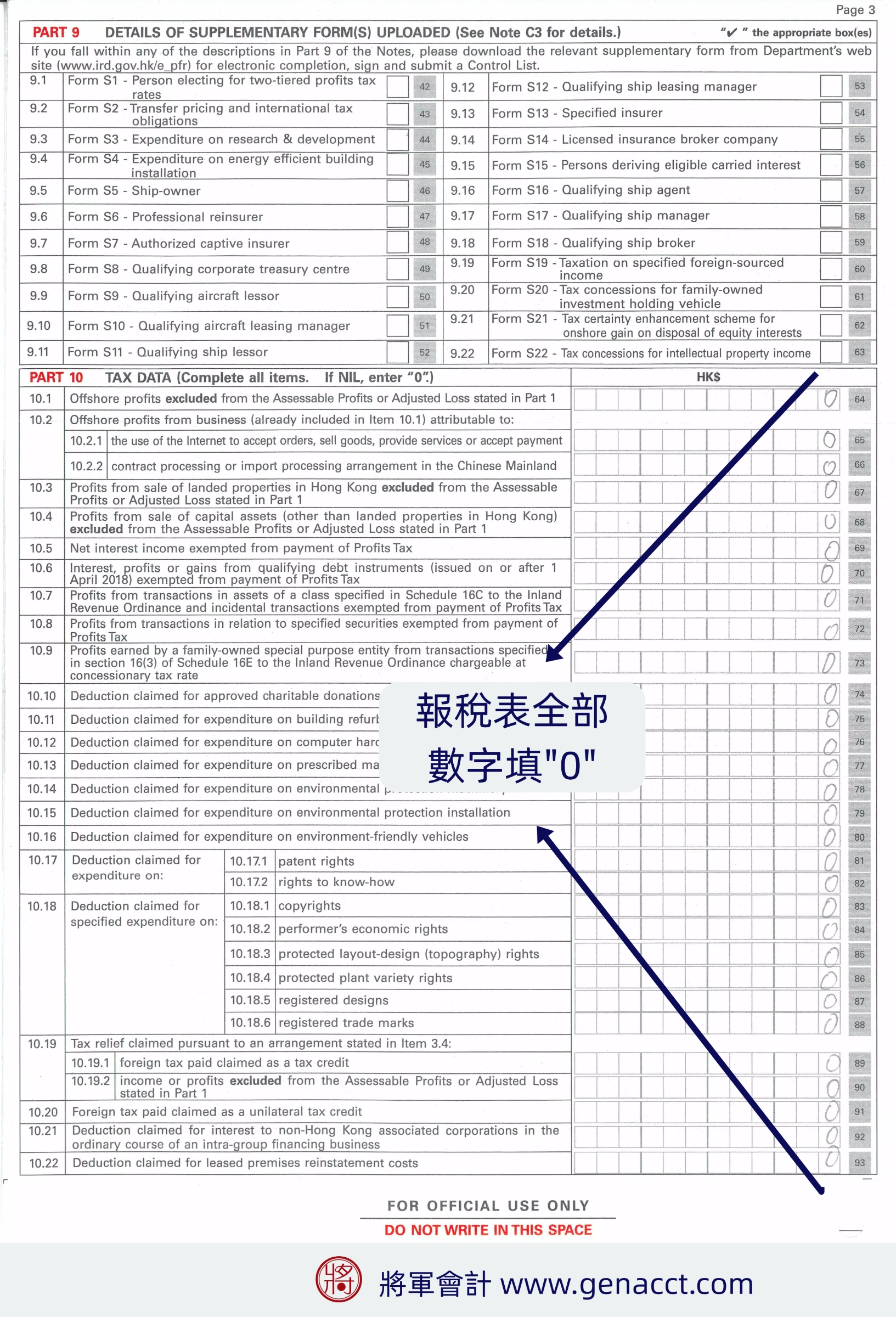
Nil reporting refers to filling in “0” in all fields on the Profits Tax Return (BIR51). The company will not conduct an audit for that financial year, nor will it submit an audit report, profit and loss account, tax computation, or other supporting documents.
What is a Dormant Company?
A dormant company is a company that has applied to the Companies Registry under the Companies Ordinance (Cap. 622) and officially become a “dormant company.” This is not an automatic status; it must be approved via a special resolution of shareholders and strictly meet multiple conditions.
If you want to clarify the basic definitions first, you can continue reading below.
The core difference between the two is:
- Nil Reporting is a method of tax filing
- Dormant Company is a legal status of a company
Without “dormant company” status, you cannot perform nil reporting.
New IRD Arrangement Since 2023: Non-dormant companies cannot file nil returns
According to the new arrangement implemented on April 1, 2023, the Inland Revenue Department clearly stipulates: except for companies that are dormant under the Companies Ordinance (Cap. 622), all corporations must submit audited financial statements when filing their tax returns.
This means:
- Even if the company has zero income and zero expenses for the whole year
- Even if there are no transactions in the bank account
- As long as it is not a “dormant company”
- It must perform bookkeeping, auditing, and file a complete tax return
5 Conditions for Applying for Dormant Status
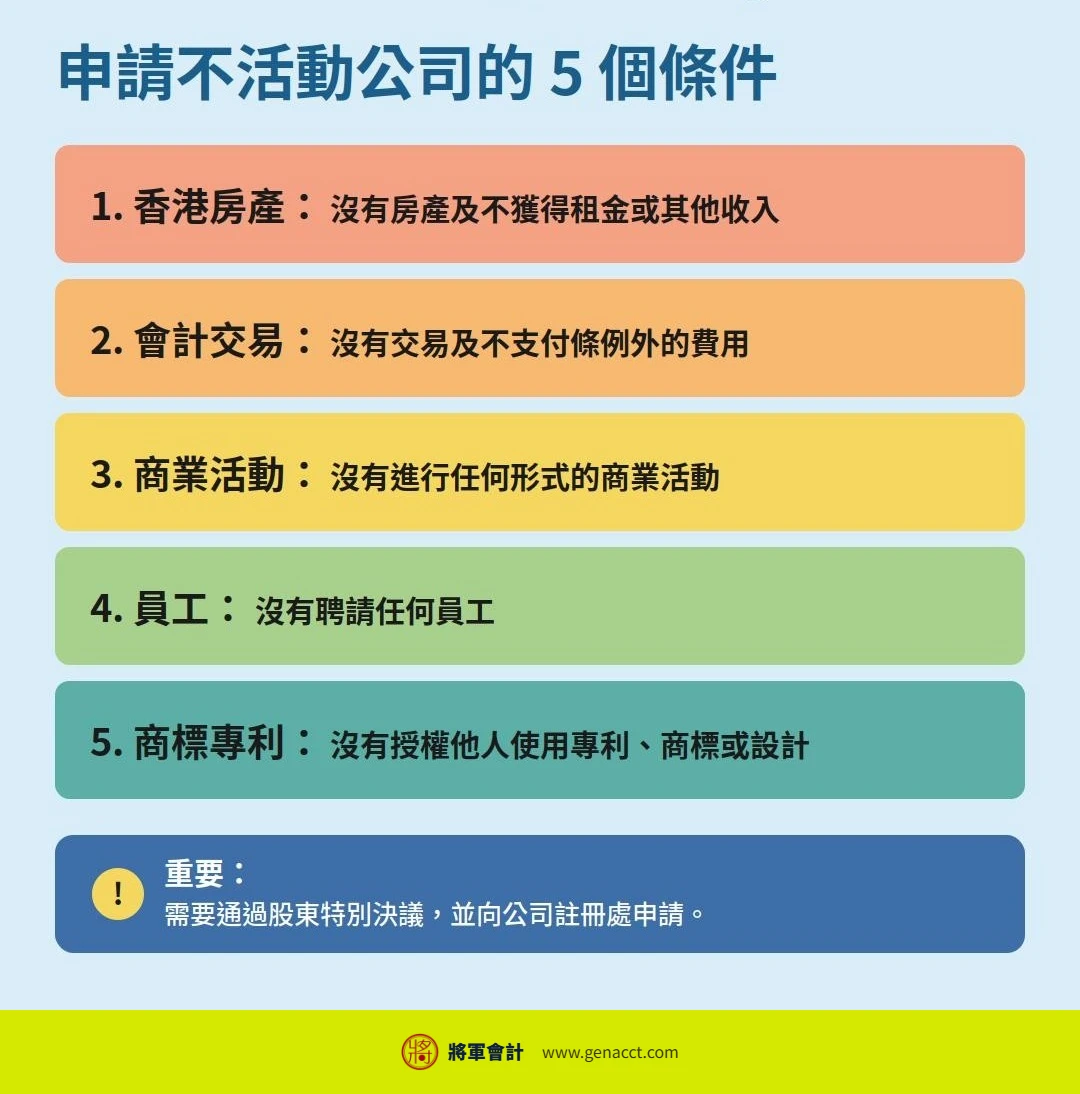
For a company to legally submit a tax return via nil reporting, the primary condition is that it has become a “dormant company.” According to the regulations of the Companies Registry, all of the following conditions must be met:
- Has not purchased or leased any real estate in Hong Kong, nor authorized others to use movable property in Hong Kong to obtain rent or other income
- Cannot enter into accounting transactions, and cannot pay any fees other than those specified by the Ordinance
- Has not engaged in any form of business activity
- Has not hired any employees
- It has not authorised others to use any patents, trademarks, or designs.
In addition to meeting the above conditions, the company also needs to pass a special resolution of shareholders before it can apply to the Companies Registry to become a dormant company (Companies Ordinance Cap. 622).
Compliance Checklist for Non-operating Companies: BR / NAR1 / Tax Filing / Audit
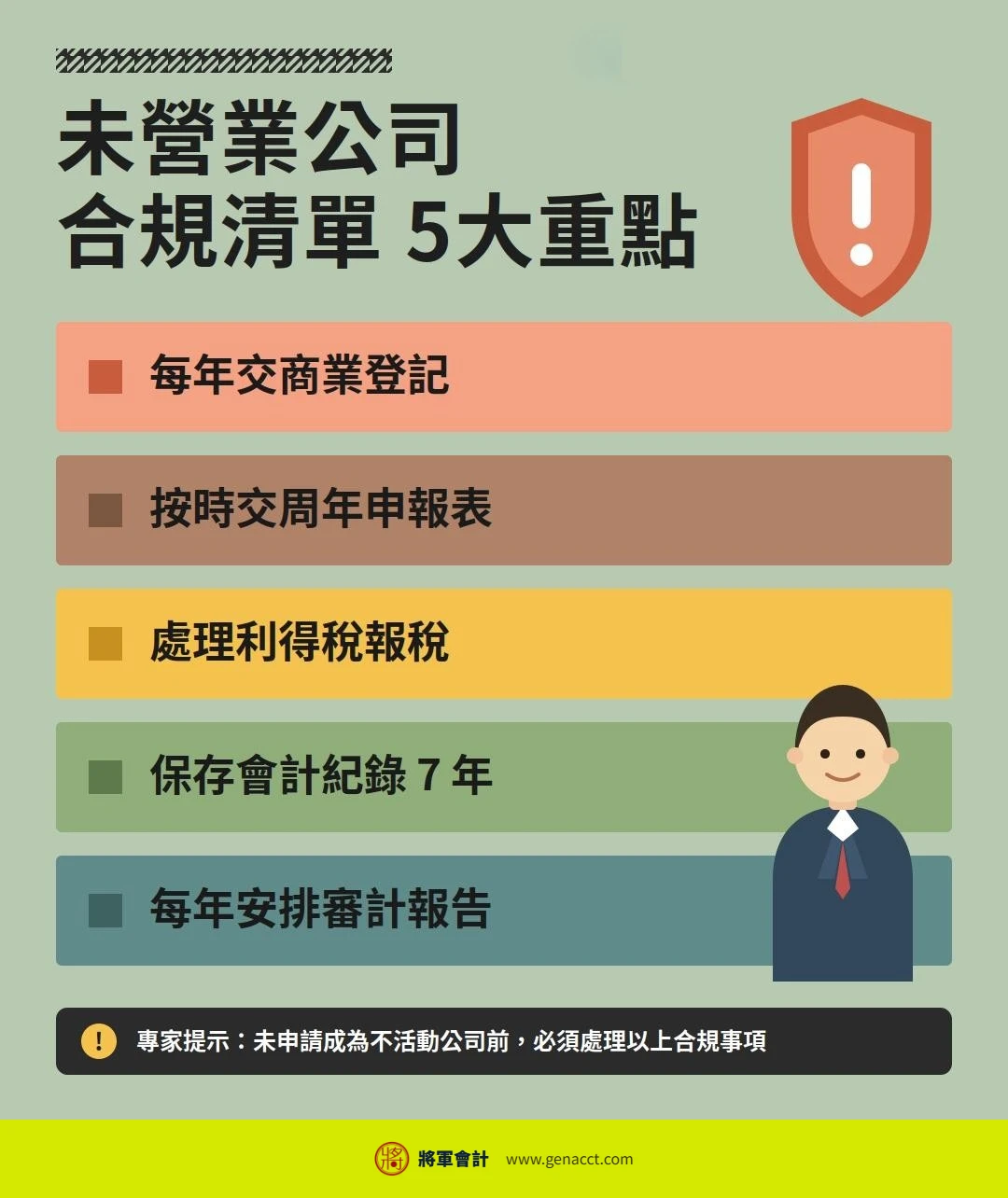
If a company has not applied to become a dormant company, it must complete the following compliance matters even if it has no business operations throughout the year:
| Compliance Item | Responsible Authority | Deadline / Requirement | Fee | Consequences of Violation |
|---|---|---|---|---|
| Business Registration (BR) | Inland Revenue Department (IRD) | Renew before expiry | 1-year cert HKD 2,350; 3-year cert HKD 6,170 | Late penalty from HKD 300; max HKD 5,000 and 1 year imprisonment |
| Annual Return (NAR1) | Companies Registry (CR) | Within 42 days of the anniversary of incorporation | On time HKD 105 | Escalating late penalties HKD 870–3,480; also subject to prosecution |
| Profits Tax Return (BIR51) | Inland Revenue Department (IRD) | Within 1 month from the date the IRD issues the return | No official fixed fee (depends on accounting/audit services) | Late or incorrect filing may trigger assessment/penalties; if eligible, can apply for tax filing extension |
| Accounting Records | Maintained by the company | Retain for at least 7 years | No official fixed fee | Violation carries a max fine of HKD 100,000 + 6 months imprisonment |
| Audit Report | Licensed CPA | Submit together with the tax return | No official fixed fee (depends on CPA charges) | Failure to submit may lead to the IRD rejecting the tax return |
⚠️ Important Reminder
The above government fees are based on the 2026-27 year. The 1-year Business Registration certificate fee for 2026-27 is HKD 2,350 (Registration fee HKD 2,200 + Levy HKD 150), and the 3-year certificate is HKD 6,170.
For the business registration application process, please refer to: Business Registration for Limited Companies.
For common errors in NAR1, please refer to: Common Errors in NAR1 and New Annual Return.
For the tax filing process for normally operating companies, please refer to: Limited Company Tax Filing Guide.
How to file taxes if the company has no income but does not meet nil reporting criteria?
If a company has not applied to become a dormant company, it must follow the formal tax filing process even if there is no business for the entire year:
- Accounting/Bookkeeping: Prepare a profit and loss account (even if the figures are zero or only consist of administrative expenses)
- Conduct Auditing: Appoint a licensed CPA to perform an audit and prepare an audit report
- Complete Tax Return: Fill in all fields of BIR51 according to the company accounts
- Submit Documents: Submit the completed Profits Tax Return together with the audit report, tax computation, and supporting documents to the IRD
The key point is: no income does not mean you can file a nil return; the key lies in whether the company has “dormant company” status.
Common Misconceptions: 6 Traps of Nil Reporting
| Misconception | Correct Practice |
|---|---|
| Thinking that no income allows for direct nil reporting | Must first apply for dormant status; otherwise, audited financial statements are still required |
| Thinking that dormant companies do not need to submit NAR1 | Dormant companies are exempt from submitting annual returns (Section 5(1) of the Companies Ordinance), but must still meet dormant conditions; if status terminates, compliant filing should resume immediately |
| Thinking that having no employees allows for nil reporting | If there are no employees, it is only the Employer’s Return that is filed as a nil return |
| Thinking that no money transfers between group companies allows for nil reporting | Any money transfers within a group may be considered as requiring an audit |
| Thinking that incorrect nil reporting only results in resubmitting documents without criminal liability | It may be regarded as tax evasion; serious cases may involve criminal liability |
Conclusion
Many startups mistakenly believe that “no operations” equals “nil reporting,” but in reality, unless the company has successfully applied for “dormant company” status, it must submit an audit report and complete tax filing documents even without income. Since 2023, the IRD has explicitly stipulated that non-dormant companies cannot file a “0 return.” Becoming a dormant company requires meeting several conditions, such as no bank account activity and no business activities, and passing a shareholder resolution. Failure to report taxes truthfully may lead to tax audits or penalties. Companies should clearly understand their tax obligations to avoid misreporting.


