
#Business Registration Application, #Start a Company, #BR
The franchise market in Hong Kong began in 1970, starting with McDonald’s and KFC. According to estimates by the Hong Kong Franchise Association, approximately 43% of franchise projects in Hong Kong are in the catering industry, 20% in retail, and 37% provide other services (such as tutoring centers and laundries).
Franchising, commonly known as joining a franchise to start a business, is one of the business models many entrepreneurs consider when starting out. This article shares essential information such as precautions, pros and cons, advantages and disadvantages, and whether it is necessary to incorporate a company for franchise stores.
Further Reading: Company Incorporation | Company Incorporation Costs
What is a Franchise?
A franchise is a common business model where a franchisor authorizes a franchisee to use registered trademarks, proprietary technology, and intellectual property through a contract. The operator must pay franchise fees, joining fees, ongoing royalties, and other expenses in exchange for mature business resources.
Do I need to incorporate a company for a franchise?
The answer is yes. A franchise is not a subordinate relationship between a headquarters and a branch, but rather a B2B (Business-to-Business) independent commercial collaboration.
- Business Registration is Mandatory: A franchisee must establish a relationship with the headquarters as a corporate entity; therefore, they must apply for a Business Registration Certificate.
- “Limited Company” Recommended: Unless otherwise required by the franchisor, it is recommended to sign the contract in the name of a “Hong Kong Limited Company.”
- Reason: A limited company is an independent legal entity with clear shareholding, and shareholders only bear limited liability for debts, which effectively isolates personal asset risks.
Further Reading: What is the difference between a Director and a Shareholder? | Responsibilities and Duties of a Hong Kong Company Director?
Should I apply for a franchise store as a limited or unlimited company?
This depends on the franchisor’s requirements. If there are no specific requirements, we recommend applying for and signing the franchise contract in the name of a Hong Kong limited company. This is because a limited company is an independent legal entity with clear shareholding, legal independence, limited liability, and advantages in asset management.
For more on the benefits of a Hong Kong limited company, please visit: [Benefits of a Limited Company] Why open a Hong Kong limited company? 10 major benefits of registering a limited company
6 Steps of the Franchising Process
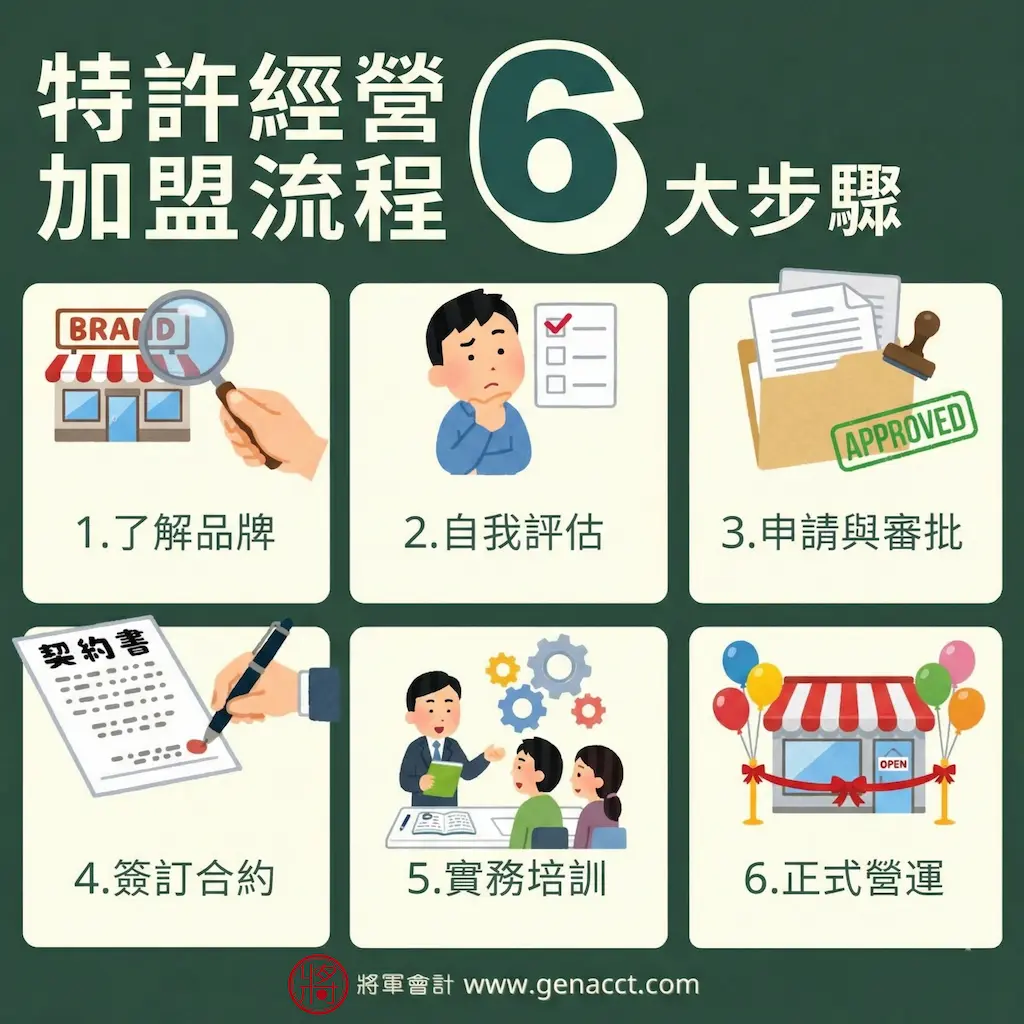
Step 1: Understand the Franchise Brand
Attend seminars for different franchise stores to understand the business model, cooperation period, joining fees, royalty fees, and administrative costs such as advertising fees.
Step 2: Self-Assessment
Determine if you have sufficient capital for investment, understand the required cash flow for the franchise, and evaluate your personal time, experience, skills, and commitment.
Step 3: Application and Approval
Submit an application to the franchisor; you may also need to provide guarantees or proof of funds.
Step 4: Sign the Contract
Complete the company registration procedures and sign the franchise contract to formally establish the relationship. Both parties must fulfill their rights and obligations according to the contract.
Step 5: Practical Training
Participate in training provided by the franchisor, such as professional skills, business models, staff training, and operational logic.
Step 6: Formal Operation
After completing the training, you can begin operations. You will need to report turnover to the franchisor regularly and undergo evaluations, while also receiving business support.
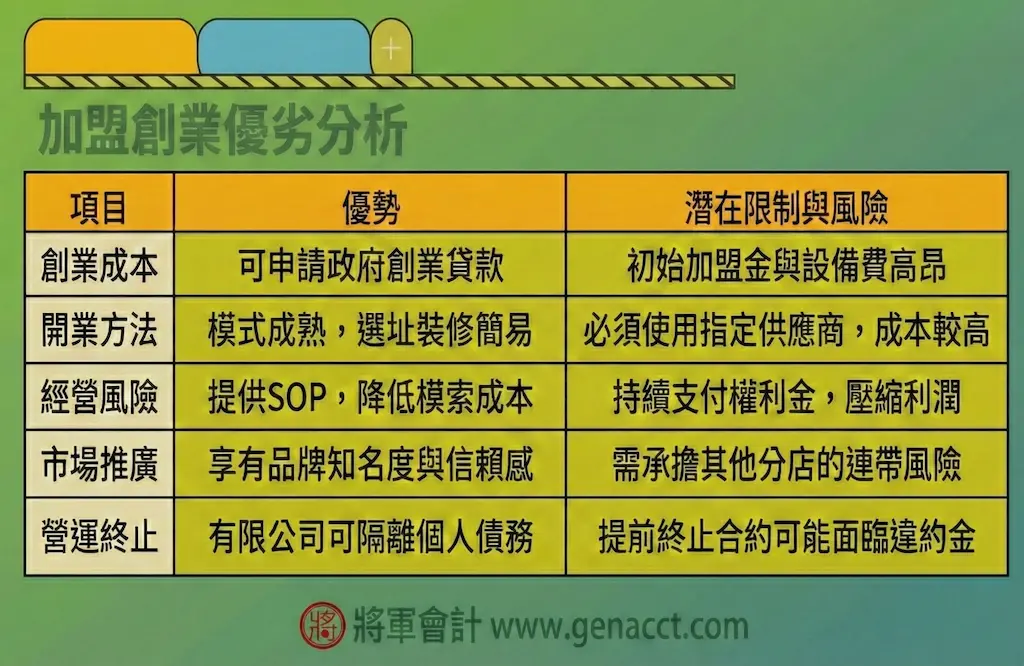
Pros and Cons of Franchising
| Category | Advantages | Disadvantages / Potential Limitations and Risks |
|---|---|---|
Startup Costs | Advantage in Obtaining Funds Applying for a Business Registration Certificate according to the law helps in applying for government-provided startup funds, such as the "Youth Entrepreneurship and Startup Loan". | High Initial Investment Requires a non-refundable initial franchise fee, as well as high costs for decoration and equipment. |
Business Setup Method | Simple Setup Procedures No need to worry about trivial matters like site selection, equipment, and decoration. Can immediately use the operational model established by the franchisor, which is easy to learn and operate. | Restricted Setup Methods Must use the decoration style, equipment, or raw material suppliers, product pricing, and operational SOPs designated by the headquarters (franchisor/brand), which may increase setup costs. |
Ongoing Operational Risks and Costs | Standardization and Low Risk The headquarters provides comprehensive assistance with store opening SOPs, site selection, decoration, marketing, and training, reducing initial exploration costs and failure risks. | Ongoing Financial Pressure Requires payment of royalties (usually a percentage of revenue), advertising funds, brand maintenance fees, and other administrative expenses, squeezing the net profit margin. |
Marketing and Promotion | Reliable Brand and Trust Can immediately leverage the established brand awareness and experience of the franchisor, saving the time and cost of building market trust. | Associated Brand Risks Must bear the reputational and revenue risks caused by poor management at the headquarters or other branches within the system (e.g., food safety crises). |
Operational Guidance and Training | Continuous Support The headquarters provides ongoing operational guidance, technical support, and business training, offering immediate assistance when difficulties arise. | Information Asymmetry and Pitfalls The headquarters may exaggerate revenue figures, or expand too rapidly leading to overlapping trade areas and market saturation, triggering price wars among franchisees. |
Business Termination Liability | Limited Company Liability If established as a limited company, shareholders have limited liability for company debts, effectively isolating personal asset risks. | High Cost of Contract Termination Unless the headquarters is in breach or fraudulent, if a franchisee terminates the business early due to losses, the headquarters may claim "incomplete performance" and demand compensation for the loss of expected profits (penalty fees). |
Further Reading: Beware of the 5 Major Traps in Registering a Hong Kong Company
Examples of Famous Local Franchise Brands in Hong Kong
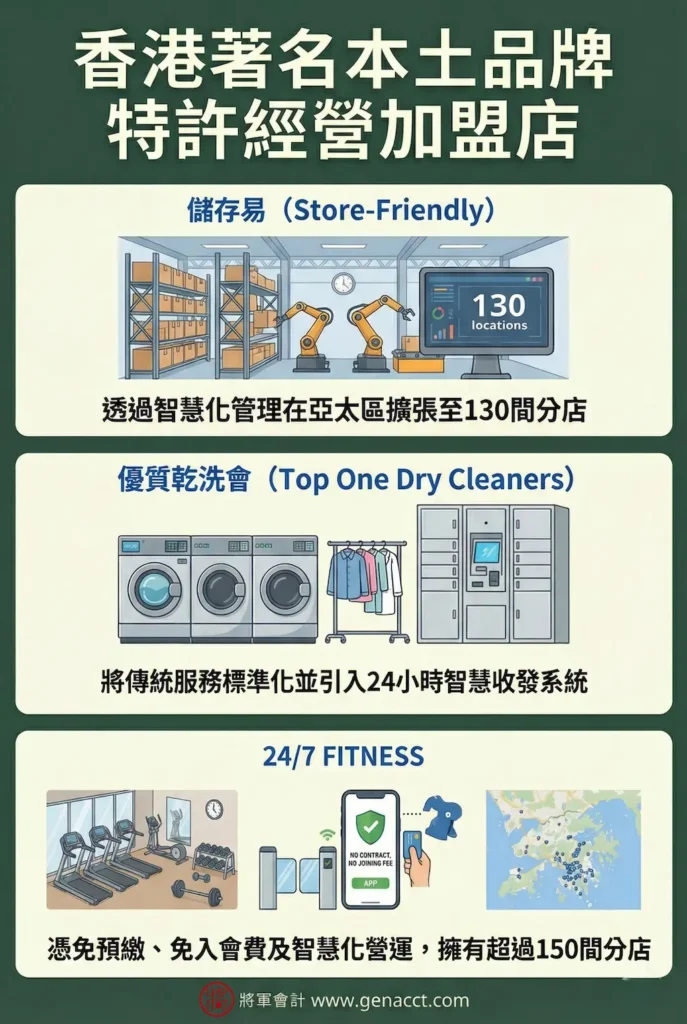
Store-Friendly Self Storage Group
Brand Reputation and Leadership
Strong brand effect effectively reduces customer acquisition costs for franchisees, allowing them to stand out in the fragmented storage market.
Smart Standardized Management
Introducing automated and unmanned technologies such as Store-Friendly Go, and providing standardized branch planning, 24-hour security systems, and temperature control standards to maintain a high-quality user experience.
Diverse Business Model Support
Providing franchisees with site selection analysis, interior design advice, and unified central customer service and marketing support to help reduce operational difficulty and increase space occupancy rates.
All-round Marketing
Maintaining high brand exposure through online and offline advertising and multi-channel marketing strategies to ensure new stores can quickly enter a stable revenue period.
Market Status
As of 2026, Store-Friendly Self Storage Group has over 130 branches in Hong Kong, Macau, Taiwan, Singapore, and Vietnam.
Top One Dry Cleaners
Professional Stain Removal and Material Technology
Investing in advanced eco-friendly dry cleaning machines and stain removal technology capable of handling expensive leathers, designer handbags, and special fibers.
Smart Collection and Delivery System
Introducing 24-hour self-service lockers or booking collection and delivery services via a mobile app to solve the problem of office workers finding it difficult to match branch opening hours due to long working hours.
Strict Quality Control
Establishing unified Standard Operating Procedures (SOPs), from item inspection and classification to final packaging, reducing the risk of lost items common in traditional laundries.
Franchise Support
Providing franchisees with complete operational manuals, staff training, and central laundry support to lower the technical barrier for franchisees.
Market Status
As of 2026, Top One Dry Cleaners has dozens of branches in major residential areas and shopping malls across Hong Kong, becoming one of the largest professional dry cleaning chains in the city.
24/7 FITNESS
Founded in 2018, 24/7 FITNESS is one of the fastest-growing fitness chains in Hong Kong. Success factors for the 24/7 FITNESS brand include:
Smart Unmanned Management
Introducing a facial recognition entry system and automated lighting and air-conditioning monitoring to achieve 24-hour self-service operation.
Transparency and No-Contract Model
Pioneering a system of “no prepayment, no joining fee, and transparent monthly fees,” successfully eliminating consumer fear of “hard selling” common in traditional gyms.
High-Density Site Selection and Multi-Club Access
Branches are concentrated in convenient locations between residential and commercial buildings. Members only need one card to access all branches in Hong Kong and overseas.
Standardized Interior Planning and Equipment
The headquarters provides unified industrial-style space design and procurement support for top global brands (such as Life Fitness and Hammer Strength) of fitness equipment.
Market Status
As of 2026, 24/7 FITNESS has over 150 branches in Hong Kong, Macau, Mainland China, Taiwan, and Singapore.
Frequently Asked Questions
Conclusion
Hong Kong franchisees and headquarters share an independent B2B (Business-to-Business) cooperative relationship rather than a subordinate one. Entrepreneurs must apply for a Business Registration Certificate as a corporate entity and are strongly advised to register a “Hong Kong Limited Company” to sign the franchise contract. Through the independent legal entity status and limited liability of a limited company, entrepreneurs can effectively isolate personal asset risks and ensure a clear shareholding structure.
In the franchise process, entrepreneurs should strictly follow the 6 major steps from self-assessment and signing the contract to practical training, and properly weigh pros and cons such as brand benefits and ongoing franchise fees. Referring to successful brand cases like 24/7 FITNESS or Store-Friendly, standardized management and legal compliance are the keys to long-term stable operation.
General Accounting was established over 20 years ago and possesses more than 30 years of extensive experience in tax and business consulting. We provide professional Hong Kong company registration, franchise business arrangements, and compliance consulting services. We hold a Trust or Company Service Provider License No.: TC002940, and our professional strength is trustworthy.
If you have any questions regarding joining a franchise, business registration, or “Incorporating a Company for a Franchise,” our professional customer service managers can provide free preliminary inquiries for entrepreneurship and company registration to help you easily take the first step in your business venture.
General Accounting provides free consultation


