
![[Objecting to an Assessment] Tax appeal for miscalculation: reasons, deadlines, online guide, and IR831 form essentials](https://www.genacct.com/wp-content/uploads/2024/09/20251107155856_300_189.webp)
#薪俸稅, #Personal Allowances, #Personal Assessment
What should you do if you want to object to an assessment? This is a common question from clients after receiving a tax bill where the tax payable differs from what they expected. We recommend first identifying the root cause—was income calculated incorrectly, was the tax return filed incorrectly, were allowances or deductions omitted, or was the assessment made incorrectly by the Inland Revenue Department?
Next, address the issue based on the reason for the discrepancy—by requesting a revision of the assessment, lodging an objection to the assessment, or filing an appeal for an incorrect assessment.
Further reading: Hong Kong Provisional Tax Guide | Salaries Tax calculation, Personal Assessment, and a quick guide to allowances and deductions
What is an objection to assessment?
An objection to assessment is a taxpayer’s right. Under Cap. 112 Inland Revenue Ordinance, section 64 , whether it is Profits Tax, Salaries Tax, or Property Tax, a taxpayer who considers an assessment to be incorrect may, within the statutory time limit for appealing an assessment, apply to the Commissioner of Inland Revenue to lodge an objection and request a re-examination or revision of the assessment.
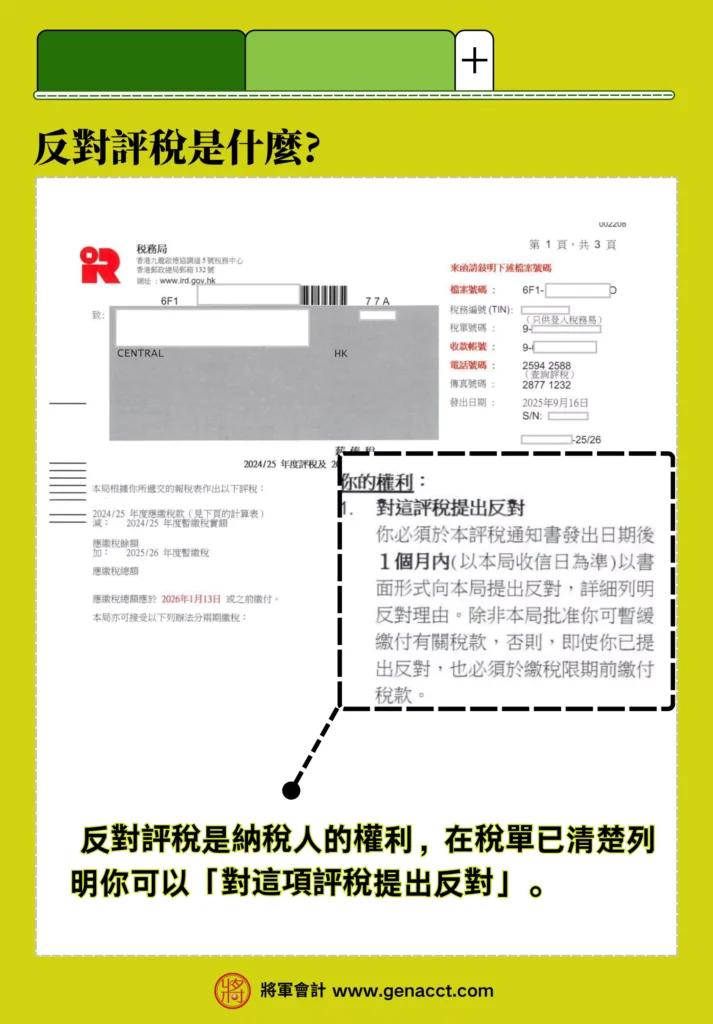
Using the above image as an example, the tax bill clearly states, under item 1, “Object to this assessment.”
What are the grounds for an appeal for incorrect assessment? Reasons for objecting to an assessment
- Estimated assessment: The taxpayer did not file the tax return within the deadline, and the Inland Revenue Department issued an estimated assessment.
- Incorrect income: including overstated salary, overestimated rental income, excessive assessable profits, and failure to take business losses into account.
- Expenses not allowed as deductions: underreported, incorrectly reported, or omitted deductible expenses.
- Allowances: underreported, incorrectly reported, or omitted allowances.
- Forgot to elect for joint assessment: a married person did not elect for joint assessment on the return.
- Other reasons: for example, tax was not computed at “standard rate.”
Further reading: What are the benefits of joint assessment for couples? A guide for married persons on completing the tax return
Time limit for lodging an objection to assessment
If a taxpayer needs to lodge an objection to an assessment, they must submit an objection/revision application to the Inland Revenue Department within one month from the date of issue of the notice of assessment. For example, if the notice of assessment is issued on January 21, 2026, the deadline to lodge an objection is February 20, 2026.
Important: Objections filed after the deadline require supporting reasons and evidence, and the Inland Revenue Department may refuse late objection applications.
Can you lodge an objection after the deadline? Reasons for late objection to assessment
Yes, but you must provide reasonable grounds and supporting evidence(1). You should state the reason for late submission in the last section of Form IR831, and the Commissioner of Inland Revenue will consider whether to accept the late objection grounds and application.
Reasons for late objection may include being outside Hong Kong, illness, or other reasonable circumstances that prevented you from lodging an appeal within the deadline. Note that, in addition to being reasonable, you must also provide supporting documents such as a medical certificate.
For example, if the reason for late objection is that you were outside Hong Kong, you will need to provide immigration records for the Commissioner’s consideration.
Process for lodging an objection to assessment

Confirm the deadline
You must submit the application in writing, via Form IR831, or through your ITP account within one month from the date of issue of the notice of assessment (tax bill)。
State the grounds for objection
For example, incorrect profits for Profits Tax, overestimated income for Salaries Tax, or overestimated rental income for Property Tax.
Prepare supporting documents
Provide supporting documents corresponding to your grounds for objection. For example, if the estimated assessment was issued because you did not file the tax return (section 59(3) of the Inland Revenue Ordinance), you must submit the completed tax return together with your objection for it to be valid.
Submission methods
You may lodge an objection to assessment through the following methods. Regardless of the method used, you should also provide the relevant supporting documents.
Complete Form IR831 or submit in writing
You may clearly state the grounds for objection in writing, or submit the objection application using Form IR831. After signing, return it to the Inland Revenue Department:
Mailing address:
Commissioner of Inland Revenue, P.O. Box 28777, Kowloon Central Post Office, Hong Kong
Fax number: 2877 1232
ITP account
You may submit a notice of objection via the Taxpayer Portal (ITP) for Salaries Tax, Property Tax for solely owned properties, and/or Profits Tax assessments for sole proprietorship businesses.
Submit the notice of objection electronically
Submit the notice of objection electronically; more details on submitting electronic information.
Acknowledgement of receipt
The Inland Revenue Department will acknowledge receipt in about 18 days.
Await review
During this period, you may be asked to provide additional information.
Done
If the IRD accepts the appeal, it will issue a revised notice of assessment and a new demand note or a tax refund cheque. The taxpayer only needs to pay the revised amount of tax.
More details: When will the tax refund cheque be issued?
4 key steps to apply online for an objection to assessment
Taxpayers may also apply online to lodge an objection to assessment via the Taxpayer Portal (ITP). For an ITP guide, please refer to: Taxpayer Portal (ITP) account guide

Step 1: Request to lodge an objection
Log in to the ITP website, go to “Request to lodge an objection,” and click “Continue.”

Step 2: Specify the assessment
Select the year of assessment and the tax type you wish to object to, then click “Request to lodge an objection.”
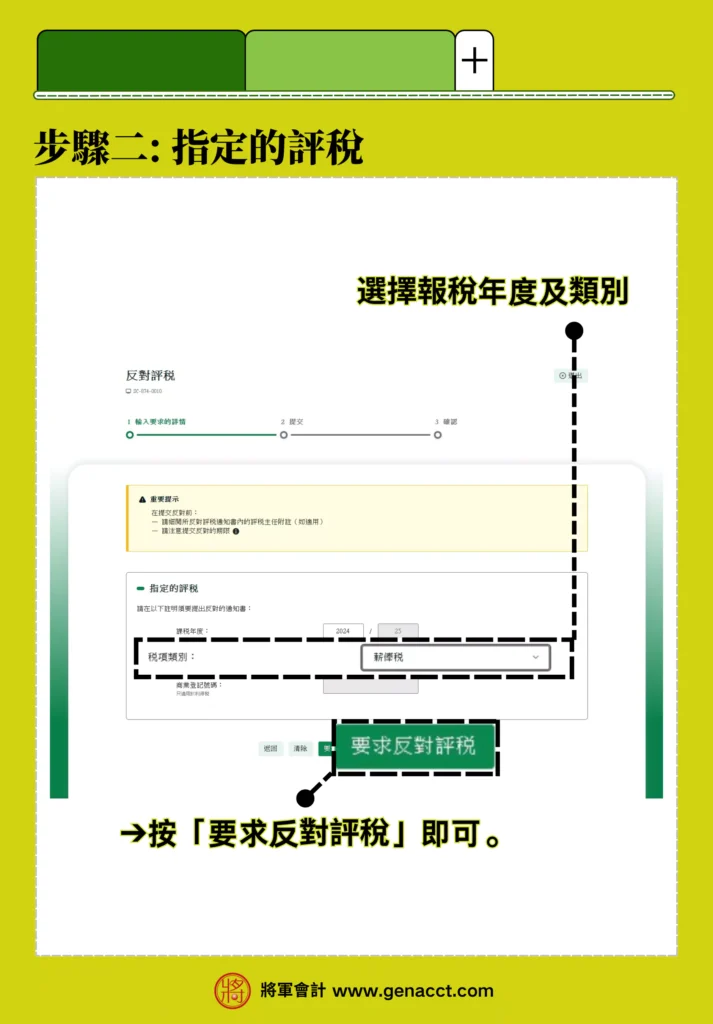
Step 3: Provide the grounds for objection
Enter the grounds for objection, then click “Attach” at the bottom left to upload supporting documents, and click “Continue.”
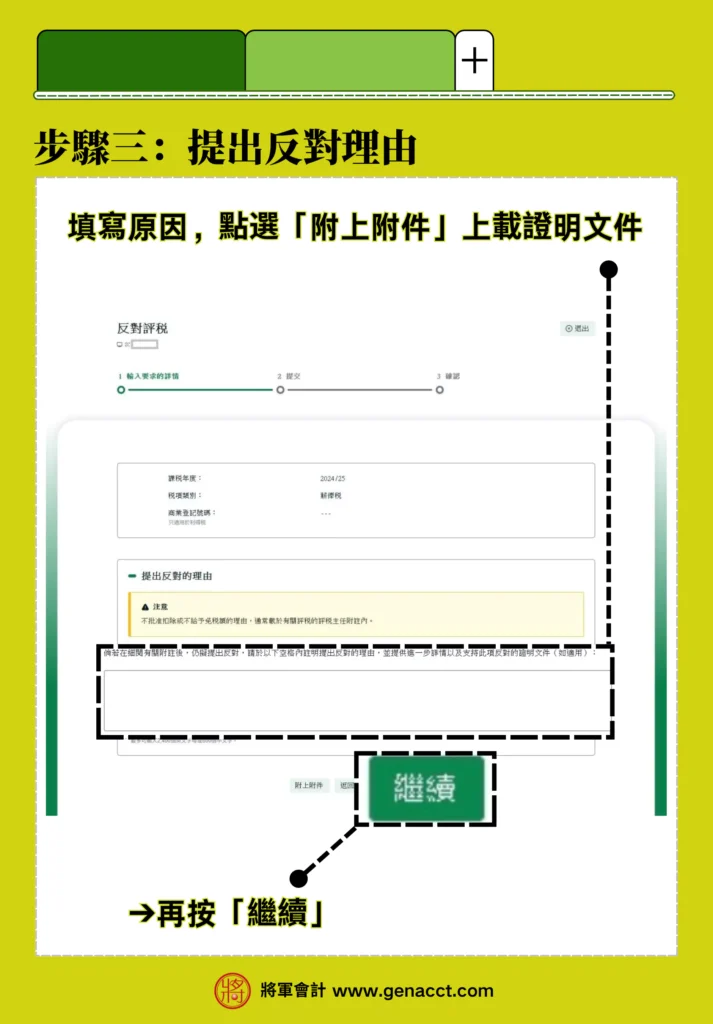
Step 4: Submit and confirm
After verifying the information is correct, click “Submit” to complete the online objection application via ITP.
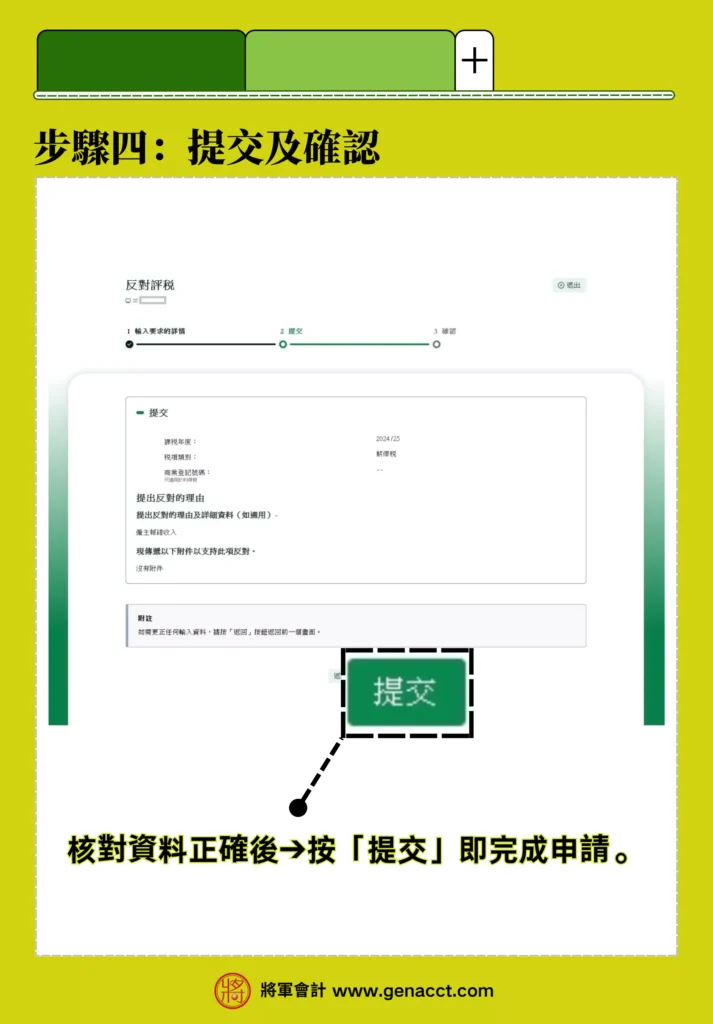
Notes for completing Form IR831 (Objection/Application for Revision of Assessment)
Completing Form IR831 accurately and submitting supporting documents together with the application can help speed up the IRD’s processing time.
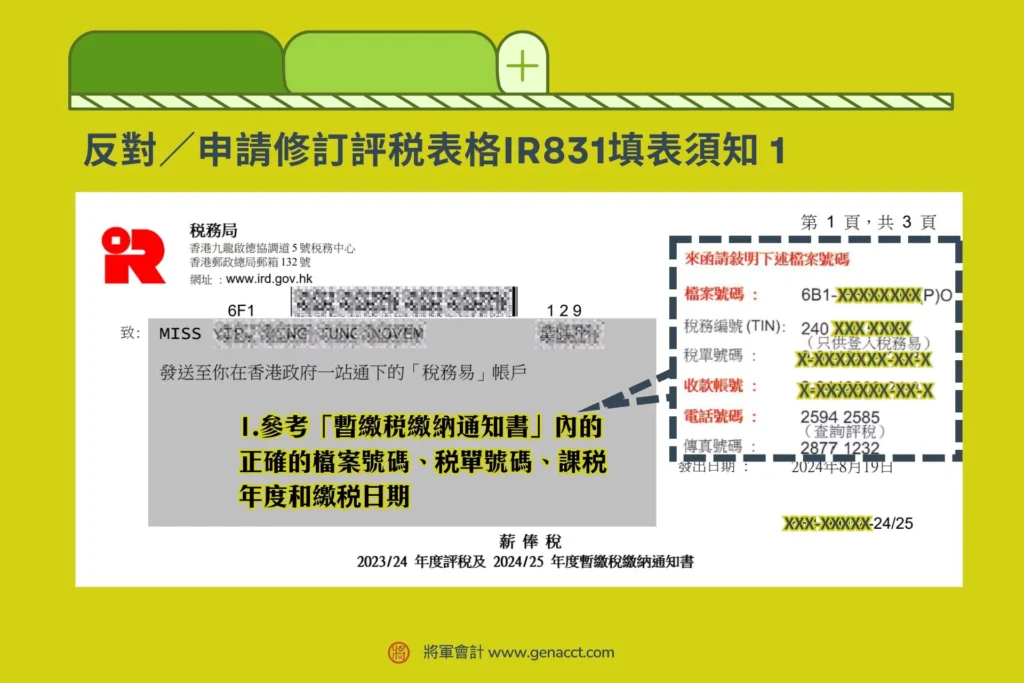
Entering the correct file number, tax bill number, year of assessment, and payment due date can help speed up the IRD’s processing time. To learn more about tax bill details, please refer to: A breakdown of 4 key dates and highlights on the Salaries Tax demand note.
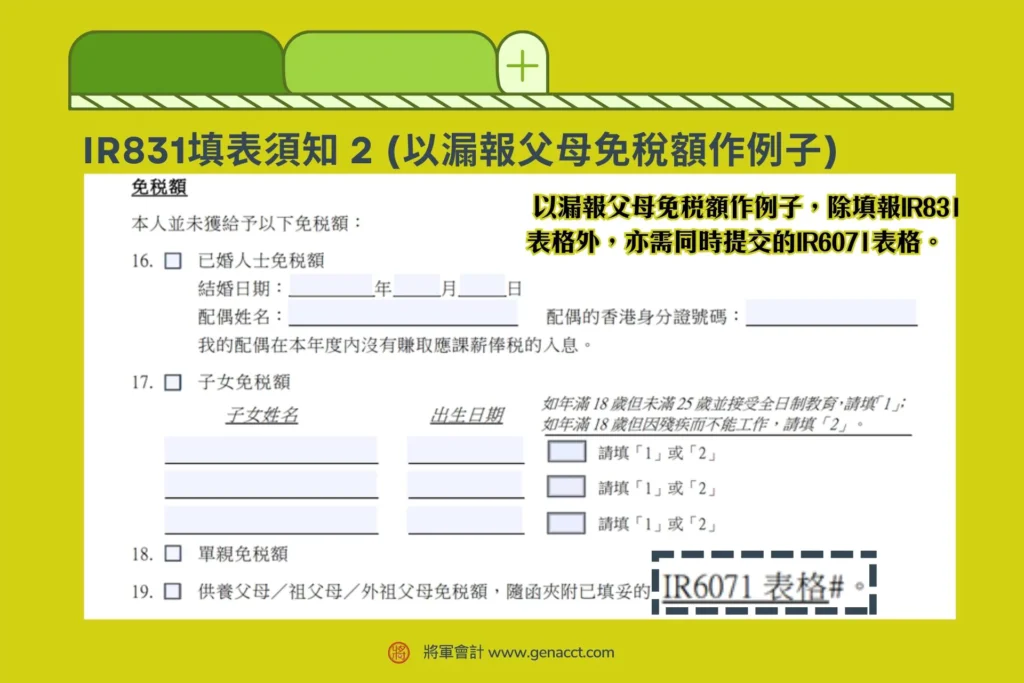
Depending on the reason for objection, complete the relevant supplementary forms. For example, if you omitted the dependent parent allowance, Form IR831 specifies under each relevant item that Form IR6071 must also be submitted. Therefore, in addition to Form IR831, you must also submit Form IR6071.
Response time for objections to assessment
According to the IRD’s service pledges effective from April 2025(2), 98% of objection cases will receive an acknowledgement within 12–18 days. The IRD will also issue a notice of settlement of objection or an assessor’s determination notice (objection result) within 4 months.
A notice of settlement of objection includes: a revised notice of assessment, a tax refund notice, and a letter notifying settlement of the objection case.
An assessor’s determination notice explains that the objection case has not yet been settled and may request the taxpayer to provide further information, such as supporting documents for the grounds of objection; or propose a resolution to the assessment appeal, recommending that the taxpayer withdraw the objection application; or notify the taxpayer that the case will be referred to the Commissioner for a decision.
Appeal process if an objection to assessment is rejected
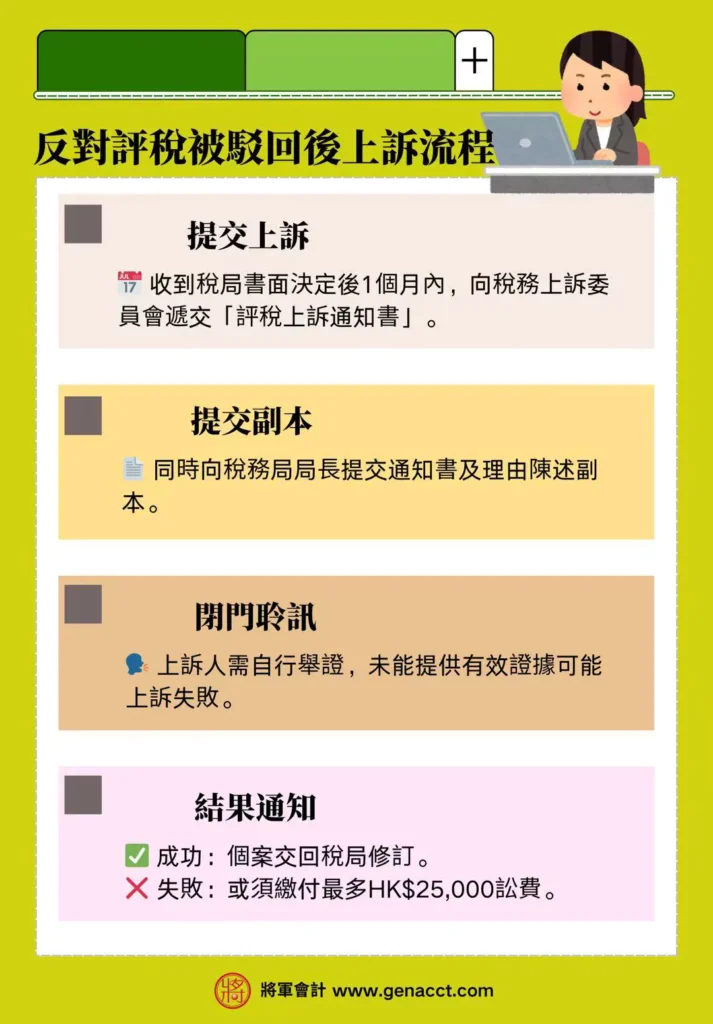
If the assessor’s determination notice does not accept the objection application, or recommends withdrawal, the taxpayer may appeal to the Board of Review (Inland Revenue).
The IRD’s reply is not always the final decision. Upon receiving this notice, taxpayers should treat it as a strategic buffer period and consult a professional tax adviser immediately to determine whether to provide additional information, accept the proposed revision, or prepare to proceed to the appeal stage, so as to avoid unnecessary legal disputes.
Process for lodging an assessment appeal with the Board of Review (Inland Revenue):
- Within 1 month after the Commissioner of Inland Revenue issues a written determination, submit a notice of appeal to the Board of Review (Inland Revenue).
- Submit a copy of the notice of appeal and the statement of grounds to the Commissioner of Inland Revenue.
- A closed hearing will be held. The appellant bears the burden of proof; failure to provide evidence supporting the appealed assessment may result in an unsuccessful appeal.
- After the hearing, if the appeal is successful, the case and the Board’s opinion will be referred back to the Commissioner of Inland Revenue for handling; if the appeal is unsuccessful, the appellant may be ordered to pay costs of up to $25,000.
If the Board of Review rejects the objection to assessment, can you appeal again?
Yes. If the Commissioner of Inland Revenue or the appellant disagrees with the Board of Review’s decision, they may apply to appeal to the Court of First Instance of the High Court within 1 month of the hearing result. Note that if the appeal is unsuccessful, the appealing party will be liable for the High Court costs.
As court costs can be substantial, we recommend seeking professional advice from General Accounting before proceeding to the appeal stage. A professional tax adviser can assess the likelihood of success in advance to help clients avoid unnecessary litigation costs.
Frequently Asked Questions
Conclusion
An objection to assessment is a taxpayer’s right. If you find an error on your tax bill, you may apply to the IRD to lodge an objection within one month. Common reasons include incorrect income calculations and omitted allowances or deductions. You may submit a notice of objection via Form IR831, the Taxpayer Portal (ITP), or electronically, stating the grounds for objection and providing supporting documents. The IRD usually acknowledges receipt within 18 days and processes the case within 4 months. If you submit late, you must provide reasonable grounds and evidence. If the IRD does not accept the application, the taxpayer may further appeal to the Board of Review or the High Court.
Further reading:
Sources
1. GovHK: Objections and Appeals
https://www.gov.hk/tc/residents/taxes/taxfiling/object/objections.htm
2. IRD service pledges effective from April 2025
https://www.ird.gov.hk/chi/abo/pam32.htm#objection
General Accounting offers a free consultation


