
Just obtaining the Certificate of Incorporation does not mean you can focus solely on running the business. Hong Kong’s Companies Ordinance (Cap. 622), Business Registration Ordinance (Cap. 310), Inland Revenue Ordinance (Cap. 112), and Anti-Money Laundering and Counter-Terrorist Financing Ordinance (Cap. 615) all apply at the same time. During the first operating cycle, the person in charge of a new company must handle multiple statutory compliance items, each with a clear deadline and a tiered penalty structure. Taking a limited company as an example, if you file the full set of incorporation documents electronically together with the first-year business registration fee, the total government fees are about HKD 3,895; however, what many entrepreneurs overlook is that failing to keep accounts and complete the audit on time, filing NAR1 late, or not renewing the Business Registration Certificate can all lead to substantial penalties, and even prosecution.
This article explains, in a timeline format, the first full tax and compliance cycle (18 months) for a Hong Kong company—covering the required compliance items, relevant legislation, fees, deadlines, and penalties—so entrepreneurs can avoid common pitfalls.
Compliance snapshot for a new Hong Kong company’s first operating cycle
- Statutory compliance items: 9 items (BR, NAR1, SCR, statutory audit, Profits Tax, Employer’s Return, accounting records, company secretary, confirm licensed TCSP service provider)
- Applicable legislation: 4 ordinances in total — Cap. 622 / Cap. 310 / Cap. 112 / Cap. 615
- Government fees (limited company incorporation): HKD 3,895 (electronic filing, including first-year BR)
- Maximum late-filing penalty: HKD 3,480 (highest tier under the NAR1 tiered penalty system)
- Timing of the first tax return: About 18 months after incorporation (BIR51)
- Accounting records retention: 7 years (Cap. 112 §51C)
Hong Kong company legal framework — 4 core ordinances
Incorporating and operating a company in Hong Kong is mainly governed by four core ordinances that apply concurrently:
| Ordinance | Function |
|---|---|
| Companies Ordinance (Cap. 622) | Company incorporation and governance, statutory audit, NAR1, SCR, company secretary |
| Business Registration Ordinance (Cap. 310) | Business Registration (BR) regime and renewal |
| Inland Revenue Ordinance (Cap. 112) | Tax regime (Profits Tax, Employer’s Return), retention of accounting records for 7 years |
| Anti-Money Laundering and Counter-Terrorist Financing Ordinance (Cap. 615) | Regulation of service providers (ensure TCSP licensing) |
As the person in charge of a new company, you need to understand that these four ordinances apply concurrently: Cap. 622 governs corporate governance, NAR1 and SCR; Cap. 310 governs BR; Cap. 112 governs Profits Tax and accounting records; and Cap. 615 governs the licensing regime for “trust or company service providers” (TCSP). In other words, Cap. 615 does not directly regulate your company itself; it regulates the service providers who offer you company secretarial, incorporation, or registered address services. As the person in charge of a new company, you must choose a service provider with a valid TCSP licence to avoid gaps in your compliance service chain; any breach of any ordinance may result in separate penalties or criminal liability.
Hong Kong company types — limited company vs unlimited company
1. Private limited company (Limited Company)
- Has separate legal personality
- Shareholders’ liability is limited
- Governed by the Companies Ordinance (Cap. 622)
2. Sole proprietorship / partnership (commonly referred to as an unlimited company)
- Does not have legal personality
- The proprietor bears unlimited liability
- Governed by the Business Registration Ordinance (Cap. 310)
This article mainly explains private limited companies, as this is the most common startup structure in Hong Kong and has the strictest compliance requirements (including NAR1, SCR, company secretary, etc.). If you choose to set up an unlimited company, while there are fewer compliance requirements, you will need to bear unlimited personal legal liability, which is materially different from a limited company. For a detailed comparison, please refer to the differences between a limited company and an unlimited company.
5 steps to incorporate a company (official process)
The Companies Registry’s 5 steps for electronic incorporation are as follows:
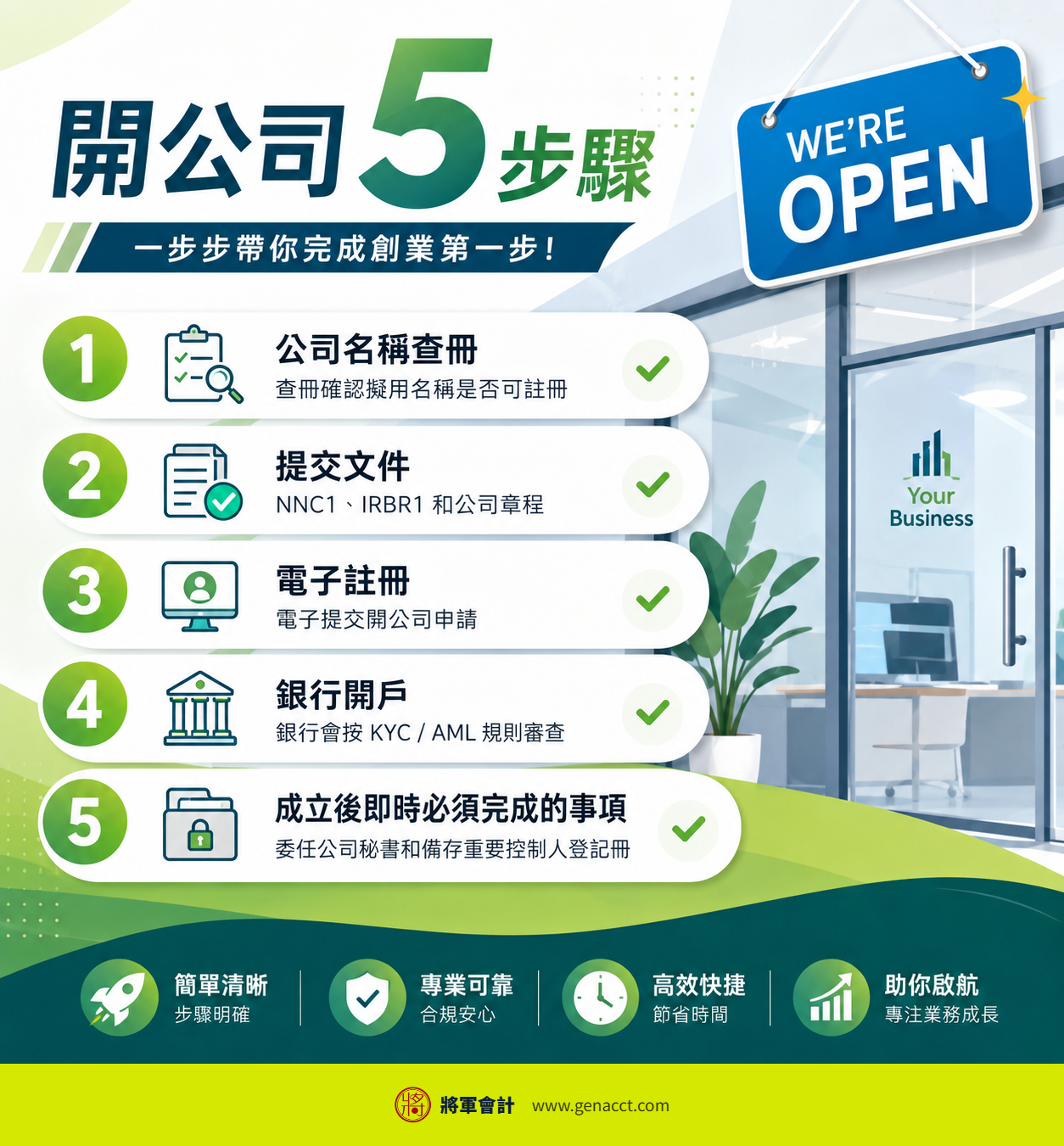
Step 1: Company name search
Use the Companies Registry’s search system to confirm whether the proposed name is available:
https://www.e-services.cr.gov.hk. Before naming, it is recommended to review key points for company name searches to avoid delays due to name issues.
Step 2: Submit documents
You need to submit:
- NNC1 (Incorporation Form)
- IRBR1 (Business Registration)
- Articles of Association
Step 3: E-incorporation
If the information is complete:
- You can submit electronically
- The Certificate of Incorporation and BR will be issued at the same time
Step 4: Open a bank account
Banks will review under KYC / AML rules:
- Company documents
- Directors’ and shareholders’ identities
- Business proof
📌 Banks have the final approval authority—incorporating a company does not mean you will definitely be able to open an account. If you encounter difficulties during bank approval, you may refer to the Hong Kong company bank account application process to understand common rejection reasons and solutions.
Step 5: Items that must be completed immediately after incorporation
After incorporation, it is not the case that you only need to deal with compliance matters at the next anniversary. The following items must be handled immediately after incorporation:
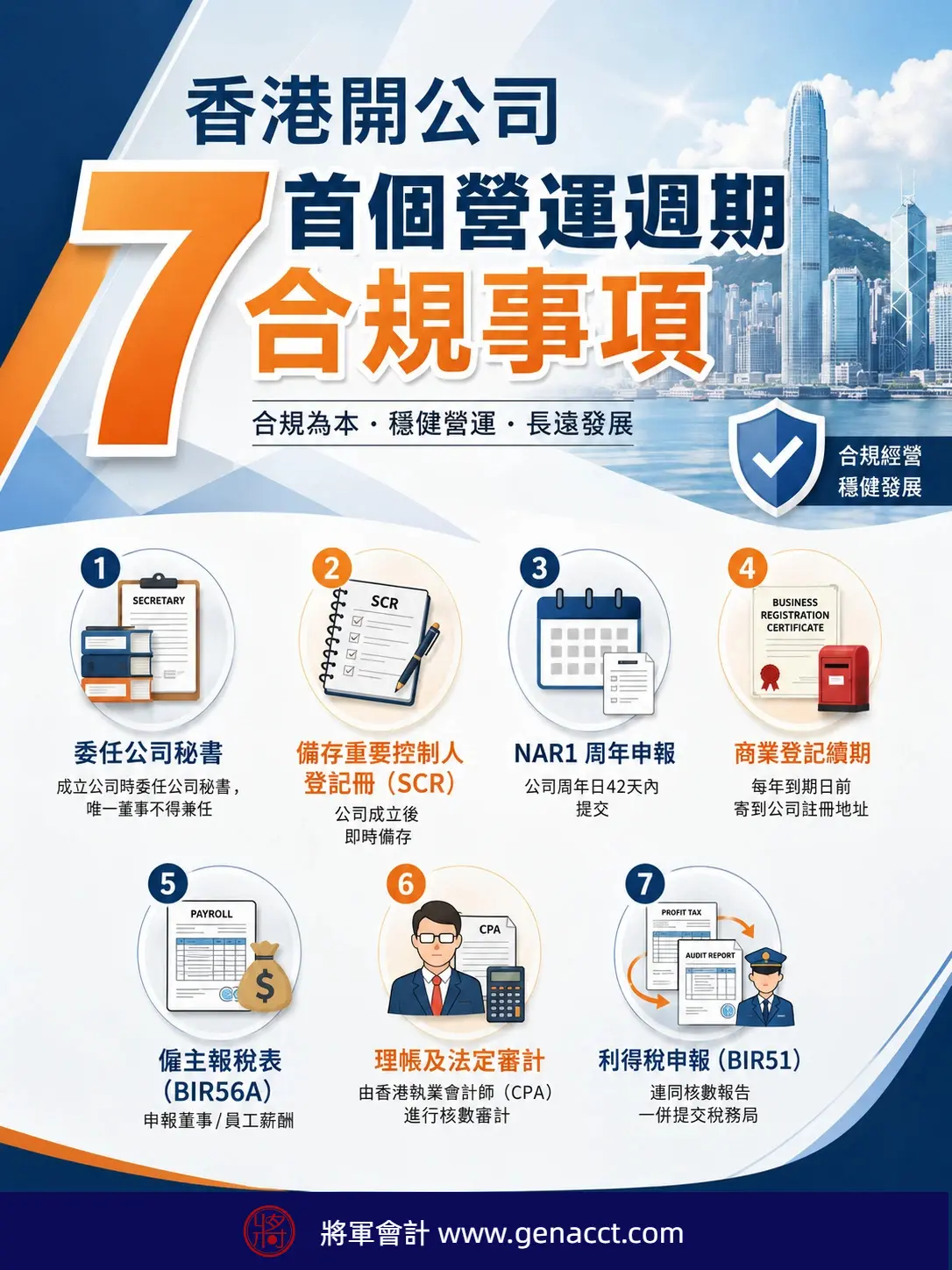
- Appoint a company secretary (Cap. 622 §474): A company must appoint a company secretary upon incorporation; the sole director cannot act as the company secretary.
- Keep the Significant Controllers Register (SCR) (Cap. 622 §653M): It only needs to be kept at the company’s registered address. If the place of keeping differs from the registered address, you must file Form NR2 to notify the Companies Registry within 15 days.
In addition, during the first operating cycle you must continue to handle the following compliance items:
- NAR1 annual return filing (within 42 days)
- BR renewal (annually)
- Employer’s Return (BIR56A) filing
- Bookkeeping and statutory audit
- Profits Tax filing (BIR51)
The 18-month compliance timeline below lays out the above requirements in chronological order. If you still find the process complex, or are concerned about missing any deadlines, you may have a licensed TCSP service provider track items on your behalf—such as SCR keeping, NAR1 filing, BR renewal reminders, bookkeeping, and tax representative extension arrangements—so you can focus on business development.
General Accounting (Genacct) is a licensed TCSP (TC002940) and provides one-stop services including company secretarial services, SCR keeping, NAR1 filing, and BR renewal reminders to help entrepreneurs stay compliant with ease. If needed, please contact General Accounting for enquiries.
The Companies Registry summarises the incorporation process into 5 stages. If you would like a more detailed checklist to follow item by item, you may also refer to our “Company Incorporation Process” (8-step practical guide), which is suitable for tracking progress step by step when preparing to incorporate.
Government fees
4.1 Business Registration (IRD)
- 1-year certificate: approx. HKD 2,350
- 3-year certificate: approx. HKD 6,170
IRD — Business Registration fee table
4.2 Company Registration fee (CR)
- Electronic filing: approx. HKD 1,545
📌 Minimum total government fees
👉 Approx. HKD 3,895 (electronic filing, including HKD 2,350 for a 1-year BR certificate + HKD 1,545 company registration fee)
These fees are government charges only and do not include professional service fees such as secretarial services, bank account opening, and registered address services.
Business Registration (BR) — renewal and penalties
The Business Registration Certificate (Business Registration, or BR) is a basic certificate that every company operating in Hong Kong must hold, issued by the Inland Revenue Department (IRD). A limited company usually applies for the first-year BR together with the incorporation process, and must renew it annually thereafter.
According to official IRD information, for the 2026/27 year of assessment, the Business Registration fee for a 1-year certificate is HKD 2,350 (registration fee HKD 2,200 + levy HKD 150), while a 3-year certificate is HKD 6,170 (registration fee HKD 5,720 + levy HKD 450). The HKD 150 levy resumed in 2026–27 after the two-year waiver period ended.
The IRD usually sends a renewal notice about 1 month before the BR expiry date. It is recommended that you record the BR expiry date when incorporating and prepare for renewal proactively, rather than waiting passively for mail. Some eligible companies may apply for a Business Registration fee waiver; please refer to the relevant eligibility requirements for details.
If BR is overdue by more than 1 month, the IRD will impose an additional penalty of HKD 300. While BR overdue will not immediately cause the company to be struck off, continued non-payment can affect the company’s reputation and hinder bank account operations. The maximum penalty upon conviction is a fine of HKD 5,000 and imprisonment for 1 year. If a company leaves BR overdue unresolved for a long time and later also becomes seriously overdue in filing the Annual Return (NAR1), it may be prosecuted by the Companies Registry as well. For NAR1 late-filing penalties and court consequences, please refer to Annual Return penalties.
Annual Return (NAR1) — the 42-day deadline
Legal Requirements
Must be filed within 42 days of the incorporation anniversary
Late-filing fees
HKD 870 → HKD 3,480 (tiered system)
The fee for filing NAR1 on time is HKD 105. For how to complete the new NAR1 and key points to note, please refer to the new Annual Return guide. Once overdue, the tiered penalties rise quickly:
- Overdue by 42 days to 3 months: HKD 870
- Overdue by 3 to 6 months: HKD 1,740
- Overdue by 6 to 9 months: HKD 2,610
- Overdue by more than 9 months: HKD 3,480
This tiered penalty regime is governed by the Companies (Fees) Regulation (Cap. 622K), and the Companies Registry has no discretion to waive it. More seriously, if a company is seriously overdue in filing NAR1, it may be prosecuted by the Companies Registry, with a maximum fine of HKD 50,000 plus a daily default fine of HKD 1,000 (Companies Ordinance section 662). If prosecuted, in addition to the tiered penalties, the company may also need to attend court. For common misconceptions and remedial steps, please refer to Annual Return penalties. For the form format and key completion points, please refer to NAR1 form format and common completion errors.
A common misconception is that “a dormant company does not need to file NAR1”. This needs to be distinguished accurately between two situations:
- You simply believe there is no business, but have not completed the statutory procedure with the Companies Registry: You must still file NAR1 every year, otherwise the company may be struck off by the Companies Registry.
- The company has been formally declared a dormant company in accordance with the law: Under sections 5 and 663 of the Companies Ordinance (Cap. 622), after the company passes a special resolution and delivers the prescribed documents to the Companies Registry to declare dormant status, it may be exempted from filing NAR1, holding an AGM, and appointing an auditor.
Entrepreneurs who are about to apply for, or have applied for, dormant status should note that this exemption requires a formal statutory procedure—it is not an automatic exemption just because you are not doing business.
Significant Controllers Register (SCR) — must be kept immediately upon incorporation
Company responsibilities
- Keep controllers’ information
- Keep at a Hong Kong address
- Make available for inspection by law enforcement officers
Update requirements
Must be updated after any change in information
The SCR (Significant Controllers Register) requirement was introduced under the Companies (Amendment) Ordinance 2018 and took effect on 1 March 2018. All companies incorporated in Hong Kong (except listed companies) must keep an SCR to record information on the company’s significant controllers.
SCR compliance has three aspects: keeping, recording, and making available for inspection. Penalties for non-compliance with SCR requirements: HKD 25,000 (level 4) plus a daily default fine of HKD 700. If false information is provided knowingly or recklessly, upon conviction on indictment the penalty is a fine of HKD 300,000 plus imprisonment for 2 years; on summary conviction, a fine of HKD 100,000 plus imprisonment for 6 months.
Any change in significant control status (e.g., share transfer or change in voting rights) must be updated in the SCR promptly. According to the Companies Registry’s official guidance, for registrable changes relating to an individual controller, the change must be entered in the register within 7 days after the person confirms all particulars; for a legal entity controller, the SCR must be updated within 7 days after the company receives the change notice. Many new company owners overlook this update window, creating potential compliance risks.
Tax filing and statutory audit — the most commonly overlooked cost
8.1 Statutory audit (Audit) and Profits Tax
Hong Kong Profits Tax adopts a two-tiered system, implemented from the 2018/19 year of assessment:
Corporate tax rates
- 8.25% (first HKD 2,000,000 of assessable profits)
- 16.5% (remainder)
Unincorporated business tax rates
- 7.5% (first HKD 2,000,000)
- 15% (remainder)
What many entrepreneurs do not realise is that a company typically receives its first Profits Tax Return (BIR51) from the IRD about 18 months after incorporation. Under the Companies Ordinance, when a limited company files BIR51, it must attach an audit report (auditor’s report) issued by a Hong Kong practising CPA. Therefore, from around month 15, you must start organising the first year’s bookkeeping records and engage a CPA to conduct the statutory audit; fees vary depending on the company’s size. If the company had no business in its first year and meets the requirements, you may arrange a nil return. In this article, “nil return” means reporting 0 on the Profits Tax Return without submitting an audit report; however, in addition to having no activity, the company must first file a dormant resolution with the Companies Registry to be eligible.
Within the same group, only one entity may be nominated to enjoy the two-tiered rates concession.
8.2 Employer’s Return
Even if the company has only one director (and no other employees), the IRD typically issues the Employer’s Return (BIR56A) about 13–20 months after incorporation (subject to the IRD’s actual issuance). The company must complete and return it within 1 month. Even if no salary has been paid, a nil return must still be filed. Late submission may be penalised.
Company secretary (legal requirement)
Requirements
- A company secretary must be appointed
- May be a natural person or a corporate body
Restrictions
- The sole director cannot also be the company secretary
- A company incorporated outside Hong Kong cannot act as a Hong Kong company secretary
- If company secretarial services are provided by a corporate body, it should be a Hong Kong incorporated limited company; if provided as a business, a valid TCSP licence is also required
Under section 474 of the Companies Ordinance (Cap. 622 §474), every company incorporated in Hong Kong must appoint at least one company secretary who ordinarily resides in Hong Kong. The company secretary’s duties include handling statutory filings, maintaining registered particulars, and assisting the board in complying with regulatory requirements. As the person in charge, you should also understand the responsibilities and duties of Hong Kong company directors, as directors bear ultimate responsibility for compliance.
For professional company secretarial services, please refer to General Accounting’s company secretarial services.
A key point that is often overlooked is: if the company has only one director, that director cannot act as the company secretary (Cap. 622 §475(2)). The sole director must appoint another qualified company secretary. Many one-person limited company founders mistakenly believe they can act as the secretary themselves, but this is non-compliant.
If a company has no secretary and remains in breach, it may be fined HKD 50,000 plus a daily default fine of HKD 1,000 (Cap. 622 §474).
When appointing a company secretary, please use the Companies Registry TCSP Licensee Register to confirm the other party holds a valid licence (TCSP is a licensing requirement for “service providers”, not a compliance obligation of the company itself, Cap. 615).
General Accounting (Genacct) is a licensed TCSP (TC002940) and provides new company clients with free company secretarial service for the first year.
TCSP regime (service providers)
Scope
- Company incorporation services
- Company Secretarial Service
- Registered address services
Note
TCSP applies to “service providers”, not an obligation of the company itself.
Under the Anti-Money Laundering and Counter-Terrorist Financing Ordinance (Cap. 615), operating company secretarial services without a licence may constitute a criminal offence, with a maximum penalty upon conviction of a fine of HKD 100,000 plus imprisonment for 6 months (Cap. 615 §53F(2)). This means that as the client (your new company) you do not directly bear the TCSP licensing obligation, but when choosing a secretarial firm you must confirm it holds a valid TCSP licence; otherwise, your compliance service chain will carry significant risk.
It should be noted that the TCSP licensing requirement targets organisations or individuals who provide company secretarial services in the course of business. Hong Kong law allows the appointment of a natural person who ordinarily resides in Hong Kong (e.g., a full-time employee, relative, or friend) to act as company secretary in a personal capacity—in such cases, the person is not operating a company secretarial business and is therefore not subject to the TCSP licensing requirement. The TCSP licensing requirement applies to service providers who offer company secretarial, incorporation, or registered address services to the public on a commercial basis.
The public may verify any service provider’s licence status through the Companies Registry TCSP Licensee Register.
18-month compliance timeline summary table
Overview of compliance items and applicable legislation
| Item | Ordinance |
|---|---|
| NAR1 Annual Return | Cap. 622 |
| SCR Significant Controllers Register | Cap. 622 |
| BR Business Registration | Cap. 310 |
| Employer’s Return (BIR56A) | Cap. 112 |
| Statutory audit + Profits Tax (BIR51) | Cap. 622 / Cap. 112 |
| Accounting records retention | Cap. 112 (§51C) |
18-month timeline
| Stage | Time point | Statutory items that must be completed | Legal basis | Notes and penalties |
|---|---|---|---|---|
| Day 1 / upon incorporation | Immediate | Appoint secretary & keep SCR | Cap. 622 | Must be kept immediately after registration. Failure to keep SCR: maximum fine HKD 25,000 + HKD 700 per day |
| About 13–20 months after incorporation (subject to the IRD’s actual issuance) | Within 1 month after receiving BIR56A | File the first Employer’s Return | Cap. 112 | Report directors’/employees’ remuneration (nil return required even if no salary is paid) |
| Around month 11 | BR expiry date | Renew Business Registration Certificate (BR) | Cap. 310 | The IRD sends a notice 1 month before expiry. If overdue by more than 1 month, an additional penalty of HKD 300 applies |
| Around months 12–13 | Within 42 days of the incorporation anniversary | Annual Return (NAR1) | Cap. 622 | Tiered late-filing penalties: HKD 870–3,480 |
| Months 15–18 | Before receiving BIR51 | Bookkeeping and statutory audit | Cap. 622 | Organise bank documents and submit them to a Hong Kong practising CPA for audit |
| Around month 18 | Within the BIR51 deadline | File the first Profits Tax Return | Cap. 112 | After receiving BIR51, file it together with the accountant’s “audit report” |
Please note that the Companies Registry and the IRD generally do not accept “being busy and forgetting” as a reason for late filing. However, if the company has appointed a tax representative, the filing deadline may still be extended by applying to the IRD through the tax representative. For details, please refer to tax filing deadlines. Entrepreneurs should set up reminders at the time of incorporation, or engage a reliable secretarial firm to track all deadlines on their behalf.
General Accounting’s company secretarial services cover compliance items such as SCR keeping, NAR1 filing, BR renewal reminders, and end-to-end follow-up for bookkeeping and audit, helping entrepreneurs focus on business development.
4 core ordinances for first-year compliance when incorporating a company in Hong Kong
A Hong Kong company’s incorporation and first 18-month compliance cycle involve four core ordinances:
- Companies Ordinance (Cap. 622) — incorporation, NAR1, SCR, company secretary, statutory audit
- Business Registration Ordinance (Cap. 310) — Business Registration (BR) and renewal
- Inland Revenue Ordinance (Cap. 112) — Profits Tax (BIR51), Employer’s Return (BIR56A), accounting records for 7 years
- Anti-Money Laundering and Counter-Terrorist Financing Ordinance (Cap. 615) — licensing of TCSP service providers


