
-1024x685.webp)
#Personal Allowances, #Personal Assessment, #薪俸稅
Following our previous guide on Hong Kong dual-status tax filing, this article explores tax relief applications for Hong Kong tax residents working cross-border between Hong Kong and Mainland China. We will explain how mainland individuals employed by a Hong Kong company, or those working directly in Hong Kong, should file tax returns: how to calculate the 183 days, and whether filing is required in both jurisdictions.
Overview of Hong Kong and Mainland China Taxation
Hong Kong Salaries Tax is determined based on whether duties are performed in Hong Kong, and is not directly related to the employer’s location, the place of payment, or nationality. Mainland China adopts a residence-based system with worldwide taxation: China tax residents (domiciled in China or residing for 183 days) must report worldwide income, while non-residents are taxed only on China-sourced income.
For more on the differences between the Hong Kong and Mainland China tax systems, please see: Hong Kong Dual-Status Tax Filing Guide: Cross-border Work Between Mainland China and Hong Kong, Tax Relief Applications, and How to Avoid Double Taxation
How to determine whether you are a Mainland China tax resident?
To determine whether a mainland individual is a China tax resident, it is not limited to the “183-day” rule; personal living and economic ties must also be considered. Key factors include:
- Whether you have a domicile in Mainland China;
- Whether you reside in Mainland China for 183 days or more in the tax year;
- Whether your immediate family members mainly live in Mainland China;
- Whether your centre of economic interests is in Mainland China (e.g., main income source, workplace, social security).
If any of the above conditions is met, you will generally be regarded as a China tax resident and must report worldwide income; non-residents are taxed only on China-sourced income.
How the 183 days are calculated
What “183 days” means in Mainland China
- Residence ≥ 183 days: Tax resident (worldwide income must be reported)
- Residence < 183 days: Non-resident (only China-sourced income is reported)

How the 183 days are calculated
- The day of arrival counts as one day
- The day of departure counts as one day
- Leave and weekends spent in the Mainland are included
- Time spent entirely outside the Mainland is not included
- Business trips are generally still counted as “residence” if the Mainland is your primary place of living
How it differs from the Hong Kong system
Determining source of income: Being employed by a Hong Kong company does not necessarily mean Hong Kong-sourced income
Comparison table of common misconceptions about source of income (individual × company × correct rule)
| Item | Individual misconception | Company misconception | Correct rule | Practical example |
|---|---|---|---|---|
| Basis of determination | If paid from Hong Kong, it is Hong Kong-sourced | If the employer is in Hong Kong, it is Hong Kong-sourced | Determined by “where duties are performed” | Remote work in Shenzhen vs on-site work in Hong Kong |
| Salary paid from Hong Kong | Believes Hong Kong tax must be filed | Believes it must be Hong Kong-sourced | Place of payment is not a determining factor | Remote work in Shenzhen is Mainland-sourced |
| Working in the Mainland | Believes only Hong Kong tax needs to be filed | Does not consider Mainland tax liability | It is Mainland-sourced income | Employed by a Hong Kong company but working entirely in Shenzhen |
| Working in Hong Kong | Mistakenly believes living in Shenzhen exempts Hong Kong tax | Believes it depends only on household registration | Performing duties in Hong Kong means Hong Kong-sourced | Shenzhen–Hong Kong cross-border commuting requires filing Hong Kong Salaries Tax |
| Entry/exit records | Does not value records | Does not keep workday data | Cross-border individuals must retain evidence | Need to provide cross-border workdays and entry/exit proof |
| Consequences of filing | Prone to under-reporting or misreporting | Prone to duplicate reporting | Split reporting by source jurisdiction | File BIR60 in Hong Kong; file IIT in the Mainland |
Further reading: Employer’s Tax Return | Employer’s Tax Obligations
The actual place of work is the key
The Hong Kong Inland Revenue Department applies the “place where duties are performed” principle:
- If you work in the Mainland, it is Mainland-sourced income and tax is payable in the Mainland.
- If you work in Hong Kong, it is Hong Kong-sourced income and Hong Kong Salaries Tax is payable in Hong Kong.
Example: Remote work in Shenzhen for a Hong Kong company
- Place of residence: Shenzhen
- Place of work: Shenzhen (fully remote)
- Employer location: Hong Kong
This is Mainland-sourced income and must be reported for Mainland IIT; when filing BIR60 in Hong Kong, you may apply for exemption.
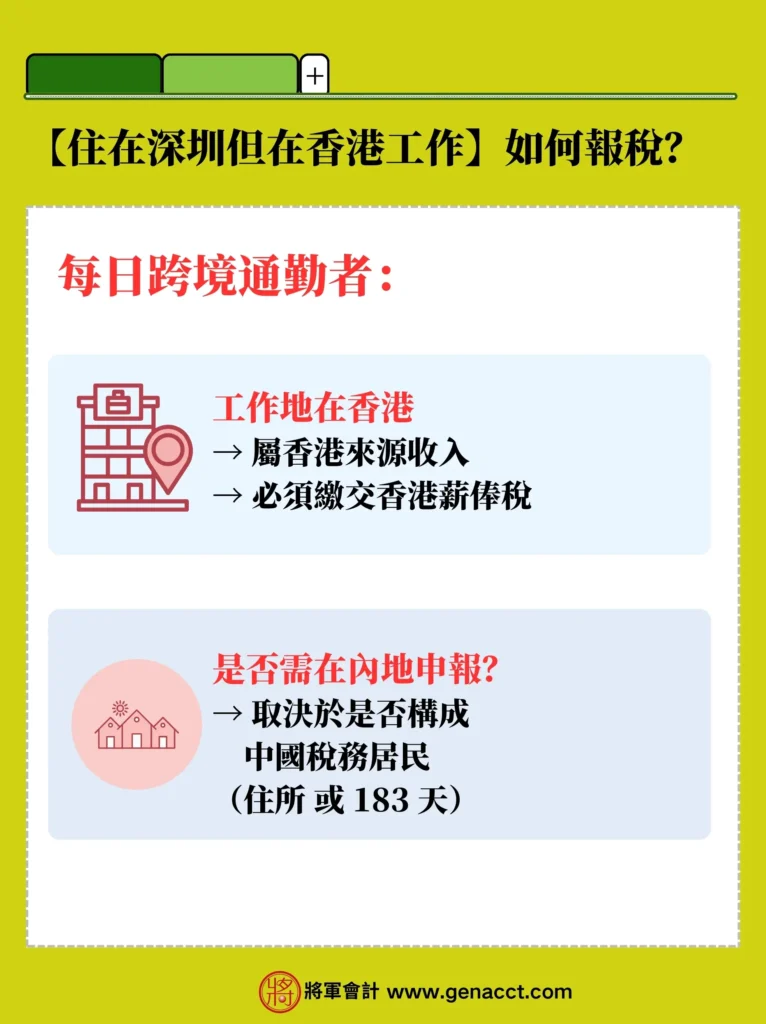
How to file tax if you live in Shenzhen but work in Hong Kong?
Working in Hong Kong = must file Hong Kong Salaries Tax
Daily cross-border commuters: if your place of work is in Hong Kong, it is Hong Kong-sourced and you must pay Hong Kong Salaries Tax.
Whether you also need to report in the Mainland depends on whether you constitute a China tax resident (domicile or 183 days).
Can mainland individuals become Hong Kong tax residents?
Definition of a Hong Kong tax resident
Generally, you may be regarded as a Hong Kong tax resident if you meet any of the following:
- You ordinarily reside in Hong Kong
- Your main source of income is in Hong Kong
- You are employed by a Hong Kong company on a long-term basis
- The company’s management and control is in Hong Kong (for corporations)
Under the above circumstances, you may apply for a Hong Kong Tax Resident Certificate (TRC).
How mainland individuals working in Hong Kong should file tax: filing methods for cross-border work
Working only in Hong Kong
Working only in the Mainland but employed by a Hong Kong company
Working partly in Hong Kong and partly in the Mainland
Income must be apportioned based on actual workdays; you may need to file in both jurisdictions and can apply for a tax credit under the CDTA (Comprehensive Double Taxation Agreement).
Further reading: How much salary do you need to earn before paying tax?| Tax Filing for Married Persons
Documents and forms required for non-Hong Kong residents to file Salaries Tax
Documents to submit in Hong Kong (individual)
- BIR60 Individual Tax Return (annual filing)
- IR56E: Employer’s notification of commencement of employment
- IR56B: Annual employer’s return of remuneration and pensions
- IR56F: Notification of cessation of employment
- Employment contract and salary proof
- Entry/exit records (to prove whether duties were performed in Hong Kong)
- Workday records (commonly used by cross-border individuals)
- Hong Kong Tax Resident Certificate (TRC) (if applying under the CDTA)
- Supporting documents for tax credit claims (if taxed in both jurisdictions)
Documents to submit in the Mainland (individual)
- Annual filing page in the Individual Income Tax app or the Natural Person E-Tax Bureau
- Labour contract and proof of salary payment
- Entry/exit records (to determine whether the 183-day rule is met)
- Evidence related to workdays (if cross-border duties are involved)
- China tax resident certificate (if required for submission to Hong Kong for exemption)
- Application materials related to the Double Taxation Agreement (DTA)
How mainland individuals working in Hong Kong can apply for tax relief
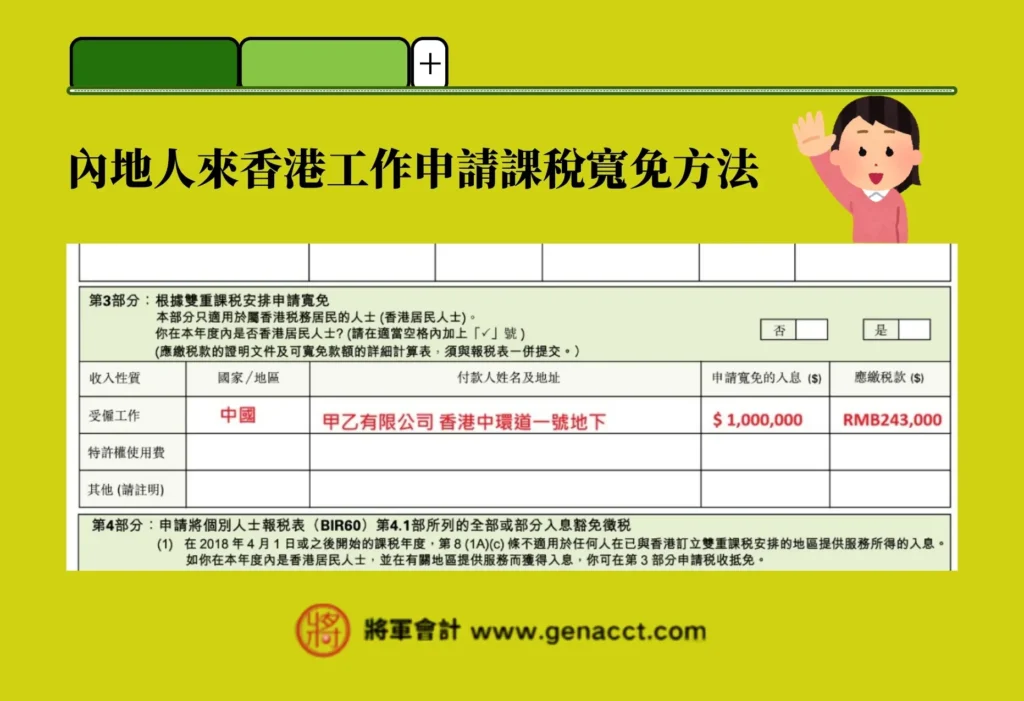
You must submit supporting documents and complete Part 3 of the appendix to the Individual Tax Return (BIR60) (Application for relief under double taxation arrangements), providing the following information:
nature of income, employment, country/territory, payer’s name and address, the income for which relief is claimed, and the tax payable.
See the following example of applying for tax relief for mainland individuals working in Hong Kong:
Frequently Asked Questions
Conclusion
The key to cross-border taxation is understanding source, residency status, and filing rules. Before coming to Hong Kong for work, mainland individuals should confirm these five points:
1. The actual place of work determines taxing rights
2. How the 183 days are calculated affects whether worldwide income must be reported in the Mainland
3. Hong Kong has no 183-day system; 180 days is only one of the treaty provisions
4. Those working in Hong Kong must file Hong Kong Salaries Tax
5. Prepare tax forms and documents in advance (BIR60, IR56 series, entry/exit records, workday records)
Further reading:
General Accounting offers free consultation


