

A YouTube channel with tens of thousands of clicks, or an Instagram KOL earning money every month—do you really know you need to file taxes? Hong Kong’s content creation industry is booming, and more people are turning creation into a profession. However, diversified income streams—AdSense, brand collaborations, fan tips, and product donations—often leave creators confused about their tax obligations.
The answer is: Hong Kong creators are self-employed. All income (AdSense, sponsorships, tips) must be reported under Profits Tax, and you must apply for Business Registration within 1 month after you start earning income. Failure to report as required may result in fines.
Want to learn more about the Hong Kong Business Registration Certificate? Please visit:
Under what circumstances do content creators need to file taxes?
Hong Kong’s definition standard for “business”
Whether a content creator needs to pay tax on income depends on two parallel conditions:- Whether the activities constitute carrying on a trade, profession, or business in Hong Kong
- Whether the profits are “arising in or derived from Hong Kong”
How do Hong Kong tax laws define “carrying on a trade, profession, or business”?
Section 14 of the Inland Revenue Ordinance (Cap. 112) provides that any person carrying on a trade, profession, or business in Hong Kong and deriving assessable profits arising in or derived from Hong Kong (excluding profits from the sale of capital assets) is chargeable to Profits Tax. It is worth noting that the tax law itself does not set out a mechanical test for determining “trade” or “business”. In practice, the Inland Revenue Department and the courts refer to the “badges of trade” established in common-law cases and consider the following factors holistically:- Continuity: whether content is created and published on an ongoing basis, rather than as a one-off or occasional activity
- Profit motive: whether there is a systematic attempt to monetize content (e.g., ad revenue share, sponsorships, subscriptions)
- Systematic nature: whether there is a fixed operating model (e.g., stable posting frequency, platform operations, commercial arrangements)
Whether income is “derived from Hong Kong” is another key factor
Even if you are carrying on a business, you must further determine whether the profits are “arising in or derived from Hong Kong”—the core of Hong Kong’s territorial source principle. For content creators, income sources often span overseas platforms (e.g., offshore ad networks, overseas brand sponsorships). The source of profits may be disputable and must be assessed case by case based on the actual facts and relevant case-law principles, rather than assuming that all online income is taxable in Hong Kong.Occasional posts vs regular updates: when should you start considering tax filing?
The answer is: regardless of income frequency, any income of a profit-making nature must be reported. Hong Kong has no exemption that allows you to “skip reporting” just because you only occasionally post and receive payment. Once you start creating content systematically and attempting to monetize it, it falls within the scope of a “business” and you must fulfill your tax filing obligations.Differences across platforms
| Platform | Main income types |
|---|---|
| YouTube | AdSense income, brand collaborations |
| Paid collaborations, fan tips, likes | |
| TikTok | Creator Fund, brand collaborations |
| Livestream e-commerce sales, paid collaborations | |
| Patreon / tipping platforms | Subscription support, tips |
Creators’ income types and tax treatment
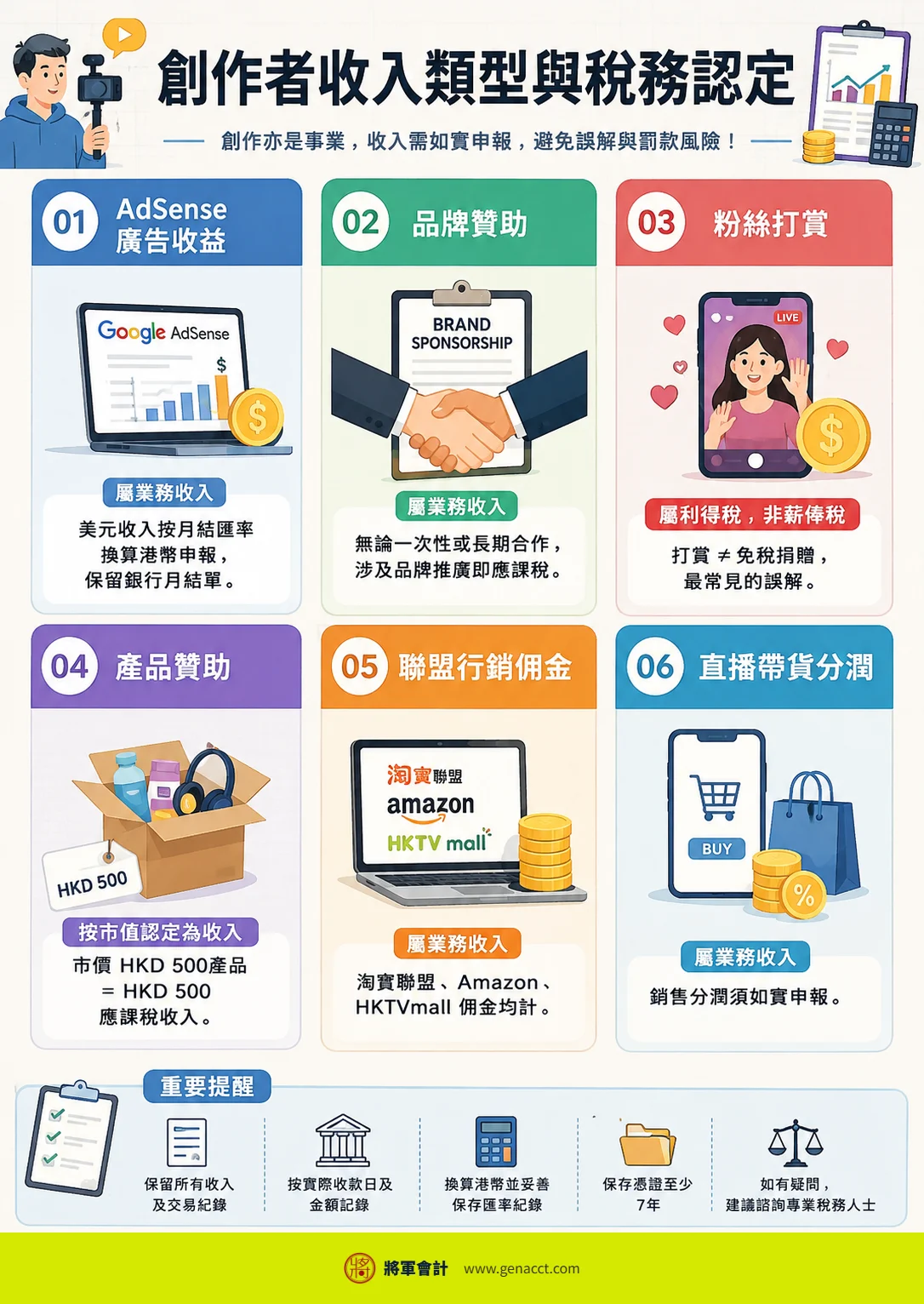
AdSense income
Advertising income paid by Google is business income. Monthly earnings are calculated in USD and must be converted to HKD for reporting using the month-end exchange rate. Keep monthly bank statements as income records.Brand sponsorships
Sponsored content created in collaboration with brands is business income. Whether it is a one-off payment or a long-term partnership, any brand promotion is taxable income.Fan tips
Tips via Patreon, YouTube Super Chat, “dounei”, etc. must be reported under Profits Tax (not Salaries Tax). This is the most commonly misunderstood income category—many creators mistakenly believe that fan “donations” do not need to be reported, but that is not the case.Product donations
Review items sent by brands are treated as income based on market value. For example, a product with a market price of HKD 500 is equivalent to HKD 500 of taxable income. It is recommended to keep the brand’s quotation or the product link as a basis for valuation.Affiliate marketing
Commission income from promotional links is business income. This includes Taobao Affiliate, Amazon Associates, HKTVmall commissions, etc.Livestream e-commerce sales
Revenue share from sales is treated as business income. Livestream e-commerce sales have become a mainstream monetization model, and the related income must be reported truthfully.Profits Tax or Salaries Tax? Creators’ tax status
Creators are “self-employed” and must report Profits Tax
Creators are not employed by any organization. They independently liaise with brands and operate their personal brand, and report business profits under §14 of the Inland Revenue Ordinance (Cap. 112).This is mandatory, not optional.Definition of self-employed persons and the scope of Profits Tax reporting
- Take on work independently, with no employment contract
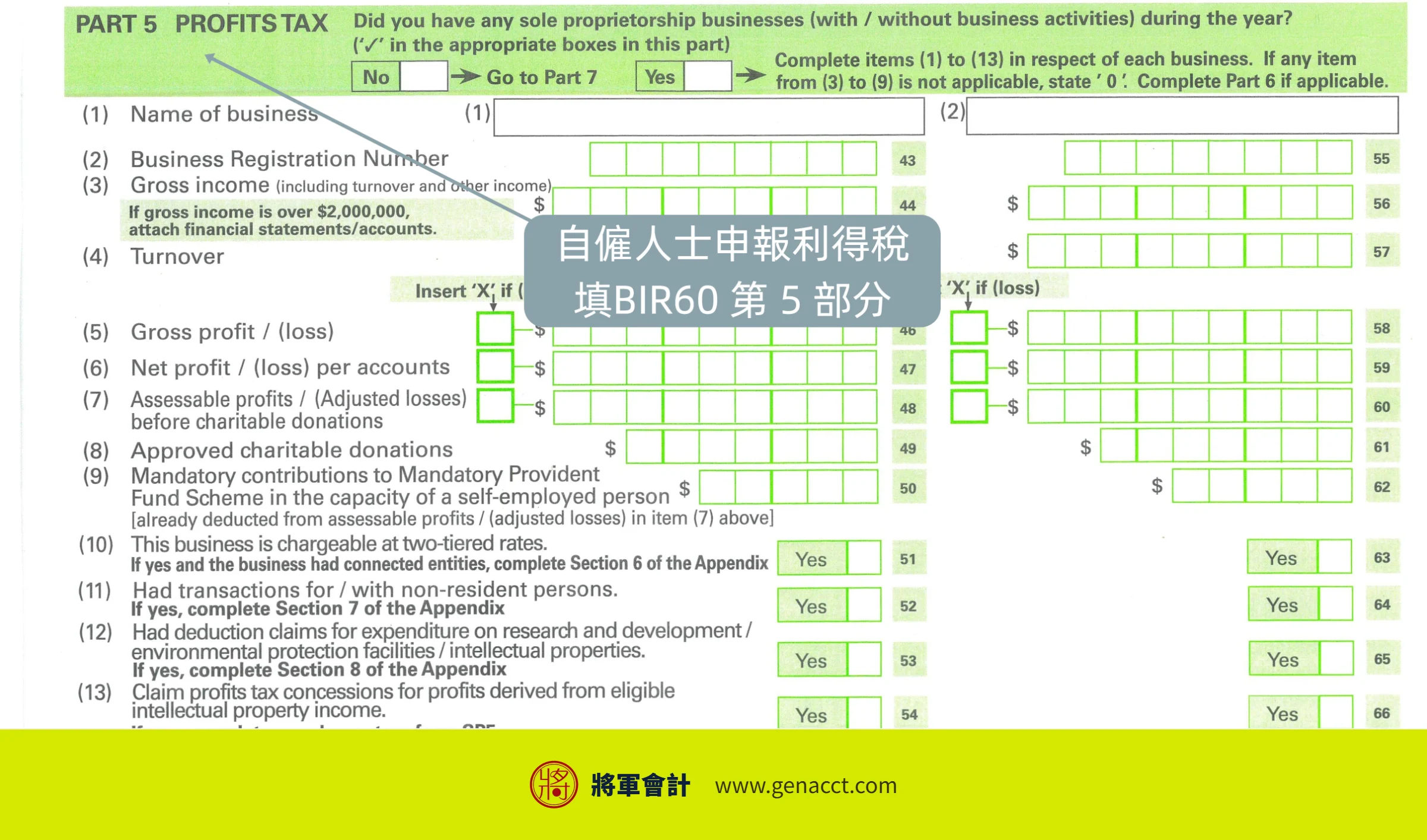
- Report under Part 5 (Profits Tax) of BIR60
- Business expenses may be deductible
When might you be regarded as an “employee” (Salaries Tax)?
This is almost impossible for creators; creators are generally self-employed. Exceptions are rare—for example, being employed by an MCN (multi-channel network) under a formal employment contract, with Salaries Tax withheld by the employer. If you are an independent creator, you are self-employed.Key differences between the two tax statuses
| Item | Self-employed (Profits Tax) | Employed (Salaries Tax) |
|---|---|---|
| Working relationship | Independent; no employment contract; B2B or B2C commercial relationship | Employment contract; MPF; employer–employee relationship |
| Nature of income | Project fees, ad revenue share, sales commissions | Salary plus commission (if any) |
| Tax return section | Part 5 of BIR60 | Part 4 of BIR60 |
| Deductions | Business expenses may be deductible | None |
| MPF | Self-contribute 5% | Employer and employee each contribute 5% |
| Tax rates | 7.5%–15% (two-tiered) | 2%–17% (progressive) or 15% (standard) |
How to determine your tax status
Ask yourself: “Am I employed by any organization?” If the answer is “No”, you are self-employed and must report Profits Tax.How to calculate different income types and bookkeeping requirements
How to report AdSense income in HKD
Monthly earnings are calculated in USD and must be converted to HKD using Google’s month-end exchange rate (or the receiving bank’s exchange rate). It is recommended to record the exchange rate and HKD amount each month and keep bank statements as proof.Invoice and receipt requirements for sponsorship income
After signing a contract with a brand, you should keep a copy of the contract as well as invoices, receipts, and proof of payment. Even for small collaborations, it is recommended to confirm any verbal agreement via message or email and keep screenshots as records.How to value product donations at market value
The suggested retail price (SRP) or the actual market price may be used as the valuation basis. It is recommended to keep the brand’s quotation email or an online store link to support the valuation rationale in the future.Tax deduction principles for necessary expenses
They must be directly related to earning business income. For example, if you renovate your living room for use as a filming location, you may apportion the business-use portion; purely personal consumption is not deductible.Common deductible items
- Equipment: cameras, lenses, computers, editing equipment (depreciable)
- Software: Adobe Creative Cloud, editing software, music licensing subscriptions
- Premises: rental of filming locations, studio rent
- Props: filming props, set materials
- Hiring staff: editors, managers, assistants, etc.
- Styling: clothing, makeup artists, hair stylists
- Other: travel, transportation, entertainment, etc.
Business Registration: do creators need to apply?
Basic threshold for Business Registration
Yes, you must apply. You must register within 1 month after you start carrying on a business in Hong Kong (monetizing your content), even if you work from home and operate in your personal capacity.When to apply for BR and its benefits
- Timing: within 1 month after commencement of business
- Benefits: legalize your business, build a professional image, facilitate bank account opening, and enhance credibility when working with brands
To understand the basics of Business Registration, please refer to The Ultimate Guide to the Business Registration Certificate.
Tax filing process: Step-by-Step
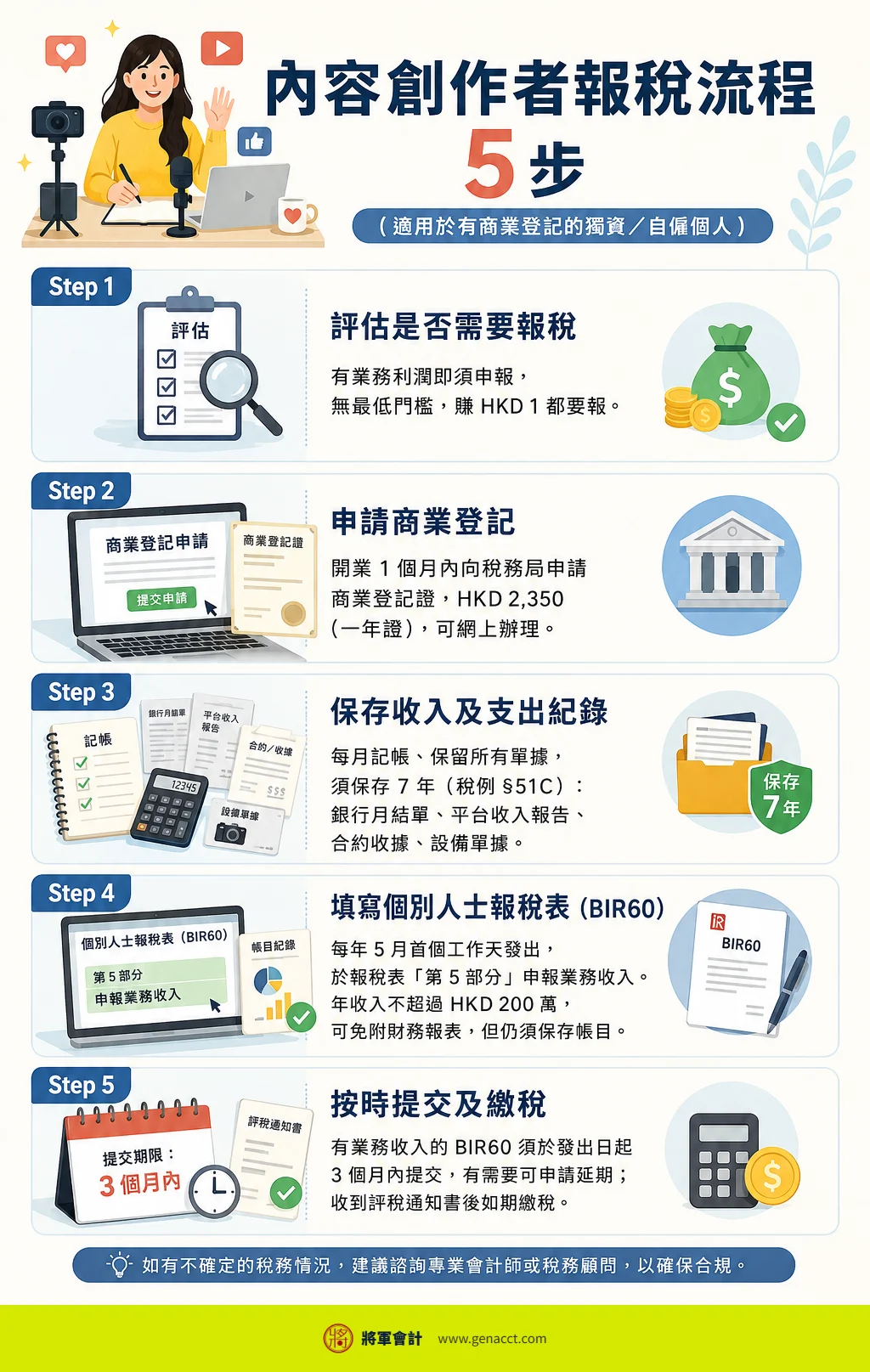
Step 1: Assess whether you need to file taxes (annual income threshold)
As long as you have business profits, you must report them regardless of the amount. Hong Kong Profits Tax has no minimum income threshold; even if your annual profit is only HKD 1, you must report it truthfully.Step 2: Apply for Business Registration if required
Apply for a Business Registration Certificate with the Inland Revenue Department. The fee is HKD 2,350 (one-year certificate), and you can apply online.Step 3: Keep records of income and expenses
Keep monthly accounts and categorize income and expenses. Retain all supporting documents (the Inland Revenue Ordinance (Cap. 112) §51C requires retention for 7 years), including:- Monthly bank statements
- Platform income screenshots or downloaded reports
- Contracts, invoices, receipts
- Receipts for equipment and service purchases
Step 4: Complete the Profits Tax return
On the first working day of May each year, after receiving the BIR60 tax return, complete Part 5 (Profits Tax). If annual business income does not exceed HKD 2 million, you may not need to submit financial statements, but you must still keep proper accounts.Step 5: Submit on time and pay tax
- Individual Profits Tax filing period: within three months from the date of issue of the tax return; an extension may be applied for if needed
- Payment deadline: after receiving the notice of assessment, pay by the due date
Tax filing deadlines and penalty notes
Late submission of a tax return may result in a fine of up to 3 times the tax payable; serious cases may be prosecuted. It is recommended to file on time or apply for an extension with the Inland Revenue Department in advance. Want to learn more about sole proprietorship tax filing? Please visit: Sole Proprietorship Tax Filing GuideCommon reporting misconceptions
Misconception 1: IRD cannot trace online income
Incorrect. The IRD has multiple channels to obtain information, including bank transfer records and reporting by platform partners. Voluntary reporting is the safest option.Misconception 2: If profits are small, there is no need to report
Incorrect. As long as you have business profits, you must report them regardless of the amount. Even if you make a loss for the year, you must still submit a tax return.Misconception 3: If you did not receive a company invoice, you do not need to report
Incorrect. Self-employed persons do not need invoices; receipts, supporting documents, platform screenshots, etc. can all serve as proof of income. The key is to keep complete records.Misconception 4: Remittances from overseas platforms do not need to be reported
Incorrect. As long as the business is carried on in Hong Kong, income from overseas platforms must also be reported. US withholding tax (e.g., 30% withheld on YouTube AdSense) cannot be credited against Hong Kong Profits Tax; they are separate tax systems. Tip: By submitting the W-8BEN correctly, Hong Kong status may qualify for 0% withholding on US-source royalty income.Misconception 5: Receiving products is not income because it is not cash
Incorrect. Product donations are treated as income based on market value and must be included in assessable profits. Even if you never monetize them, the value of donated items is still taxable income. If you have further questions about tax filing for online stores and digital businesses, it is recommended to consult the Inland Revenue Department or a professional accountant.Comparing filing taxes in your personal name vs setting up a limited company
Operating as a sole proprietorship (in your personal name)
Advantages of setting up a limited company
- Tax planning: the two-tiered Profits Tax rates for limited companies (8.25% on the first HKD 2 million) are more favorable for higher-income earners
- Liability separation: separates personal assets from company assets, reducing personal financial risk
- Professional image: a limited company is more credible when working with brands and applying for banking services
When it is recommended to consider setting up a limited company
- Higher income (estimated annual profit exceeding HKD 1 million)
- Need a stronger professional image for brand collaborations
- Have employees or partners who require formal contractual arrangements


